Saudi Arabia launches Eid aid projects in various countries

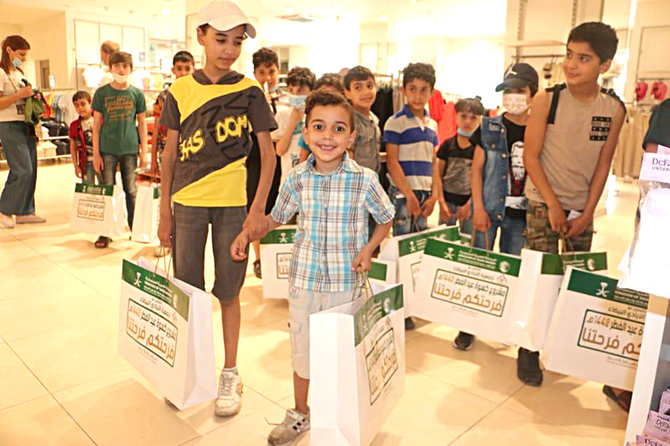
A young boy beams with joy on receiving Eid Al-Fitr clothes distributed by the King Salman Humanitarian Aid and Relief Center (KSrelief) among orphans of Syrian and Palestinian refugees in Beirut. (SPA)
Short Url
Updated 12 May 2021
Follow

Saudi Arabia launches Eid aid projects in various countries

  • The project will benefit 294,000 people and help them join in the celebrations of Eid Al-Fitr

JEDDAH: As the Eid Al-Fitr celebrations are about to begin all across the world, the Kingdom is expediting its efforts to ensure that all Muslims join their brethren in the festivities by launching special aid programs.

The King Salman Humanitarian Aid and Relief Center (KSrelief) distributed Eid clothes among orphans of Syrian and Palestinian refugees living in different parts of Lebanon. The program benefited 6,548 children, which also included members of the host community.

The aid packages to the cities of Tripoli, Zahle, and Dbayeh, east of the Lebanese capital Beirut, form part of the center’s project to provide Eid clothes for children.

KSrelief on Tuesday launched a project to distribute 6,876 cartons of dates weighing 55 tons to support Jordanians, Syrian and Palestinian refugees in Jordan.

Saud bin Abdul Aziz Al-Hazim, KSrelief director in Jordan, said the center distributes the aid in cooperation with the Jordanian Hashemite Charitable Organization.

In Yemen, KSrelief launched its special Eid aid program in Al-Mahrah governorate. It is part of the center’s project to benefit 42,000 families in nine governorates including Aden, Abyan, Lahj, Al-Dhale’e, Hadramout, Shabwah, Marib, and Taiz.

The project will benefit 294,000 people and help them join in the celebrations of Eid Al-Fitr.

FASTFACTS

• KSrelief distributed Eid clothes among 6,548 children in Lebanon.

• The center’s Eid program will benefit 294,000 people in Yemen.

• The center distributed 14,351 bags of rice weighing 21 kg each among 86,106 individuals in different parts of Pakistan.

• KSrelief launched a project to distribute 6,876 cartons of dates in Jordan.

The center distributed 14,351 bags of rice weighing 21 kg each among 86,106 individuals in different parts of Pakistan including Islamabad, Lahore, Faisalabad, Khanewal, Sahiwal, Dera Ismail Khan, and Lower Dir.

Pakistan’s Communications Minister Murad Saeed thanked King Salman and Crown Prince Mohammed bin Salman for the humanitarian support extended to the Pakistani people and other countries.

He praised the work of the center and lauded its “dedication” in selecting beneficiaries and the overall distribution process.

KSrelief has implemented 1,556 projects worth more than $5 billion in 59 countries. The initiatives have been carried out in cooperation with 144 local, regional and international partners since the inception of the center in May 2015.

According to a recent KSrelief report, the countries and territories that benefited the most from the center’s various projects were Yemen ($3.53 billion), Palestine ($363 million), Syria ($305 million), and Somalia ($203 million).

Experimental farm in Al-Lith looks into future of Saudi Arabian agriculture

Updated 01 February 2026
Follow

Experimental farm in Al-Lith looks into future of Saudi Arabian agriculture

  • Research initiative reflects strategic transformation

JEDDAH: An experimental farm in Saudi Arabia’s Al-Lith Governorate is one of the research initiatives reflecting the strategic transformation taking place in the Kingdom’s agricultural sector.

The farm uses highly efficient, sustainable production models that combine scientific research with commercial application, contributing to strengthening the country’s food security system and the sustainability of water resources.

Located in the Ghumaiqa Center on an area of about 10 hectares, the cutting-edge farm is a testing platform for modern agricultural technologies that tackle the challenge of water scarcity.

The farm includes developed open fields and modern greenhouses, supported by smart irrigation encompassing drip and sprinkler irrigation alongside surface and subsurface technologies.

All the systems operate via smart controls that enable the monitoring of water consumption and ensure improved efficiency, thereby achieving a balance between agricultural production and water conservation.

The farm also uses treated and diluted low-salinity seawater.

It aims to diversify agricultural water sources, reduce reliance on freshwater, and open new horizons for agriculture in coastal and semi-arid environments.

The project represents a promising investment opportunity in the field of smart agriculture, enabling the development of commercially scalable production models, particularly for high-value vegetables and fruits, while reducing operational costs associated with water and energy, enhancing the economic feasibility of future agricultural projects.

In addition, the project contributes to transferring and localizing agricultural expertise, supporting local food supply chains, and creating an attractive environment for agricultural investment.

This aligns with Sustainable Development Goals and enhances the efficiency of the private sector in adopting innovative agricultural solutions.

Yahya bin Abdulrahman Al-Mahabi, the director of the Ministry of Environment, Water and Agriculture office in Al-Lith Governorate, told the Saudi Press Agency that the project represented the future of agriculture in the Kingdom.

He explained that the vision was based on investing in technology, enhancing the return on water per unit, and integrating scientific research with investment opportunities.

Al-Mahabi spoke of the experimental farm as a modern, scalable and replicable model applicable in several regions of the Kingdom, particularly in coastal environments.

Al-Mahabi highlighted the Ministry of Environment, Water and Agriculture’s commitment to supporting distinctive projects that contributed to achieving food security while developing rural areas and enhancing agricultural production efficiency, in line with the objectives of the Kingdom’s Vision 2030.