

Iran has enriched uranium to up to 63 percent purity, IAEA says

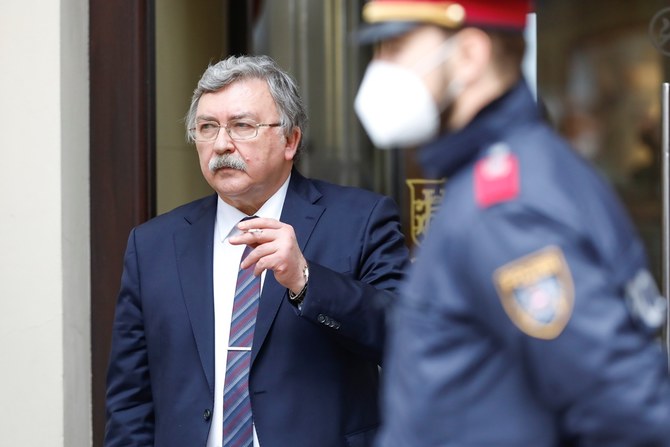
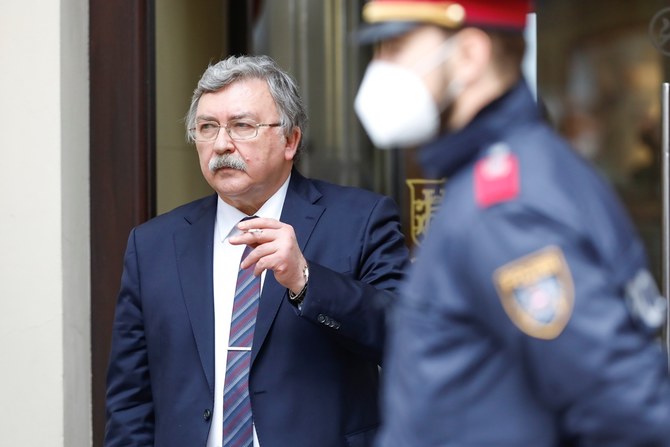
Russia's Governor to the International Atomic Energy Agency (IAEA), Mikhail Ulyanov, at a break outside of the 'Grand Hotel Wien' where closed-door nuclear talks with Iran take place in Vienna. (AP)
Short Url
Updated 12 May 2021
Follow

Iran has enriched uranium to up to 63 percent purity, IAEA says

  • Iran made the shift to 60%, a big step towards nuclear weapons-grade from the 20% previously achieved
  • The deal says Iran cannot enrich beyond 3.67% fissile purity, far from the 90% of weapons-grade

VIENNA: “Fluctuations” at Iran’s Natanz plant pushed the purity to which it enriched uranium to 63 percent, higher than the announced 60 percent that complicated talks to revive its nuclear deal with world powers, a report by the UN nuclear watchdog said on Tuesday.
Iran made the shift to 60 percent, a big step toward nuclear weapons-grade from the 20 percent previously achieved, last month in response to an explosion and power cut at Natanz that Tehran has blamed on Israel and appears to have damaged its enrichment output at a larger, underground facility there.
Iran’s move rattled the current indirect talks with the United States to agree conditions for both sides to return fully to the 2015 nuclear deal, which was undermined when Washington abandoned it in 2018, prompting Tehran to violate its terms.
The deal says Iran cannot enrich beyond 3.67 percent fissile purity, far from the 90 percent of weapons-grade. Iran has long denied any intention to develop nuclear weapons.
“According to Iran, fluctuations of the enrichment levels... were experienced,” the International Atomic Energy Agency (IAEA) said in the confidential report to its member states, seen by Reuters.
“The agency’s analysis of the ES (environmental samples) taken on 22 April 2021 shows an enrichment level of up to 63 percent U-235, which is consistent with the fluctuations of the enrichment levels (described by Iran),” it added, without saying why the fluctuations had occurred.
A previous IAEA report last month said Iran was using one cascade, or cluster, of advanced IR-6 centrifuge machines to enrich to up to 60 percent and feeding the tails, or depleted uranium, from that process into a cascade of IR-4 machines to enrich to up to 20 percent.
Tuesday’s report said the Islamic Republic was now feeding the tails from the IR-4 cascade into a cascade of 27 IR-5 and 30 IR-6s centrifuges to refine uranium to up to 5 percent.



UN rights chief shocked by ‘unbearable’ Darfur atrocities

Updated 19 January 2026
Follow

UN rights chief shocked by ‘unbearable’ Darfur atrocities

  • Mediation efforts have failed to produce a ceasefire, even after international outrage intensified last year with reports of mass killings, rape, and abductions during the RSF’s takeover of El-Fasher in Darfur

PORT SUDAN: Nearly three years of war have put the Sudanese people through “hell,” the UN’s rights chief said on Sunday, blasting the vast sums spent on advanced weaponry at the expense of humanitarian aid and the recruitment of child soldiers.
Since April 2023, Sudan has been gripped by a conflict between the army and the paramilitary Rapid Support Forces that has left tens of thousands of people dead and around 11 million displaced.
Speaking in Port Sudan during his first wartime visit, UN Human Rights commissioner Volker Turk said the population had endured “horror and hell,” calling it “despicable” that funds that “should be used to alleviate the suffering of the population” are instead spent on advanced weapons, particularly drones.
More than 21 million people are facing acute food insecurity, and two-thirds of Sudan’s population is in urgent need of humanitarian aid, according to the UN.
In addition to the world’s largest hunger and displacement crisis, Sudan is also facing “the increasing militarization of society by all parties to the conflict, including through the arming of civilians and recruitment and use of children,” Turk added.
He said he had heard testimony of “unbearable” atrocities from survivors of attacks in Darfur, and warned of similar crimes unfolding in the Kordofan region — the current epicenter of the fighting.
Testimony of these atrocities must be heard by “the commanders of this conflict and those who are arming, funding and profiting from this war,” he said.
Mediation efforts have failed to produce a ceasefire, even after international outrage intensified last year with reports of mass killings, rape, and abductions during the RSF’s takeover of El-Fasher in Darfur.
“We must ensure that the perpetrators of these horrific violations face justice regardless of the affiliation,” Turk said on Sunday, adding that repeated attacks on civilian infrastructure could constitute “war crimes.”
He called on both sides to “cease intolerable attacks against civilian objects that are indispensable to the civilian population, including markets, health facilities, schools and shelters.”
Turk again warned on Sunday that crimes similar to those seen in El-Fasher could recur in volatile Kordofan, where the RSF has advanced, besieging and attacking several key cities.
Hundreds of thousands face starvation across the region, where more than 65,000 people have been displaced since October, according to the latest UN figures.