

Iranian president slams new election criteria

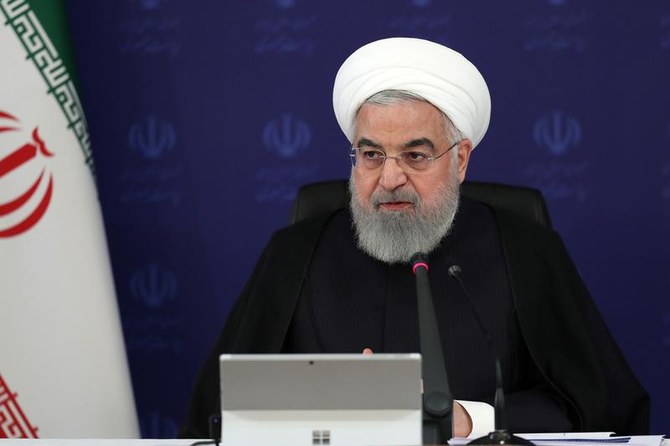
Iranian President Hassan Rouhani, Tehran, Iran, April 5, 2020. (Reuters)
Short Url
Updated 11 May 2021
Follow

Iranian president slams new election criteria

  • Rouhani: Age restrictions ‘too narrow’
  • Critics say comments are charade to conjure mirage of democracy

LONDON: Iran’s outgoing President Hassan Rouhani has slammed the country’s electoral criteria as “too narrow” ahead of June elections.

But dissidents and critics say his comments are a charade designed to give legitimacy to an autocratic regime and conjure a mirage of democracy in the country.

Rouhani, who is set to relinquish his position before the election, said Iran’s 12-member Guardian Council had “no legal authority” to impose new criteria excluding candidates aged younger than 40 and older than 75. 

He urged the Interior Ministry, which oversees electoral registrations, to bypass the council’s new age controls.

Their most noticeable effect will be the prevention of Mohammad Javad Azari Jahromi, minister of communications and information technology, from standing for president. 

Critics have long said the Guardian Council has the power to block candidates based on other criteria, including simple disapproval by the country’s religious leadership.

Council member Siamak Raphik defended the age criteria, saying the body is “the sole custodian of the eligibility of candidates.” 

Iran’s list of approved electoral candidates will be revealed on May 26 following an appeal period.

Before the last presidential election in 2017, 1,636 people registered to run, a massive increase compared with 686 in 2013. But after inspection by the Guardian Council, just six candidates were allowed to stand. 

And despite many women putting their names forward during elections, not a single one has ever been allowed to stand in Iran’s history.

This year’s election will take place amid widespread public disillusionment, a fourth wave of coronavirus and middle-class animosity, meaning low voter turnout is highly likely. The turnout in last year’s parliamentary election dropped to a record low of 42 percent.

Currently, more than 30 political figures have declared a campaign to run for president, including key members of the Islamic Revolutionary Guard Corps. 

Several major politicians have yet to announce their intentions, as they test support and seek final intelligence on whether they have sufficient approval. Supreme Leader Ali Khamenei said he wants the eventual president to be “young and pious.”

Lebanon PM Nawaf Salam says he will not allow anyone to drag the country into new conflicts

Updated 6 sec ago
Follow

Lebanon PM Nawaf Salam says he will not allow anyone to drag the country into new conflicts

  • Salam said Hezbollah can threaten to become further involved between Iran, Israel and the US, but the Lebanese government has full control

DUBAI: Lebanon’s Prime Minister Nawaf Salam said that Lebanon has had enough ventures in the past and that he would not allow anyone to drag the country into new conflicts.

Speaking at the World Governments Summit on Tuesday, Salam said Lebanon has been involved in the war on Gaza over the last couple of years, and the damage it has cost them has been massive.

Salam said Hezbollah can threaten to become further involved between Iran, Israel and the US, but the Lebanese government has full control over the southern region and will not allow further involvement. 

“For the first time since 1996, the Lebanese government through the Lebanese Armed Forces … has full control over the south of the country,” he said.

“No one is ready to involve the country in further adventures which could cost us more and will not engage in further ventures and conflicts,” he added.

“We are aware that we are in one of the most tense regions in the world. We need to fortify ourselves by working on restoring the decision on peace and war in Lebanon,” he added.

Salam said Lebanon’s goal was to reform its sovereignty and attract global investment.

“People only focus on reforms in financial institutions, but reforms are much wider than that for my government, which of course means financial reform, but administrative reforms are also important and needed,” he added.

Salam said that attracting investment requires achieving a sense of security in the country, not only for the Lebanese people but for the world.

“Reform and sovereignty go hand in hand. We need to restore the Lebanese state and the confidence in our people,” he explained.

Salam emphasized his country’s position in achieving judicial, security and financial reforms and said he will not allow anyone to do their work for them. 

“All we want from our brothers here is to support our journey, but not take our place or play our role,” he said, referring to countries of the Gulf Cooperation Council.

The minister said there would be a conference soon to support the Lebanese Armed Forces, and he invited all Arab leaders to participate in this event, adding that it was a way to enhance Lebanon’s security.