

Facebook, Instagram accused of bias by censoring Palestinian content

Hundreds of social media users have accused Instagram and Facebook of removing content and accounts reporting on the Sheikh Jarrah violence.
Short Url
Updated 11 May 2021
Follow

Facebook, Instagram accused of bias by censoring Palestinian content

  • Director of 7amleh said the censorship of Palestinians happened through two channels
  • The organization was able to restore some content and pages of users who reported removals to them

DUBAI: Imagine the pain of being kicked out of your own home. Then imagine being unable to let the world know what is happening to you.

This is the reality for Palestinians living in Jerusalem’s Sheikh Jarrah neighborhood, which houses 28 families from the 1948 Nakba. Under international law, East Jerusalem is considered part of the Palestinian Territories.

Earlier this year, the Israeli Central Court in East Jerusalem approved a decision to evict four Palestinian families from their homes in the neighborhood. 

The court was scheduled to issue a ruling on the evictions on May 6 amid heated demonstrations and clashes between Palestinians and Israeli settlers, but the decision was delayed until May 10.

Hundreds of social media users have accused Instagram and Facebook of removing content and accounts reporting on the Sheikh Jarrah violence.

One of the videos that was deleted from the story archives of Palestinian journalist Maha Rezeq was about Israeli settler Jacob, who took over the house of Muna El-Kurd in 2009. He told her that if he did not steal her house then someone else would.

“What I’ve been sharing is raw footage, videos, testimonies of people on the ground, some are actually coming from the mouth of an Israeli, the mouth of a settler, why is that controversial? Everything was self-explanatory, there is no blood or graphic footage that violates the community standard,” Rezeq said.

Rezeq told Arab News that only her content on Sheikh Jarrah was removed.

“The only thing that was removed from my archive were stories and posts related to exposing Israeli crimes against Palestinians.”

Mohammed El-Kurd, a Palestinian writer from Jerusalem, was posting videos and stories on violence in Sheikh Jarrah when he received a warning that his account might be deleted.
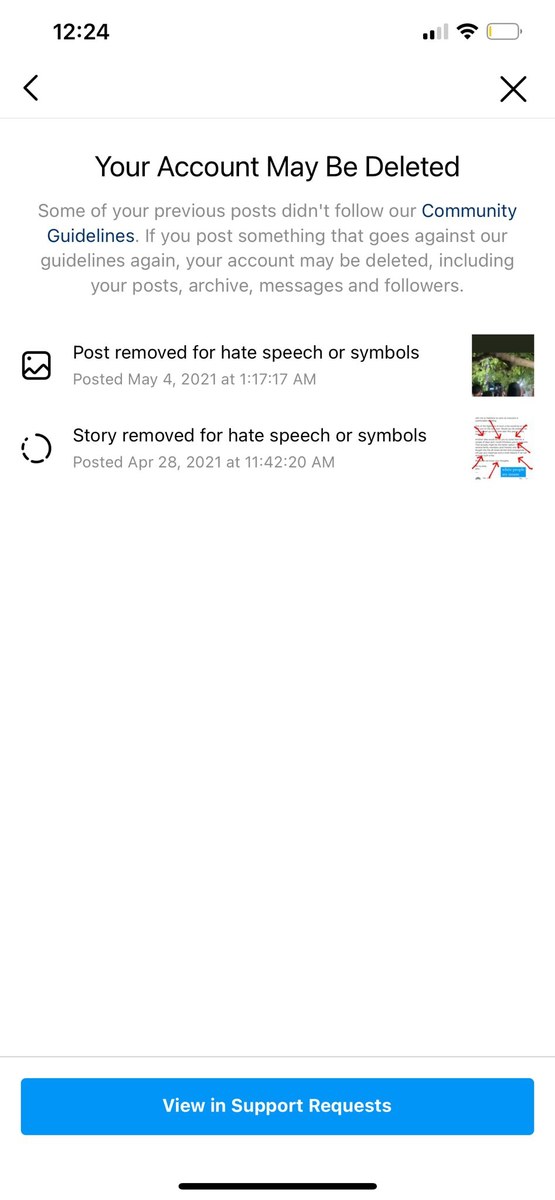
“Some of your previous posts didn’t follow our Community Guidelines,” the message read. “If you post something that goes against our guidelines again, your account may be deleted, including your posts, archive, messages and followers.”

Facebook also removed “57 pieces of content” from his page because they went against the guidelines.

Yasmin Dabat said her stories with the hashtag #SaveSheikhJarrah, dated to May 3, were “removed by Instagram without any warnings or updates.”

Instagram, which is owned by Facebook, tweeted it was facing technical issues on May 6, after hundreds of people began reporting the censorship.

“We know that some people are experiencing issues uploading and viewing stories. This is a widespread global technical issue not related to any particular topic and we’re fixing it right now. We’ll provide an update as soon as we can.”

Nadim Nashif, the director of a nonprofit organization called 7amleh that advocates for Palestinian digital rights, said the explanation did not make sense to them.

“(It) is very weird, like you know, to compare what happened in a certain neighborhood in Jerusalem, with huge countries like Canada, the US and Colombia, doesn’t sound logical to us, doesn’t sound like it’s really explaining, because in Canada and the US they were taking down stories that are about various topics, (but) here (it was) about (a) certain hashtag, specifically about Sheikh Jarrah,” he said.

Nashif said the censorship of Palestinians happened through two channels.

“One factor is what the Israelis are doing, they are basically trying to push the social media platforms to adopt their own standards of what should be there and what shouldn’t be there. There’s strong cooperation between them and Facebook mainly.”

According to Nashif, this leads to what’s called “voluntary takedowns,” where Israeli cyber units send requests to social media platforms to take down specific content without a court order.

Another way that Palestinian content was pushed out of social media was through “armies of trolls and applications called Act.IL organizing people to report in a massive way,” he added.

Act.IL is an app that describes itself as “the place where all pro-Israeli advocates, communities and organizations meet to work together to fight back against the demonization and delegitimization of the Jewish state.”

According to the app, users “will be able to remove inciting content from social media, fight antisemitism and anti-Zionism, influence the online narrative regarding Israel, and take part in special pro-Israel campaigns and efforts.”

Palestinians are also being silenced on social media through the use of Artificial Intelligence by those platforms to identify what content violates their user guidelines.

“Social media platforms are (using) artificial intelligence for takedowns and there is lots of use of keywords, mainly around what the US government consider(s) as terrorist organizations,” Nashif explained.

Some of those who reported content takedowns and account removals to 7amleh were able to restore their content after the organization reached out to Facebook.

“We managed to restore tens or hundreds of them in this struggle, because we are (a) trusted partner of Facebook,” Nashif added.

Dabat was able to recover her stories around 12 hours later after getting in touch with Instagram.

“I emailed Instagram directly mentioning this and applied pressure on them to put them back. They then put them back without replying to me,” she said.

Nashif said the system was still biased despite the restoration of content and accounts.

“We (haven’t) managed to get a transparent, clear system of content moderation. The keyword here is transparency and equality, because this is not happening in the Israeli side.”

Instagram hid the hashtag #الأقصى (Al-Aqsa in Arabic) two days ago, when Israeli police in riot gear were deployed in large numbers as thousands of Muslims held Tarawih prayers. Medics said over 200 Palestinians were wounded that night.

“Part of the escalation that happened is that they were even taking down hashtags, I mean they were hiding hashtags like Al-Aqsa, which is something new,” Nashif said.

He advised social media users to continue reporting instances of censorship through their platforms and contact organizations that handled these issues to raise awareness and correct such behavior.

Facebook did not respond to multiple requests for comment.

On Thursday, the UN Special Coordinator for the Middle East Peace Process Tor Wennesland urged Israel to cease demolitions and evictions in Sheikh Jarrah in line with its obligations under international humanitarian law.

On Sunday Prime Minister Benjamin Netanyahu said Israel rejected pressure not to build in Jerusalem, after days of unrest and growing international condemnation of planned evictions of Palestinians from homes in the city claimed by Jewish settlers.

“We firmly reject the pressure not to build in Jerusalem. To my regret, this pressure has been increasing of late.”

Last week, the Red Cross reported that 22 Palestinians were wounded by Israeli police in annexed East Jerusalem.


Hamas tightens grip in Gaza as Trump pushes peace plan

Updated 8 sec ago
Follow

Hamas tightens grip in Gaza as Trump pushes peace plan

  • Hamas’ continuing influence over key Gaza power structures has fueled widespread skepticism about the prospects of Trump’s peace plan
  • Hamas says it is ready to hand over administration of the enclave to a US-backed committee of Palestinian technocrats

CAIRO/JERUSALEM: Hamas is cementing its hold over Gaza by placing loyalists in key government roles, collecting taxes and paying salaries, according to an Israeli military assessment seen by Reuters and sources in the Palestinian enclave.
Hamas’ continuing influence over key Gaza power structures has fueled widespread skepticism about the prospects of US President Donald Trump’s peace plan, which requires the militant group to give up its weapons in exchange for an Israeli military withdrawal from the territory.
Trump’s international Board of Peace, which is meant to supervise Gaza’s transitional governance, is holding its inaugural meeting in Washington on Thursday.
“Hamas is advancing steps on the ground meant to preserve its influence and grip in the Gaza Strip ‘from the bottom up’ by means of integrating its supporters in government offices, security apparatuses and local authorities,” the military said in a document presented to Prime Minister Benjamin Netanyahu in late January.
Hamas says it is ready to hand over administration of the enclave to a US-backed committee of Palestinian technocrats headed by Ali Shaath, a former Palestinian Authority official in the occupied West Bank. But it says Israel has not yet allowed committee members to enter Gaza to assume their responsibilities.
Netanyahu did not respond to Reuters’ questions about Hamas’ control over Gaza. An Israeli government official, speaking on condition of anonymity, dismissed any notion of a future role for the group as “twisted fantasy,” saying, “Hamas is finished as a governing authority in the Gaza Strip.”
The Israeli military declined to comment on Hamas’ assertions.
Israeli military officials say Hamas, which refuses to disarm, has been taking advantage of an October ceasefire to reassert control in areas vacated by Israeli troops. Israel still holds over half of Gaza, but nearly all its 2 million people are in Hamas-held areas.
Reuters could not determine the full scope of Hamas’ appointments and attempts to replenish its coffers.

NEW GOVERNORS
Hamas has named five district governors, all of them with links to its armed Al-Qassam Brigades, according to two Palestinian sources with direct knowledge of its ⁠operations. It has also ⁠replaced senior officials in Gaza’s economy and interior ministries, which manage taxation and security, the sources said.
And a new deputy health minister was shown touring Gaza hospitals in a ministry video released this month.
“Shaath may have the key to the car, and he may even be allowed to drive, but it is a Hamas car,” one of the sources told Reuters.
Israel’s military appears to have reached a similar conclusion.
“Looking ahead, without Hamas disarmament and under the auspices of the technocrat committee, Hamas will succeed, in our view, to preserve influence and control in the Gaza Strip,” it said in its assessment, which was first reported by Israel’s Channel 13 news. This is the most complete account of the document’s contents.
Ismail Al-Thawabta, director of the Hamas-controlled government’s media office, denied these were new appointments, saying temporary replacements had been found for posts left vacant during the war to “prevent any administrative vacuum” and ensure residents receive vital services while negotiations continue over next steps in the peace process.
The US State Department and Shaath’s National Committee for the Administration of Gaza (NCAG) did not immediately respond to requests for comment.
A source close to the 15-member NCAG said it was aware of Hamas’ actions and was not happy about them.
On Saturday, the committee issued ⁠a statement urging international mediators to step up efforts to resolve outstanding issues, saying it would not be able to carry out its responsibilities “without the full administrative, civilian, and police powers necessary to implement its mandate effectively.”

TRUMP’S BOARD OF PEACE HOLDS FIRST MEETING
The appointment of Shaath’s committee in January marked the start of the next phase of Trump’s plan to end the war in Gaza, even as key elements of the first phase — including a complete cessation of hostilities between Israel and Hamas — remain unfulfilled.
The Board of Peace is expected to receive reports on the committee’s work on Thursday.
Trump is also expected to announce countries that will commit personnel for a UN-authorized stabilization force and help train a new Palestinian police force, which the NCAG is expected to manage.
Hamas is looking to incorporate 10,000 of its police officers in the new force, Reuters reported in January. They include hundreds of members of its powerful internal security service, which has merged with the police, two sources in Gaza said.
Hamas’ Thawabta dismissed the reports of a merger between the two forces as “entirely unfounded,” saying, “There has been no change whatsoever in their work or the scope of responsibilities of either one.”
Asked whether Israel would raise concerns about Hamas’ entrenchment in Gaza at Thursday’s meeting, Netanyahu’s office did not comment.
Israel has said repeatedly it opposes any role for Hamas in Gaza after it attacked southern Israel in October 2023, killing more than 1,200 people, according to Israeli tallies. Israel’s air and ground assault on the enclave has killed more than 72,000 people, according to the Palestinian health ministry.
One of the stated goals of this campaign was “dismantling Hamas governing capabilities” in Gaza.
The group seized control of the territory in a brief civil war with its political rival, Fatah, in 2007. Since then, appointments to government ministries and municipal offices there have been decided by Hamas’ political wing. ⁠It also set up its own civil service, which employs tens ⁠of thousands of people.
At least 14 of Gaza’s 17 ministries are now operating, compared with five at the height of the war, according to the Israeli military document. At least 13 of its 25 municipalities have also resumed operations, it says.
Thawabta said “this relative recovery” was not a product of “political considerations.”
“The organizational measures taken during the past period were necessary to prevent the collapse of the service system and do not conflict with any future arrangements agreed upon,” he said in a statement to Reuters.
According to the two sources, Hamas appointed the five governors along with four mayors to replace people killed or dismissed during the war. The selection of people with ties to its armed wing for the governors’ roles was to crack down on armed gangs, they said, adding some had received weapons and financing from Israel. Netanyahu acknowledged Israeli backing for anti-Hamas clans in June, though Israel has provided few details.

TAXES ON SMUGGLED CIGARETTES, PHONES
Since a violent campaign against its opponents in the first weeks of the truce, Hamas has focused on maintaining public order and collecting taxes in its side of the “yellow line” agreed to demarcate Israeli- and Hamas-controlled areas, according to Israeli military officials and Gaza sources.
“There is no opposition to Hamas within the yellow line now, and it is taking over all economic aspects of daily life,” an Israeli military official told Reuters.
Mustafa Ibrahim, a political commentator in Gaza, said looting and robbery had stopped.
“Hamas is trying to organize markets and streets through the traffic police,” Ibrahim said. “Police stations have reopened ... The tax department and economy ministry are working and collecting.”
Hamas collects taxes mainly from the private sector, the Israeli military document says. They include fees levied on Gaza merchants bringing in smuggled goods, such as cigarettes, batteries, solar panels and mobile phones, according to three other sources, including a merchant.
Hamas has earned hundreds of millions of shekels by taxing smuggled cigarettes since the war began, according to an Israeli indictment filed this month against a suspected smuggling ring, which includes Israeli reservists serving in Gaza.
Hamas has also continued to pay salaries to public servants and fighters, which average around 1,500 shekels (around $500) a month, according to at least four Hamas sources.
“Every moment of delay in allowing the technocratic committee to enter the Gaza Strip leads to the imposition of a de facto reality,” said Reham Owda, a Palestinian political analyst, “increasing the administrative and security control of the Hamas government in Gaza.”