

EU’s Borell says Iran nuclear talks moving to crucial stage

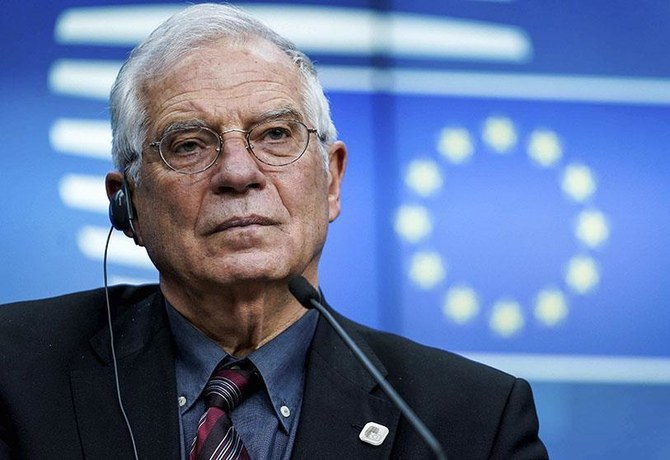
Josep Borrell is chairing the nuclear talks between Iran and world powers in Vienna. (AFP/File Photo)
Short Url
Updated 10 May 2021
Follow

EU’s Borell says Iran nuclear talks moving to crucial stage

  • “I am optimistic,” EU foreign affairs chief said

VIENNA: Negotiations in Vienna between world powers and Iran are moving into a crucial stage and the next few weeks will be critical to saving their 2015 nuclear deal, the European Union's top diplomat said on Monday.

US officials returned to Vienna last week for a fourth round of indirect talks with Iran on how to resume compliance with the deal, which former US President Donald Trump abandoned in 2018, prompting Iran to begin violating its limits on uranium enrichment about a year later.

“I am optimistic, there is a window of opportunity that will stay open for a couple of weeks, (until) end of the month,” EU foreign affairs chief Josep Borrell, who is chairing the talks, told a news conference in Brussels.

“But a lot of work is needed, time is limited and I hope that the negotiations will enter into a phase of nonstop (talks) in Vienna,” he said following a meeting of EU foreign ministers.

The crux of the 2015 agreement was that Iran committed to rein in its uranium enrichment program to make it harder to obtain the fissile material for a nuclear weapon, in return for relief from US, EU and UN sanctions.

Tehran denies having nuclear weapons ambitions.

German Foreign Minister Heiko Maas described the negotiations as tough and laborious, but added that all participants were conducting them in a constructive atmosphere.

“However, time is running out. We aim for the full restoration of the Iran nuclear deal as this is the only way to guarantee that Iran will not be able to come into possession of nuclear weapons,” Maas said in Brussels. 


Kushner’s vision for rebuilding Gaza faces major obstacles

Updated 46 min 9 sec ago
Follow

Kushner’s vision for rebuilding Gaza faces major obstacles

  • It remains uncertain whether Hamas will disarm, and Israeli troops fire upon Palestinians in Gaza on a near-daily basis

JERUSALEM: Modern cities with sleek high-rises, a pristine coastline that attracts tourists and a state-of-the-art port that jut into the Mediterranean. This is what Jared Kushner, President Donald Trump’s son-in-law and Middle East adviser, says Gaza could become, according to a presentation he gave at an economic forum in Davos, Switzerland.
In his 10-minute speech on Thursday, Kushner claimed it would be possible — if there’s security — to quickly rebuild Gaza’s cities, which are now in ruins after more than two years of war between Israel and Hamas.
“In the Middle East, they build cities like this ... in three years,” said Kushner, who helped broker the ceasefire in place since October. “And so stuff like this is very doable, if we make it happen.”
That timeline is at odds with what the United Nations and Palestinians expect will be a very long process to rehabilitate Gaza. Across the territory of roughly 2 million people, former apartment blocks are hills of rubble, unexploded ordnance lurks beneath the wreckage, disease spreads because of sewage-tainted water and city streets look like dirt canyons.
The United Nations Office for Project Services says Gaza has more than 60 million tons of rubble, enough to fill nearly 3,000 container ships. That will take over seven years to clear, they say, and then additional time is needed for demining.
Kushner spoke as Trump and an assortment of world leaders gathered to ratify the charter of the Board of Peace, the body that will oversee the ceasefire and reconstruction process.
Here are key takeaways from the presentation, and some questions raised by it:
Reconstruction hinges on security
Kushner said his reconstruction plan would only work if Gaza has “security” — a big “if.”
It remains uncertain whether Hamas will disarm, and Israeli troops fire upon Palestinians in Gaza on a near-daily basis.
Officials from the militant group say they have the right to resist Israeli occupation. But they have said they would consider “freezing” their weapons as part of a process to achieve Palestinian statehood.
Since the latest ceasefire took effect Oct. 10, Israeli troops have killed at least 470 Palestinians in Gaza, including young children and women, according to the territory’s Health Ministry. Israel says it has opened fire in response to violations of the ceasefire, but dozens of civilians have been among the dead.
In the face of these challenges, the Board of Peace has been working with Israel on “de-escalation,” Kushner said, and is turning its attention to the demilitarization of Hamas — a process that would be managed by the US-backed Palestinian committee overseeing Gaza.
It’s far from certain that Hamas will yield to the committee, which goes by the acronym NCAG and is envisioned eventually handing over control of Gaza to a reformed Palestinian Authority. Hamas says it will dissolve the government to make way, but has been vague about what will happen to its forces or weapons. Hamas seized control of Gaza in 2007 from the Palestinian Authority.
Another factor that could complicate disarmament: the existence of competing armed groups in Gaza, which Kushner’s presentation said would either be dismantled or “integrated into NCAG.” During the war, Israel has supported armed groups and gangs of Palestinians in Gaza in what it says is a move to counter Hamas.
Without security, Kushner said, there would be no way to draw investors to Gaza and or stimulate job growth. The latest joint estimate from the UN, the European Union and the World Bank is that rebuilding Gaza will cost $70 billion.
Reconstruction would not begin in areas that are not fully disarmed, one of Kushner’s slides said.
Kushner’s plan avoids mention of what Palestinians do in meantime
When unveiling his plan for Gaza’s reconstruction, Kushner did not say how demining would be handled or where Gaza’s residents would live as their areas are being rebuilt. At the moment, most families are sheltering in a stretch of land that includes parts of Gaza City and most of Gaza’s coastline.
In Kushner’s vision of a future Gaza, there would be new roads and a new airport — the old one was destroyed by Israel more than 20 years ago — plus a new port, and an area along the coastline designated for “tourism” that is currently where most Palestinians live. The plan calls for eight “residential areas” interspersed with parks, agricultural land and sports facilities.
Also highlighted by Kushner were areas for “advanced manufacturing,” “data centers,” and an “industrial complex,” though it is not clear what industries they would support.
Kushner said construction would first focus on building “workforce housing” in Rafah, a southern city that was decimated during the war and is currently controlled by Israeli troops. He said rubble-clearing and demolition were already underway there.
Kushner did not address whether demining would occur. The United Nations says unexploded shells and missiles are everywhere in Gaza, posing a threat to people searching through rubble to find their relatives, belongings, and kindling.
Rights groups say rubble clearance and demining activities have not begun in earnest in the zone where most Palestinians live because Israel has prevented the entry of heavy machinery.
After Rafah will come the reconstruction of Gaza City, Kushner said, or “New Gaza,” as his slide calls it. The new city could be a place where people will “have great employment,” he said.
Will Israel ever agree to this?
Nomi Bar-Yaacov, an international lawyer and expert in conflict resolution, described the board’s initial concept for redeveloping Gaza as “totally unrealistic” and an indication Trump views it from a real estate developer’s perspective, not a peacemaker’s.
A project with so many high-rise buildings would never be acceptable to Israel because each would provide a clear view of its military bases near the border, said Bar-Yaacov, who is an associate fellow at the Geneva Center for Security Policy.
What’s more, Kushner’s presentation said the NCAG would eventually hand off oversight of Gaza to the Palestinian Authority after it makes reforms. But Prime Minister Benjamin Netanyahu has adamantly opposed any proposal for postwar Gaza that involves the Palestinian Authority. And even in the West Bank, where it governs, the Palestinian Authority is widely unpopular because of corruption and perceived collaboration with Israel.