

20 Palestinians killed as tensions mount on Gaza border

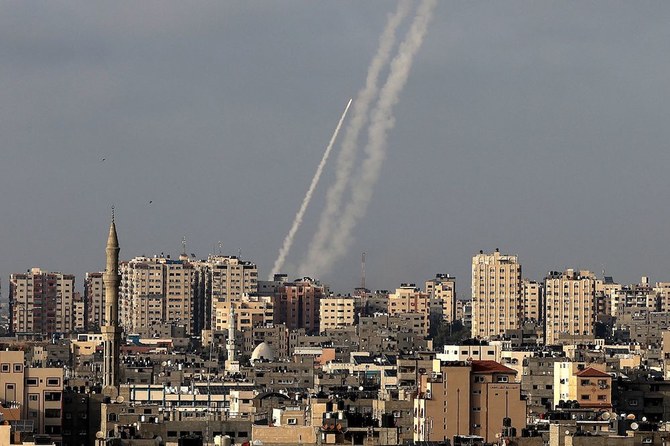
Rockets were fired from Gaza towards Israel on Monday after days of clashes in Jerusalem. (AFP)
Short Url
Updated 11 May 2021
Follow

20 Palestinians killed as tensions mount on Gaza border

  • Palestinian health officials say nine children among the dead after Israel retaliates
  • Hamas fires dozens of rockets into Israel following weeks of confrontations between Israeli police and Palestinian protesters

GAZA CITY: Palestinian health officials in the Gaza Strip said 20 people, including nine children, have been killed in fighting with Israel.
Israel’s army said it launched airstrikes on Monday, killing a senior Hamas commander, in response to rockets fired by Hamas amid spiraling violence sparked by unrest at Jerusalem’s Al-Aqsa mosque compound.
He said Israeli forces had targeted “a Hamas military operative,” while Hamas sources in Gaza said that one of their commanders had been killed.
Tensions on the Gaza Strip border with Israel continued to mount following recent violent confrontations at Al-Aqsa Mosque and in the Sheikh Jarrah neighborhood of Jerusalem.
A spokesman for Al-Qassam Brigades — the military wing of Hamas in Gaza — said that “a volley of rockets was fired toward the enemy in occupied Jerusalem in response to its crimes and aggression on the holy city and repression of its residents in Sheikh Jarrah and the Al-Aqsa Mosque.”

BACKGROUND

Mohammed Deif, commander-in-chief of the Al-Qassam Brigades, the military wing of Hamas in Gaza, recently warned that the resistance would ‘not stand idly by’ and that Israel would ‘pay a dear price’ if it continued with its actions against Palestinians.

The Islamic Jihad said that it targeted an Israeli vehicle with an anti-tank missile on the border with the Gaza Strip.
The developments in the Gaza Strip came after the Al-Qassam Brigades issued a warning to Israel to evacuate the Al-Aqsa Mosque and Sheikh Jarrah neighborhood, and release the detainees in Jerusalem, with a deadline of 6 p.m.

A number of rockets fired from Gaza toward Israeli towns on Sunday evening and Monday morning were intercepted by Israel’s Iron Dome air defense system and no injuries were reported. Incendiary balloons were also launched toward Israel.
The Israeli army responded to the attacks by bombing sites belonging to Palestinian factions in Gaza.
Night demonstrations also resumed along the border in support of several Palestinian families threatened with eviction from their homes in Jerusalem and as part of the so-called March of Return protests that have gone on for two years.
Mohammed Deif, commander-in-chief of the Al-Qassam Brigades, earlier said that the resistance would “not stand idly by” and that Israel would “pay a dear price” if it continued with its actions against Palestinians.
He said the brigades’ leadership was “watching what is happening (in Sheikh Jarrah) closely” while saluting “our steadfast people in occupied Jerusalem.”


A relative of a Palestinian, who was killed amid a flare-up of Israeli-Palestinian violence, is comforted as he reacts at a hospital in the northern Gaza Strip on Monday. (Reuters)

Deif has been on Israel’s wanted list for more than two decades and has been accused of being behind numerous military operations against the country. He has survived several assassination attempts, the most recent being during the 2014 Gaza war.
Jerusalem has recently witnessed violent clashes between Israeli police and Palestinian protesters over eviction plans to give Palestinian homes in the city suburb to Jewish settlers.
In East Jerusalem, which includes the Old City, Palestinians feel an increasing threat from settlers who have sought to expand the Jewish presence there by buying properties, constructing new buildings, and through court-ordered evictions.
Meanwhile, Israel has suspended Palestinian fishing rights off Gaza over the incendiary balloon attacks which it blamed on Hamas.


Fire billows from an Israeli air strike in Gaza in response to a barrage of rockets fired by Hamas. (AFP)

A statement on Sunday issued by the coordinator of the Israeli government’s activities in the Palestinian Territories, said: “It has been decided to close the fishing distance in the Gaza Strip, and the decision will take effect immediately, and will continue until further notice.”
On Monday, the Israelis also announced the complete closure of the Erez border crossing. Israeli Army Radio said: “Hamas in Gaza is making an extensive effort to ignite the situation. On the other hand, we are ready on all fronts. I advise them not to give us a try.”
Speaking at a recent Cabinet meeting, Israeli Prime Minister Benjamin Netanyahu said: “I tell the terrorist organizations that Israel will respond forcefully to any rocket fire from the Gaza Strip.”


Mustafa Ibrahim, a columnist, told Arab News that the current escalation in tensions was calculated both by Hamas and Israel.
He said: “At this stage, it seems that Hamas is well aware that the conditions are not conducive to escalating toward a military confrontation with Gaza. Therefore, the rockets fired from Gaza have a short range ... and also the current Israeli response to them does not indicate that it wants to expand the confrontation.

Opinion

This section contains relevant reference points, placed in (Opinion field)

“The somewhat positive reactions from the international community toward Jerusalem seem to have curbed the harsh reaction by the Palestinian factions in Gaza.
“Any developments in Jerusalem and the West Bank may always push Gaza into a military confrontation that may be limited and may be wide. But it seems that we have not reached a broad confrontation this time,” he added.


What role will Palestinian technocrats play in Gaza’s recovery and reconstruction?

Updated 4 sec ago
Follow

What role will Palestinian technocrats play in Gaza’s recovery and reconstruction?

  • Newly formed committee prepares to help administer Gaza under Trump-backed plan, despite continued uncertainty
  • Stabilization efforts gather pace with Board of Peace funding pledges, but access and security questions remain unresolved

DUBAI: US President Donald Trump convened the first meeting of his Board of Peace in Washington on Feb. 19, bringing together about two dozen allied leaders and diplomats to discuss postwar governance of Palestine’s Gaza Strip.

Among those in attendance was Ali Shaath, a former undersecretary in the Palestinian Authority widely regarded as a nonpartisan figure. In January, he was appointed to lead the National Committee for the Administration of Gaza, a 15-member body of technocrats expected to serve as the board’s governing partner on the ground.

As the vision takes shape, the scale of reconstruction presents a daunting challenge. A joint rapid damage assessment by the UN, European Union and World Bank estimates the cost of rebuilding Gaza and making it safe at approximately $70 billion.

Officials say about $20 billion will be needed in the first three years to jump-start recovery and stabilization.

At Thursday’s meeting, nine board member states committed a total of $7 billion toward a relief package, while the US committed an additional $10 billion.

Saudi Arabia pledged $1 billion to support efforts aimed at ending the Israeli-Palestinian conflict. Addressing the board, Saudi Minister of State for Foreign Affairs Adel Al-Jubeir said the Kingdom was embarking “on a journey toward establishing a lasting and just peace in the Middle East.”

Member of the Council of Ministers of Saudi Arabia Adel bin Ahmed Al-Jubeir attends the inaugural meeting of the Board of Peace at the Donald J. Trump Institute of Peace on February 19, 2026 in Washington, DC. (AFP)

He emphasized a two-state solution in which “Palestine and Israel live side by side in peace and security.”

Such an outcome, he added, would transform the region “from death and destruction to hope and prosperity.” He also expressed Saudi Arabia’s readiness to cooperate with the Board of Peace to advance what he described as a “noble objective.”

For his part, Shaath outlined the committee’s mandate. “A new governing authority is now in place for Gaza with a clear mandate and a clear commitment to establishing development and stability,” he said, noting it would operate “in extremely difficult conditions.”

“Large parts of the Gaza Strip are severely damaged — destroyed actually, humanitarian needs are acute, law and order remain fragile,” he added.

Israel’s military campaign, launched after the Hamas-led Oct. 7, 2023, attack on southern Israel, has killed tens of thousands of Palestinians, displaced nearly the entire population, and devastated civilian infrastructure.

Against this backdrop, the Board of Peace, announced in mid-January, is intended to coordinate Gaza’s reconstruction, security arrangements, and political transition under US leadership, with Trump as chair.

As part of that effort, Shaath said the committee’s immediate priority would be to restore security by deploying a 5,000-strong police force drawn entirely from Gaza within 60 days.

From there, the focus would shift to reviving economic activity, delivering sustained emergency relief, and restoring basic services.

“Our mandate is simple,” he said. “Step by step, to build the foundation for lasting peace, dignity and prosperity for the people of Gaza.”

But what is the structure of the Palestinian governing body tasked with carrying out that mission, and how viable will it be?

Hugh Lovatt, a senior policy fellow with the European Council on Foreign Relations, told Arab News that the committee’s final composition has been in flux for months. By cross-referencing images from meetings in Cairo with European Commission records, he has identified several of its members.

He said the group appears to include many former Palestinian Authority officials, despite Israel’s insistence that neither Hamas nor the Palestinian Authority should play a role in postwar governance.

“What comes out of the profiles is the extent to which the members of the committee have had ties to the Palestinian Authority and to the Fatah party of President (Mahmoud) Abbas,” Lovatt said.

As an example, he cited Sami Nasman, a prominent officer in the Palestinian General Intelligence Service who is expected to oversee internal security.

At the same time, he noted that several other members come from humanitarian and academic backgrounds and appear less politically aligned.

According to Lovatt, the committee faces significant hurdles, with Hamas having yet to disarm, and Israel continuing to block committee members from entering Gaza.

“They aren’t even allowed into Gaza at the moment,” he said. “They don’t have funding; they don’t have civil service at the moment.”

Israel has barred committee members from entering Gaza via the Rafah crossing, citing security concerns, according to a report in the Israeli newspaper Haaretz. Members are currently operating from Egypt or remotely, limiting their ability to exercise authority on the ground.

In the interim, Lovatt said, governance on the ground is largely in the hands of existing civil servants, adding that Hamas insists on keeping much of Gaza’s bureaucracy intact after any transfer of power — an arrangement that appears to have been accepted for now.

As a result, while the technocratic committee undergoes training in Cairo under the Board of Peace, the day-to-day administration of Gaza continues to rely on the pre-existing civil infrastructure.

Indeed, although Hamas publicly pledged in late January to hand over civilian administration, it reportedly retains full control of security forces, about 40,000 civil servants, and its weapons.

Full disarmament, which is a core condition tied to Phase Two of Trump’s 20-point ceasefire plan and Board of Peace oversight, has yet to be implemented.

The war in Gaza has been widely described by rights groups and UN bodies as amounting to “genocide,” with accusations that Israel used starvation as a weapon of war.

According to the local health authority, at least 72,000 Palestinians, most of them women and children, were killed and more than 171,680 were injured until a ceasefire took effect on Oct. 9.

In November 2024, the International Criminal Court issued arrest warrants for Israeli Prime Minister Benjamin Netanyahu and former Defense Minister Yoav Gallant, as well as a former Hamas commander, citing allegations of war crimes and crimes against humanity.

Nickolay Mladenov, a former Bulgarian politician selected as the Board of Peace’s high representative for Gaza, said that while the committee is prepared to assume its mandate, the situation remains volatile.

“Unfortunately, some people believe that this is a bit like changing a government after an election,” he told CNN during a recent interview. “It’s far more complicated than that.

“We need to be able to verify and to confirm that the transfer of authority by Hamas to the International Committee happens in a meaningful way.”

Mladenov, who acts as the link between the board and the committee, maintained that Trump’s plan is the most comprehensive path forward, while warning that alternatives could be catastrophic.

“I think we need to make very clear to everyone that there are only three pathways forward,” he said.

“One pathway leads to a resumption of war, and that is certainly something that we want to avoid. The second pathway, perhaps even more dangerous than the resumption of war, is cementing the situation which you have now, where Gaza is divided.”

The third pathway, he said, “requires Hamas to give up civilian control of Gaza, to decommission all weapons inside the Gaza Strip, and to have a new governance model that allows for reconstruction to happen.”

Gaza remains physically and politically divided, split between Israeli-controlled eastern buffer zones, including the Yellow Line, and a densely packed western coastal strip where most Palestinians are confined.

Israel controls more than half of Gaza’s land, enforcing no-go zones and preventing full Palestinian access or return. The remaining coastal enclave, which is ever-shrinking due to operations, is managed uneasily between Hamas’s residual security hold, the sidelined technocratic committee, and limited aid flows via Rafah, which Israel contests.

Given these circumstances, some observers question whether the committee will ultimately be able to benefit Palestinians in Gaza.

Hannan Hussein, a senior expert at the Initiate Futures policy think tank, cautioned that the technocratic committee might “ultimately work to implement reconstruction in Gaza in a manner that is beneficial to Israel.”

He told Arab News: “Its success is ultimately tethered to the operations of the Board of Peace. Its mandate comes at a time when the possibilities of enduring peace in Gaza are not in line with the interests of besieged Palestinians.

“This is important, because enduring stability remains distant when those subject to aggression lack a voice within the committee. To succeed, it needs ownership from the ground up, which is lacking.”

Those concerns are compounded by ongoing violence despite a ceasefire that took effect on Oct. 9. Israel has continued airstrikes and raids that have killed Palestinians and obstructed large-scale reconstruction, keeping the territory in a state of chronic emergency.

Since the ceasefire took effect, another 601 Palestinians had been killed and 1,607 injured, according to Gaza’s health authority.

Aid groups continue to call for a genuine and sustained cessation of violence, saying continued violence, displacement and restrictions on humanitarian access are hindering the delivery of essential assistance.

Although the Rafah crossing with Egypt reopened on Feb. 2 in both directions, the flow of people and aid is below agreed levels, an official from the Egyptian Red Crescent in North Sinai told Asharq Al-Awsat newspaper on Feb. 19.

Hussein also raised concerns about the committee’s lack of independent oversight and questions surrounding transparency.

Even so, the committee appears, for now, to have the broadest backing of any Palestinian body positioned to govern Gaza, with both Hamas and Israel agreeing in principle to its formation.

Implementation of the Gaza plan appears to be moving forward, according to the European Council on Foreign Relations.

The latest confirmed list of technocrats suggests a final roster of 16 to 17 commissioners, although several portfolios — including transport, energy, land authority and religious affairs — remain to be finalized.