Pakistan’s army chief visits Afghanistan, discusses peace process with President Ghani

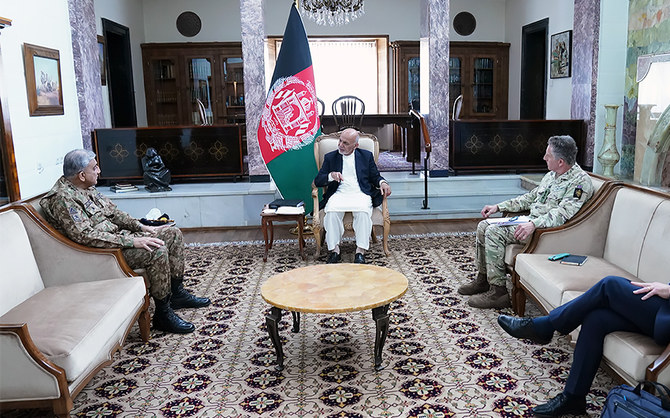
Pakistan's Army Chief General Qamar Javed Bajwa, left, meets Afghan President Ashraf Ghani in Kabul, Afghanistan, on May 10, 2021. (Picture courtesy: @ARG_AFG/Twitter)
Short Url
Updated 11 May 2021
Follow

Pakistan’s army chief visits Afghanistan, discusses peace process with President Ghani

  • President Ghani thanked Gen Bajwa for a meaningful discussion and “appreciated Pakistan’s sincere & positive role in Afghan Peace Process”
  • Pakistan’s foreign office on Monday welcomed a three-day cease-fire during the upcoming Eid Al-Fitr holiday announced by the Afghan Taliban

ISLAMABAD: Pakistan’s army chief General Qamar Javed Bajwa visited Kabul on Monday where he held meetings with President Ashraf Ghani and Chairman of the Afghan High Council for National Reconciliation Dr. Abdullah Abdullah to discuss intra-Afghan peace talks, said the military’s media wing, ISPR, in a statement.
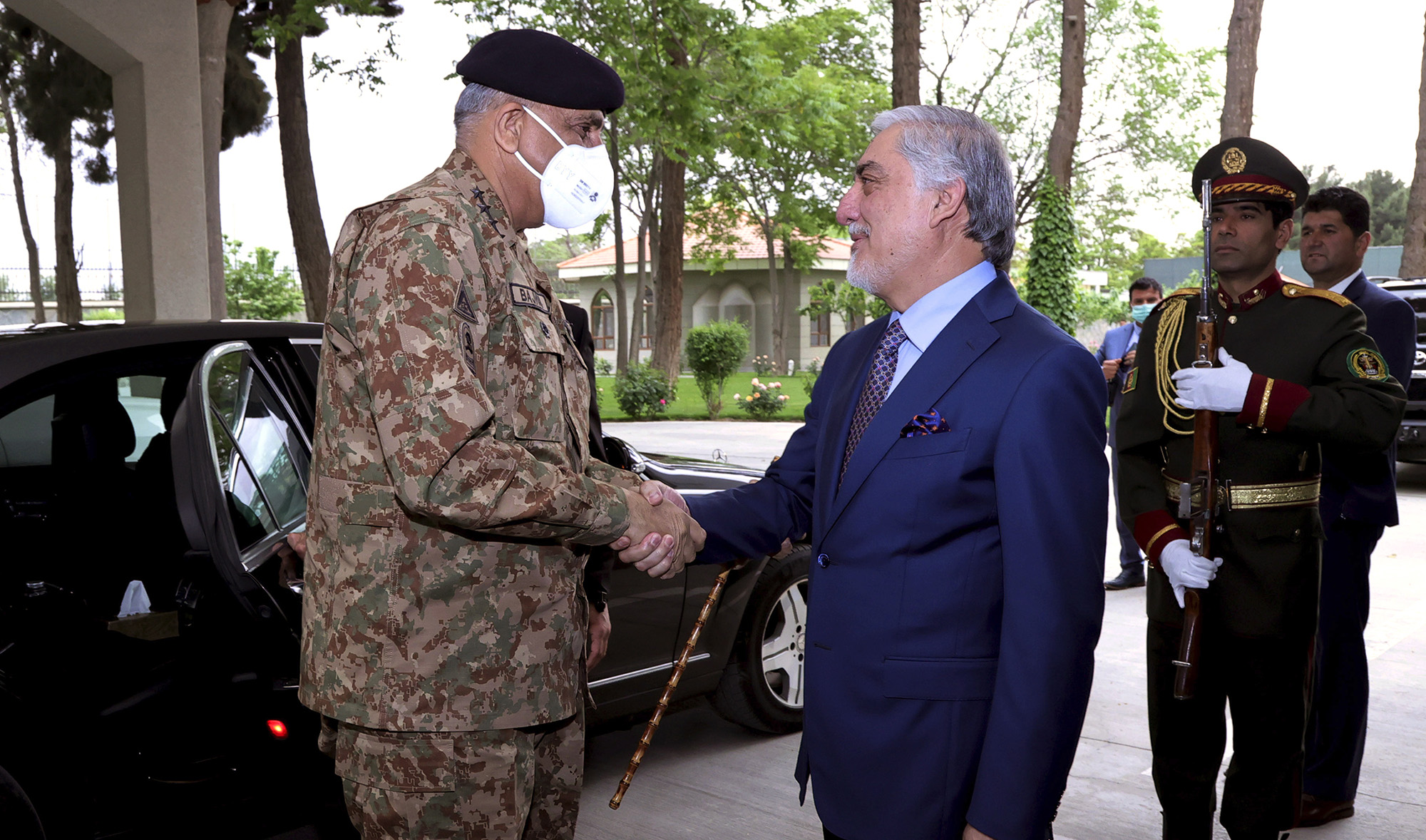


Pakistan's army chief Gen. Qamar Javed Bajwa, left, shakes hands with Abdullah Abdullah, Chairman of the High Council for National Reconciliation, on his arrival in Kabul, Afghanistan, on May 10, 2021. (Sapidar Palace via AP)

Gen Bajwa reiterated that a peaceful Afghanistan means a peaceful region in general and a peaceful Pakistan in particular. “We will always support ‘Afghan led-Afghan Owned’ Peace Process based on mutual consensus of all stakeholders,” he was quoted as saying by the ISPR.

Military statement added that Afghan President Ghani thanked Gen Bajwa for a meaningful discussion and “appreciated Pakistan’s sincere & positive role in Afghan Peace Process.”

Bajwa undertook his visit to Afghanistan at a time when it is witnessing increased militant violence against its security forces and civilian population, making regional actors urge the Taliban insurgents to abandon violence and create a more conducive environment for peace talks with the administration in Kabul.

The United States has already started pulling out its troops from the war-battered country and is likely to complete the process by the 20th anniversary of September 11 this year.

Bajwa also met Britain’s Chief of Defense Staff General Nicholas Patrick Carter in Kabul, who was also present at his meeting with the Afghan president.

“During the meeting, matters of mutual interest, regional security situation, particularly current developments in Afghan peace process and measures to further enhance bilateral and defense cooperation, were discussed,” the ISPR said.

The statement added that General Carter “appreciated Pakistan’s sincere efforts for peace and stability in the region, especially the Afghan peace process.”

Pakistan also welcomed the Taliban announcement on Monday to declare a three-day cease-fire in Afghanistan during this week’s Eid Al-Fitr holiday.

Eid Al-Fitr marks the end of the Muslim fasting month of Ramadan, and the holiday begins after the crescent is sighted for the next month on Islamic lunar calendar.

“We welcome the three-day cease-fire announcement for Eid-ul-Fitr by Taliban,” Pakistan’s foreign office said in a tweet.

It added: “We fully support all efforts that lead to reduction in violence and contribute to achieving durable stability & lasting peace in Afghanistan.”


The cease-fire announcement from the Taliban came only two days after a bomb attack on a girls’ schools in Afghanistan on Saturday that killed about 60 people, mostly young schoolgirls.

The Taliban condemned the deadly bomb blast outside the school and denied any responsibility.


Pakistan, Iraq agree on tighter coordination over pilgrims under new regulated travel system

Updated 4 sec ago
Follow

Pakistan, Iraq agree on tighter coordination over pilgrims under new regulated travel system

  • New system requires all Iraq-Iran pilgrimages to be organized by licensed groups under state oversight
  • Long-running “Salar” model relied on informal caravan leaders, leading to overstays and missing pilgrims

ISLAMABAD: Pakistan and Iraq this week agreed to closely coordinate on the management and security of Pakistani pilgrims, as Islamabad rolls out a new, tightly regulated travel system aimed at preventing overstays, undocumented migration and security breaches during religious visits to Iraq and Iran.

The understanding was reached during a meeting between Pakistan’s Interior and Narcotics Control Minister Mohsin Naqvi and Iraq’s Interior Minister General Abdul Amir Al-Shammari on Thursday evening, where both sides discussed measures to facilitate pilgrims while strengthening oversight, Pakistan’s interior ministry said.

The agreement comes as Pakistan dismantles its decades-old pilgrim travel model and replaces it with a centralized, licensed system after authorities confirmed that tens of thousands of Pakistani pilgrims had overstayed or gone missing abroad over the past decade, triggering concerns from host governments.

“You have, for the first time during your tenure, taken effective measures to organize pilgrim groups, which are commendable,” Al-Shammari told Naqvi, according to Pakistan’s interior ministry.

“All pilgrims included in the list provided by Pakistan’s Ministry of Interior will be allowed to enter Iraq,” he added, making clear that only travelers cleared under the new system would be permitted.

Naqvi said Pakistan would strictly enforce return timelines under the revised framework.

“Pilgrims traveling to Iraq will not be allowed to stay beyond the designated period,” he said, adding that relevant authorities in both countries would remain in close coordination.

Both interior ministers also agreed to strengthen information-sharing and joint mechanisms on security cooperation, counterterrorism and the prevention of human smuggling, officials said.

“The safety, dignity, and facilitation of Pakistani pilgrims is the top priority of the Government of Pakistan,” Naqvi said.

Al-Shammari said he would visit Pakistan soon to finalize a joint roadmap to further improve pilgrim facilitation, security coordination and broader bilateral cooperation, according to the interior ministry.

Pakistan’s government has overhauled its pilgrim travel regime this year, abolishing the long-running “Salar” system under which informal caravan leaders managed pilgrimages. The move followed official confirmation that around 40,000 Pakistani pilgrims had overstayed or disappeared in Iran, Iraq and Syria over the past ten years.

Under the new Ziyarat Management Policy, only licensed Ziyarat Group Organizers (ZGOs) are allowed to arrange pilgrimages, with companies held directly responsible for ensuring pilgrims return on time. Authorities have completed security clearance for 585 companies seeking registration, while scrutiny of applications remains ongoing.

Islamabad has also barred overland travel for major pilgrimages, including Arbaeen, citing security risks in Pakistan’s southwestern Balochistan province, meaning all travel to Iraq and Iran is now restricted to regulated air routes.

Tens of thousands of Pakistani pilgrims travel each year to Iraq and Iran to visit some of the most revered shrines in Shia Islam, including the mausoleums of Imam Ali in Najaf and Imam Hussain in Karbala in Iraq, and major religious sites in Mashhad and Qom in Iran. Pilgrimages peak during religious occasions such as Arbaeen, when millions of worshippers converge on Karbala from across the region. The scale of travel, often involving long stays and cross-border movements, has long posed logistical, security and migration-management challenges for Pakistani authorities and host governments alike.