

Yemen accuses Iran of ‘fueling war’ over weapons seizure

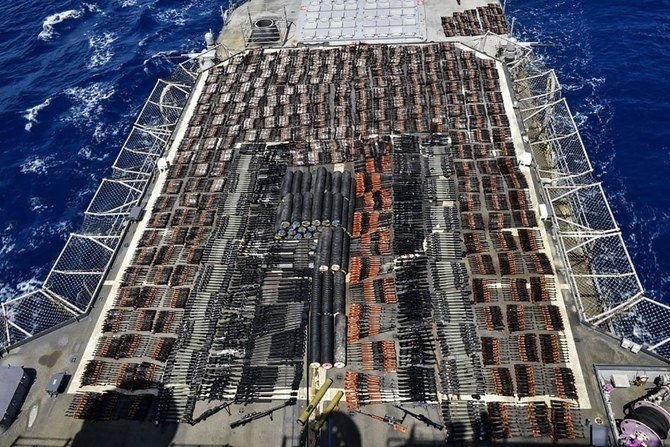
The weapons were seized from a dhow in the Arabian Sea. (US Navy)
Short Url
Updated 10 May 2021
Follow

Yemen accuses Iran of ‘fueling war’ over weapons seizure

  • Seizure includes thousands of assault weapons, machine guns and sniper rifles hidden aboard a ship
  • Secret shipment is ‘further evidence’ of Tehran’s support for militia, minister warns

AL-MUKALLA: The internationally recognized government of Yemen has accused Iran of fueling the country’s civil war by supplying Houthi militias with weaponry and military know-how.

Following the accusations, Yemeni officials repeated demands for Iran to face punishment for meddling in the country’s affairs.

It came as the US Navy announced on Sunday that it had seized a new arms shipment of thousands of weapons concealed on a vessel in the Arabia Sea.

The shipment was sent by Iran and was destined for Houthi militias, a US defense official told The Associated Press.

Muammar Al-Eryani, Yemeni minister of information, culture and tourism, said that the shipment is “further evidence” of Iran’s support for the Houthis and their use of the militia as a “tool to destabilize the region.”

He said: “This confirms the continued smuggling of Iranian weapons to the militia and using them (the Houthis) as a tool to implement their expansionist plan, spreading chaos and terrorism in the region and threatening international interests.

“We call on the international community, the UN and the permanent members of the UN Security Council to take a clear and explicit stance against the continuation of Iranian interference in Yemen.”

For more than a decade, successive Yemeni governments have accused Iran of supporting the Houthis militarily and financially by smuggling advanced weaponry, and more recently, sending Iraqi and Lebanese fighters into the country.

Yemeni officials believe that military expertise and weapons from Iran have shored up Houthi strength and firepower depleted by years of fighting and Arab coalition airstrikes.

Opinion

This section contains relevant reference points, placed in (Opinion field)

“Unfortunately, as we approach the conclusion of Ramadan, instead of ending the conflict, the Houthis are still escalating it. And this is evidenced by the interception of another cache of smuggled arms coming from Iran going to Yemen,” the Embassy of Yemen in Washington, D.C said on Twitter on Sunday, adding: “The Iranian regime should stop supporting and supplying arms to the Houthis, both foreign procured or domestically produced.” 
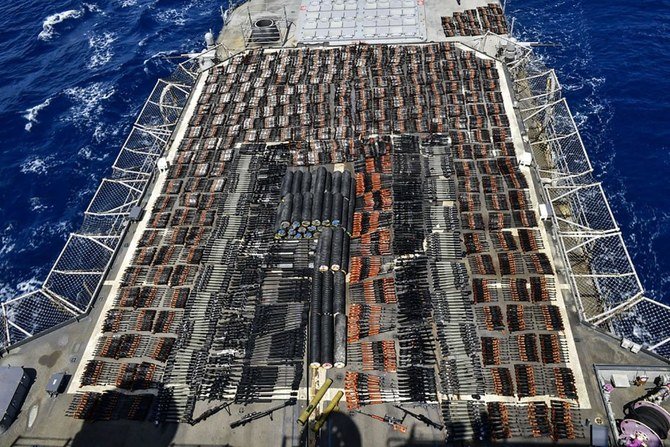


The weapons were seized from a dhow in the Arabian Sea. (US Navy)

Western diplomats and officials have also shared the same concerns about the role of Iran in undermining security in Yemen and stoking conflict.

“That the US Navy seized another shipment of Iranian weapons bound for Yemen should come as no surprise. Iran has sought to fuel civil war in Yemen since at least 2013,” Tom Cotton, a US senator, said on Twitter


Pakistan’s deputy PM says country seeks to convert $1 billion UAE deposit into investment

Updated 28 December 2025
Follow

Pakistan’s deputy PM says country seeks to convert $1 billion UAE deposit into investment

  • Ishaq Dar says the UAE will acquire shares in Pakistani companies using the amount, with transaction to be completed by March 31
  • The UAE’s remaining $2 billion in deposits, part of funds used to shore up Pakistan’s foreign reserves, are due for rollover in January

ISLAMABAD: Pakistan is seeking to convert part of its financial support from the United Arab Emirates into long-term investment to reduce external debt, Deputy Prime Minister Ishaq Dar said on Saturday, following talks with UAE President Sheikh Mohamed bin Zayed Al Nahyan during his visit to Islamabad.

Dar said Pakistan was engaged with the UAE on converting $1 billion in deposits into equity investment, potentially involving stakes in companies linked to the Fauji Fertilizer Group, a move that would end Pakistan’s repayment obligation on that portion of the funds.

The UAE has been one of Pakistan’s key financial backers in recent years, providing $3 billion in deposits to the central bank as part of a broader effort to stabilize the country’s external finances and unlock support from the International Monetary Fund.

Speaking at a year-end briefing, Dar said Pakistan had already begun discussions with the UAE on rolling over the first $1 billion tranche, but Islamabad now wanted to replace short-term borrowing with investment.

“They will be acquiring some shares, and this liability will end,” Dar said, adding that discussions were under way for the transaction to be completed by March 31.

Dar said the Fauji Foundation Group was taking the lead in the process, with plans for partial disinvestment by Fauji-linked and other companies to facilitate the deal.

He added that Pakistan also raised the issue of a separate $2 billion rollover due in January during talks with the UAE leadership, saying Islamabad had conveyed that converting debt into investment would be preferable to repeated rollovers.

The issue was discussed during Al Nahyan’s visit, which Dar described as cordial, adding that the UAE had expressed willingness to expand its investment footprint in Pakistan.

Pakistan has relied on repeated rollovers of deposits from friendly countries to manage its balance-of-payments pressures, a practice economists say provides short-term relief but adds to debt vulnerabilities unless replaced with foreign direct investment.

The country acquired $5 billion from Saudi Arabia and $4 billion from China, which, along with the UAE, helped shore up its foreign reserves and meet IMF conditions at a time when its external account was under severe pressure.

Dar said Pakistan was now focused on shifting from temporary financing toward longer-term capital inflows to stabilize its economy and reduce reliance on external borrowing.