Elon Musk says he is first SNL host with Asperger’s syndrome

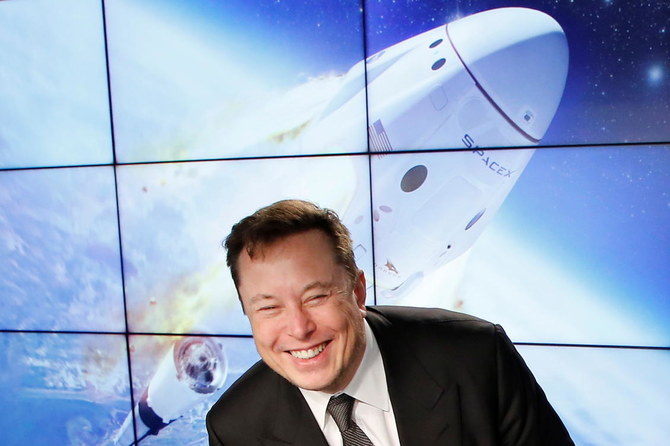
Tesla boss and SpaceX founder Elon Musk also tried his hand at TV presenting as guest host on Saturday Night Live. (Reuters)
Short Url
Updated 09 May 2021
Follow

Elon Musk says he is first SNL host with Asperger’s syndrome

  • Crypto comments move Dogecoin price
  • Musk has previously drawn criticism for mocking SEC

WASHINGTON: Elon Musk kicked off his “Saturday Night Live” debut by declaring himself to be the first person with Asperger’s syndrome to host the US comedy sketch show.
“Or at least, the first person to admit it,” he said.
In his opening monologue, the eccentric tech entrepreneur behind Tesla and SpaceX offered an explanation for some of his past eyebrow-raising behavior.
“Look, I know I say or post strange things but that’s just how my brain works. To anyone I’ve offended I just want to say, I reinvented electric cars and I’m sending people to Mars in a rocket ship,” he said. “Did you think I was also going to be a chill, normal dude?“
Musk has previously drawn criticism for moves like publicly mocking the US Securities and Exchange Commission and calling a cave diver who rescued boys trapped in Thailand a “pedo guy.”
But on SNL, the billionaire took swipes at his own expense.
And of course, as a big booster of cryptocurrencies, he once again enumerated the benefits of dogecoin.
Pressed on what exactly dogecoin is, Musk called the cryptocurrency — which now has a market value of around $72 billion — “an unstoppable vehicle that’s going to take over the world.”
But then he agreed that actually “it’s a hustle.”
For the second time in a week, the world’s second-richest person seemed to drive the value of the digital asset. Not long after its recent surge after Musk’s Twitter endorsement, it was sent on a brief tailspin during his SNL performance.
It dropped to as low as 49 cents during the broadcast after a pre-show high of about 74 cents, according to CoinDesk.
During the show, cast members wondered aloud why exactly the tech billionaire would want to join their set.
With a segment of a Chinese rocket re-entering Earth’s atmosphere around the time of the live broadcast, they concluded that the spaceman “needed an alibi.”


Saudi minister at Davos urges collaboration on minerals

Global collaboration on minerals essential to ease geopolitical tensions and secure supply, WEF hears. (Supplied)
Updated 1 min 38 sec ago
Follow

Saudi minister at Davos urges collaboration on minerals

  • The reason of the tension of geopolitics is actually the criticality of the minerals

LONDON: Countries need to collaborate on mining and resources to help avoid geopolitical tensions, Saudi Arabia’s minister of industry and mineral resources told the World Economic Forum on Tuesday.

“The reason of the tension of geopolitics is actually the criticality of the minerals, the concentration in different areas of the world,” Bandar Alkhorayef told a panel discussion on the geopolitics of materials.

“The rational thing to do is to collaborate, and that’s what we are doing,” he added. “We are creating a platform of collaboration in Saudi Arabia.”

Bandar Alkhorayef, Saudi Minister of Industry and Mineral Resources 

The Kingdom last week hosted the Future Minerals Forum in Riyadh. Alkhorayef said the platform was launched by the government in 2022 as a contribution to the global community. “It’s very important to have a global movement, and that’s why we launched the Future Minerals Forum,” he said. “It is the most important platform of global mining leaders.”

The Kingdom has made mining one of the key pillars of its economy, rapidly expanding the sector under the Vision 2030 reform program with an eye on diversification. Saudi Arabia has an estimated $2.5 trillion in mineral wealth and the ramping up of extraction comes at a time of intense global competition for resources to drive technological development in areas like AI and renewables.

“We realized that unlocking the value that we have in our natural resources, of the different minerals that we have, will definitely help our economy to grow to diversify,” Alkhorayef said. The Kingdom has worked to reduce the timelines required to set up mines while also protecting local communities, he added. Obtaining mining permits in Saudi Arabia has been reduced to just 30 to 90 days compared to the many years required in other countries, Alkhorayef said.

“We learned very, very early that permitting is a bottleneck in the system,” he added. “We all know, and we have to be very, very frank about this, that mining doesn’t have a good reputation globally.

“We are trying to change this and cutting down the licensing process doesn’t only solve it. You need also to show the communities the impact of the mining on their lives.”

Saudi Arabia’s new mining investment laws have placed great emphasis on the development of society and local communities, along with protecting the environment and incorporating new technologies, Alkhorayef said. “We want to build the future mines; we don’t want to build old mines.”