

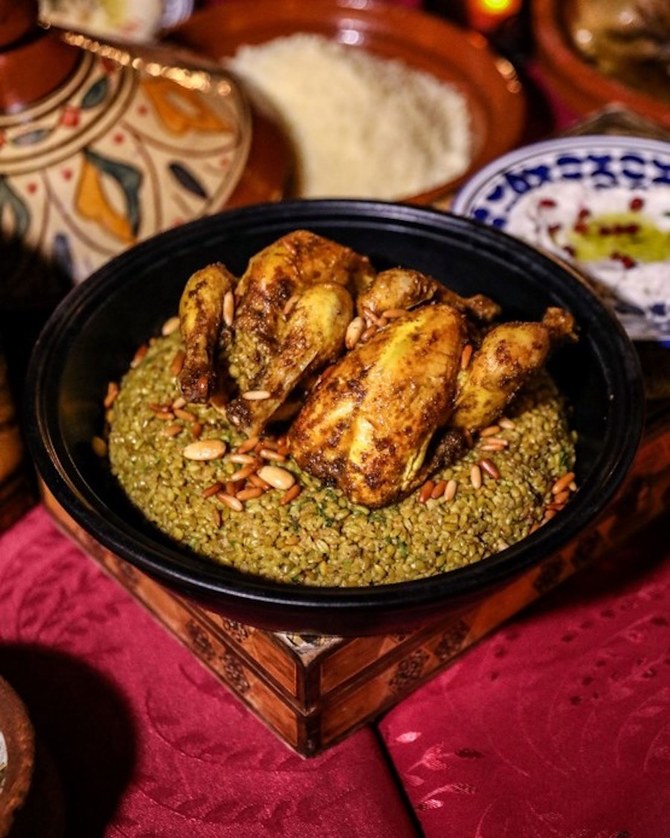
Ramadan recipes: This freekeh-stuffed chicken is comfort food for the soul

(Supplied)
Short Url
Updated 09 May 2021
Follow

Ramadan recipes: This freekeh-stuffed chicken is comfort food for the soul

DUBAI: Jordanian Chef Hassan Al-Naami shares his delectable recipe for fragrant freekeh-stuffed chicken, a dish that is wildly popular at The Ritz-Carlton, Dubai, where he brings his culinary vision to life at the hotel’s Middle Eastern restaurant, Amaseena.

As Ramadan draws to a close, give this dish a go for a special iftar this week.

Chicken ingredients:  

Whole baby chicken

2 tbsp extra virgin olive oil

1 tsp salt

½ tsp black pepper

1 tsp paprika

1/3 tbsp 7 spice

½ tbsp coriander powder

2 ½ tbsp lemon juice

1 handful of almonds

1 handful of pine nuts

Freekeh ingredients:

5 cups freekeh 

3 tbsp olive oil

¼ cup onion (chopped)

1 tsp cinnamon powder

½ tsp cardamom powder

1 tbsp 7-spice

1 ½ tbsp cumin powder

6 cups chicken stock

Salt and black pepper to taste

Instructions:

1.       Wash and drain freekeh until clean. In a hot pan combine olive oil and spices, toss for a few minutes till fragrant. Add the freekeh then sauté for another 5 minutes. Add chicken stock and bring to boil. Cover and cook for 30-40 minutes on a low heat. The freekeh should be cooked but still have a chewy texture.

2.       Preheat the oven to 180 degrees Celsius. In a small bowl, mix all the spices and rub chicken with spices all over and inside, including under the skin. Take the cooked freekeh and stuff the chicken with it, cross the legs and tie with twine. Place the chicken in a roasting tray, cover with foil and roast for 60-80 minutes. Allow the chicken rest before serving (keeping it covered).

3.       Serve stuffed chicken on over leftover cooked freekeh. Decorate with roasted nuts and serve with minted yogurt on the side.


Sistine Chapel sketch by Michelangelo goes on show in Dubai

Updated 10 sec ago
Follow

Sistine Chapel sketch by Michelangelo goes on show in Dubai

DUBAI: A previously unknown study by Italian Renaissance artist Michelangelo for perhaps his most famous work, the frescoes on the Sistine Chapel ceiling, went on show in Dubai this week, with Christie’s specialist Giada Damen on hand to convey the significance of the find to Arab News.

The sketch of the right foot of the Libyan Sibyl, whose final form is at the far east end of the Sistine Chapel ceiling in the Vatican, will go under the hammer at a Feb. 5 auction in New York, with an estimate of $1.5 million to $2 million.

This is the first time a work by Michelangelo has gone on show in the UAE. A significant degree of grit and determination went into identifying and verifying the small sketch, which first came to light after an unsuspecting owner sent a photograph to Christie’s online Request an Auction Estimate portal.

Of the roughly 600 sheets by Michelangelo that survive today — only a fraction of the thousands of drawings he must have produced — this is one of only 50 studies relating to the Sistine Chapel.

“This drawing is the only preparatory (drawing) for the Sistine Chapel that has ever come on the market,” Damen explained, adding that the prolific artist was known for burning sketches after a painting had been completed.

“There are so many clues attached to this drawing that point to the fact that it is a real drawing by Michelangelo,” she added, pointing to the red chalk used in the small sketch — typical of the sketches Michelangelo  did in the run-up to the second half of the Sistine Chapel ceiling — as well as a sister sketch housed in New York’s Metropolitan Museum of Art.

“He made the first part of the Sistine ceiling starting in 1508, and it took two years. Then the scaffolding was removed and only at that point, Michelangelo was able to see the ceiling from a distance from the floor of the chapel (and he) realized that actually the figures that he had made, those scenes, they were too crowded and with too small figures that you couldn’t really see all these details,” Damen said of the first half of the ceiling.

“From here on, he decided in the second phase to do bigger figures and less details … and the (Libyan) Sibyl is part of this second phase.”

The figure of the female seer is depicted by Michelangelo in a dynamic, twisted pose, with her toes pressing down against a platform supporting her weight as she holds a book of prophecies.  

 Michelangelo Buonarroti (1475-1564) is one of the foremost figures in global art history, famous for his work as a sculptor, architect, painter and thinker. His frescoes on the ceiling and back wall of the Sistine Chapel are among his most famous works.