



ISLAMABAD: Prime Minister Imran Khan and Crown Prince Mohammed bin Salman signed the agreement on the establishment of the Saudi-Pakistan Supreme Coordination Council in Jeddah, the foreign office said on Saturday.
Ahead of the visit, Pakistan’s Cabinet on Tuesday approved the establishment of the council — a body created for streamlining bilateral cooperation between the two countries — to ‘remove hurdles’ to investment deals signed during the crown prince’s visit to Pakistan in February 2019.
Khan arrived in the Kingdom on Friday evening for a three-day visit on the invitation of the crown prince, who was present at Jeddah airport to receive him and the first lady. He is accompanied by a high-level delegation, including the foreign minister and other members of the Cabinet.
Khan and the crown prince held wide-ranging talks on bilateral, regional and international issues in Jeddah, the FO statement said.
“The two leaders reaffirmed the strong and historic bonds between the two countries rooted firmly in shared beliefs, common values, mutual trust and longstanding tradition of mutual support,” the statement said, and added that the two parties agreed to “further strengthen, deepen and diversify the existing bilateral political, economic, trade, defense and security ties.”
“Special emphasis was laid on increasing Saudi investments in Pakistan, collaboration in the field of energy, and increased job opportunities for Pakistanis in Saudi Arabia,” the statement said.
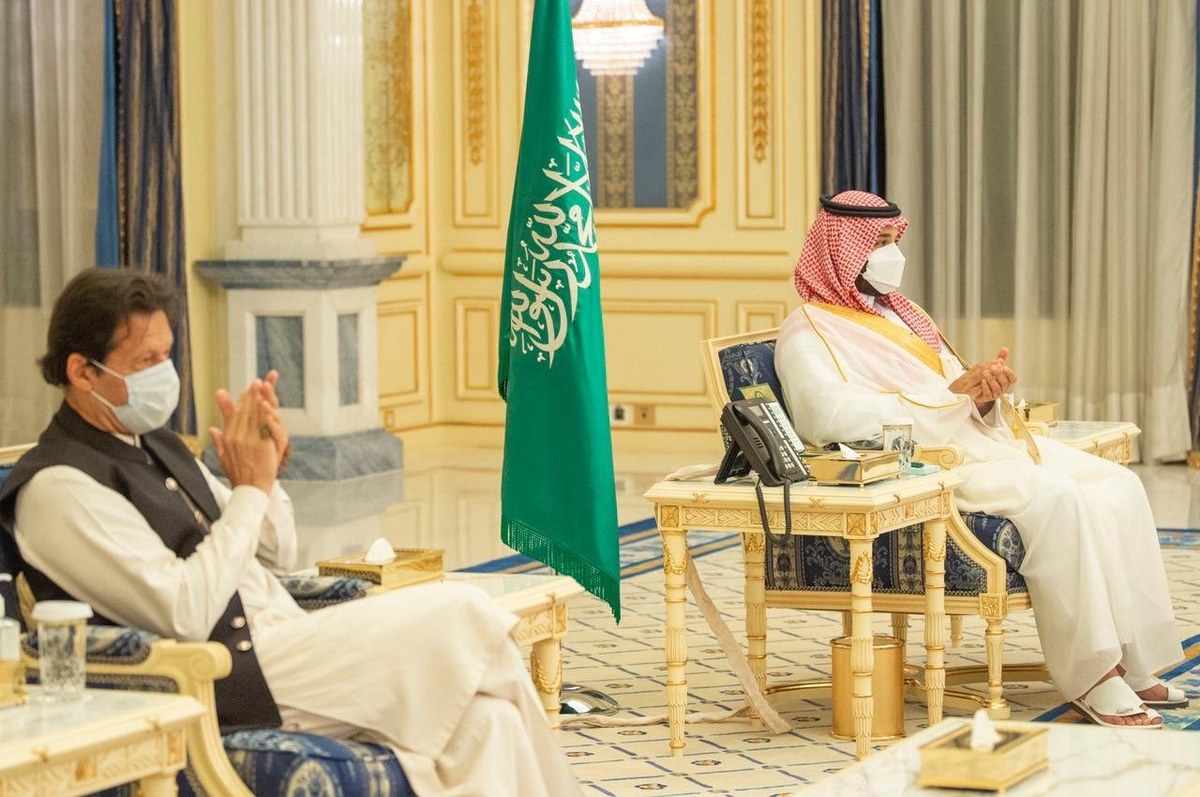
Pakistan Prime Minister Imran Khan (L) and Saudi Arabia's Crown Prince Mohammed bin Salman (R) during the signing of the agreement on the establishment of the Saudi-Pakistan Supreme Coordination Council in Jeddah on May 8, 2021. (Courtesy: SPA)
Saudi Arabia is home to more than two million Pakistanis who remit billions of dollars back home every year.
On regional issues, Khan outlined his vision of a ‘peaceful neighborhood.’ He lauded the crown prince for efforts and initiatives aimed at reinforcing and promoting regional peace.
Khan highlighted the situation in Indian-administered Kashmir and stressed the importance of a peaceful resolution of the Jammu and Kashmir dispute. He also said Pakistan had made consistent efforts to support peace and reconciliation in Afghanistan, the statement reported.
The Afghan question is important in the region against the backdrop of foreign troops pulling out of Pakistan’s neighboring country after a war that has lasted two decades, and that ends with the Taliban controlling huge swathes of the country.
During talks, issues related to the environment and climate change were discussed and the PM appreciated the crown prince’s ‘Green Saudi Arabia’ initiative.
Khan has also invited the crown prince to visit Pakistan at his earliest convenience, the foreign office said.
A host of bilateral agreements were signed during delegation level talks, ranging from crime to narcotics and from transport to energy generation.
#WATCH: #Pakistan Prime Minister @ImranKhanPTI and #SaudiArabia's Crown Prince Mohammed bin Salman affirm commitment to deepen Pakistan-Saudi relations in all fields || #PMIKinKSA #رئيس_وزراء_باكستان_في_السعودية
-
Full coverage: https://t.co/RJKg8kuGli— Arab News Pakistan (@arabnewspk) May 8, 2021
According to a joint statement circulated by the PM House in Islamabad on Saturday evening, the two countries agreed to intensify contacts and cooperation between their government officials and private sector to further strengthen bilateral relations.
They discussed ways to enhance economic and trade relations by exploring areas of investment and opportunities available in light of the Kingdom's 2030 vision and Pakistan’s development priorities emanating from a shift from geo-politics to geo-economics.
“Both sides expressed satisfaction at existing cooperation in bilateral military and security relations and agreed to further augment collaboration and cooperation to achieve mutually agreed goals,” the joint statement continued.
Pakistan and Saudi Arabia also reaffirmed their full support for all the legitimate rights of the Palestinian people, and condemned the attacks of terrorist groups and militias, including the Houthis in Yemen, by ballistic missiles and drones on the Saudi territory.
“They expressed serious concern at the threats posed to the security of oil exports and the stability of energy supplies, which was vital for the progress and development of the region and its peoples,” the statement added.
Other than that, the two countries also agreed to continue supporting each other at multilateral fora.
Khan and his Cabinet members visited the Prophet’s Mosque in Madinah on Saturday evening. They are also expected to visit Makkah and perform their umrah.
On Friday, Pakistani army chief General Qamar Javed Bajwa, whose official visit preluded Khan’s, held talks with the Saudi crown prince and reviewed bilateral ties.
He also discussed defense cooperation with the Saudi military chief of staff.


