ISLAMABAD: Prime Minister Imran Khan’s visit to Saudi Arabia on Friday has been described as a “welcome development” by defense and foreign policy experts who said it was highly significant in the context of regional peace, stability and enhancement of bilateral relations.
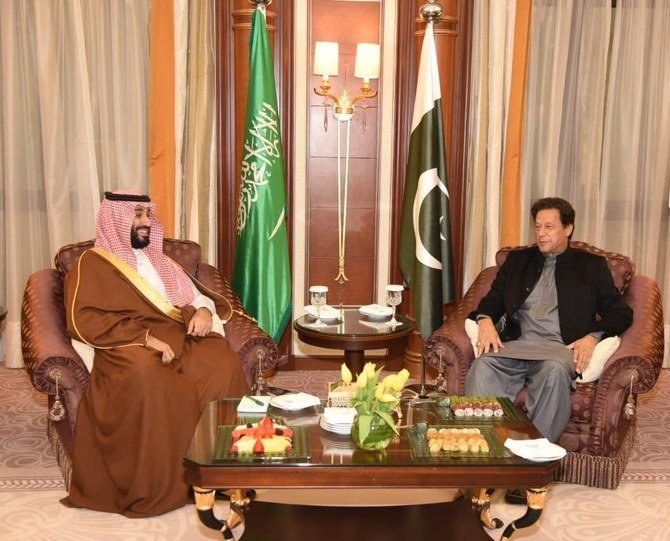
Khan embarked on a three-day visit to the kingdom today on the invitation of Saudi Crown Prince Mohammed bin Salman to discuss a range of issues, including trade, investment, energy, environment and the welfare of the Pakistani diaspora.
“The visit of the top Pakistani leader is taking place after a brief hiatus, though it is also quite a timely, essential and welcome development for both countries,” Vice Admiral (r) Khan Hasham bin Saddique, a former Pakistani envoy to the kingdom, told Arab News.
“We are also witnessing global and regional transformations of the geopolitical landscape of the world, making it imperative for the two brotherly countries to consult each other and position themselves accordingly,” he said.
In Pakistan’s direct neighborhood, US President Joe Biden’s announced pullout of troops from Afghanistan by Sept. 11 has jeopardized Washington’s push for peace with Taliban Islamists and increased the chances of an upsurge in violence, which has serious ramifications on Pakistan. In the Middle East, Saudi Arabia is seeking to make peace with countries like Qatar and even Iran.
International relations expert Zafar Nawaz Jaspal observed that the visit was at the center of the world attention due to various transformations in global and regional strategic environment.
“Given that the [Pakistan] army chief is also visiting the kingdom,” Jaspal said, “it is clear that the two countries will further enhance their defense cooperation.”
Indeed, many analysts described Pakistan’s army chief General Qamar Javed Bajwa’s visit to the kingdom this week, ahead of the prime minister’s trip, as significant.
“The chief of army staff’s visit is important since it will help the two sides sort things out in a manner that will make Khan’s visit more productive and result-oriented,” Lt. Gen. (r) Amjad Shoaib told Arab News. “The prime minister’s visit is very important. I have a feeling that Saudis are going to restore oil supplies to Pakistan and fulfil their investment promises.”
“We have had a strong relationship with the kingdom in the areas of defense and security since the early 1980s,” he said. “Our troops are deployed there, and I think Saudis have a good experience of working with them.”
Amna Khan, director of the Center for Middle East and Africa at the Institute of Strategic Studies Islamabad, said Pakistan needed a close relationship with the kingdom “for greater economic engagement and to secure the interests of its workforce.”
Over two million Pakistanis live and work in Saudi Arabia, which is the largest source of remittances to Pakistan.
The visit of the Saudi crown prince to Pakistan in February 2019 had also raised expectations about investments in Pakistan, Saddique said.
“Hopefully, when the two leaders meet again, there will also be progress on the mega projects they agreed to undertake [during the crown prince’s visit to Islamabad in 2019],” he said.


![]()

Pakistani PM’s visit to Saudi Arabia ‘timely and significant’ — experts
Short Url
https://arab.news/2rmqn
Pakistani PM’s visit to Saudi Arabia ‘timely and significant’ — experts
- Observers say two countries need to consult each other amid significant transformations to global and geopolitical landscape
- Many analysts described Pakistani army chief’s visit to the kingdom this week, ahead of the prime minister’s trip, as significant
Latest updates


© 2026 SAUDI RESEARCH & PUBLISHING COMPANY, All Rights Reserved And subject to Terms of Use Agreement.