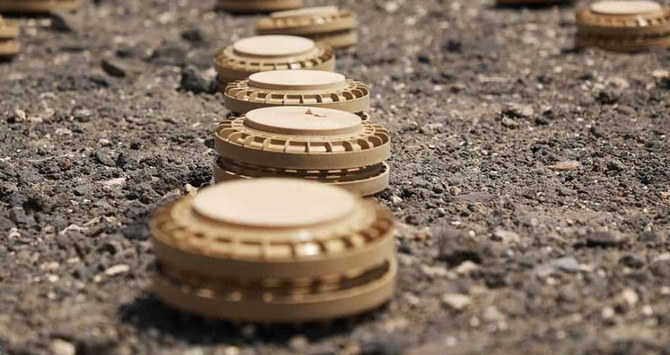
RIYADH: The Saudi Project for Landmine Clearance (Masam) dismantled 4,184 mines in Yemen during the fourth week of April, the Saudi Press Agency reported.
They comprised 314 anti-personnel mines, 2,995 anti-tank mines, 834 unexploded ordnances and 41 explosive devices.
Masam is one of several initiatives undertaken by Saudi Arabia on the directive of King Salman to help ease the suffering of the Yemeni people.
It is implemented by Saudi cadres and international experts to remove mines planted by Iran-backed Houthi militias in various Yemeni regions, especially Marib, Aden, Al-Jawf, Shabwa, Taiz, Hodeidah, Lahij, Sanaa, Al-Bayda, Al-Dhale, and Saada.
A total of 241,048 mines have been extracted since the start of the project. More than 1.1 million mines have been planted by the Houthis, claiming hundreds of civilian lives.
Masam has 32 demining teams, and aims to dismantle mines in Yemen to protect civilians and ensure that urgent humanitarian supplies are delivered safely.
It trains local demining engineers, gives them modern equipment and helps mine victims.
In 2020, Masam’s contract was extended for one year at a cost of $30 million.
Earlier, the director of Yemen’s National Mine Action Program thanked Saudi Arabia for clearing mines in Yemen.
Brig. Ameen Al-Aqeeli said mines and improvised explosive devices planted by the Iran-backed Houthi militia have so far killed more than 8,000 civilians in the country.
Al-Aqeeli called on the international community to pressure the Houthi militia to stop planting landmines, saying they have caused a humanitarian disaster in Yemen.


![]()


Landmine clearance project Masam clears 4,184 more mines in Yemen
Short Url
https://arab.news/6way6
Landmine clearance project Masam clears 4,184 more mines in Yemen


Saudi envoy to Spain discusses tourism cooperation with UNWTO chief
Saudi Ambassador to Spain Princess Haifa Al-Mogrin met with Shaikha Nasser Al-Nowais, secretary-general of the UN World Tourism Organization, at the organization’s headquarters in Madrid, on a courtesy visit following her assumption of office.
During the meeting, they exchanged views on the sustainable development of tourism and ways to strengthen cooperation in this area, the Saudi Embassy in Spain wrote in a post on X.
Meanwhile, Abdulmajeed Al-Samary, undersecretary of protocol at the Ministry of Foreign Affairs, received the credentials of Mohamed Amin Sheikh Osman, the newly appointed ambassador of Somalia to the Kingdom, the Foreign Ministry wrote in a post on X.


Latest updates


© 2026 SAUDI RESEARCH & PUBLISHING COMPANY, All Rights Reserved And subject to Terms of Use Agreement.