PM Khan urges Pakistani diplomats to improve services to expats

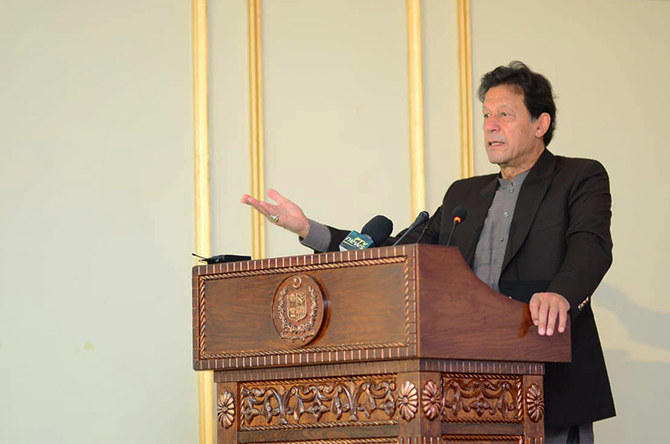
Pakistan's Prime Minister Imran Khan address a ceremony in Islamabad, Pakistan, on April 11, 2021. (Photo courtesy: PM Imran Khan/Facebook)
Short Url
Updated 05 May 2021
Follow

PM Khan urges Pakistani diplomats to improve services to expats

  • PM’s call comes in the wake of inquiry against the country’s embassy in Riyadh over complaints by expat Pakistani workers
  • Without remittances from overseas workers, the country would have run into bankruptcy, PM Khan says

ISLAMABAD: Pakistan Prime Minister Imran Khan on Wednesday called on the country’s diplomats to improve their services and support to overseas Pakistanis, a state-run news agency, Associated Press of Pakistan, reported.
The prime minister’s address to the envoys comes days after his office initiated a formal inquiry against the country’s embassy in Riyadh, suspended the outgoing ambassador to Saudi Arabia, and recalled several members of staff following complaints by expat Pakistani workers in the kingdom who said their embassy had mistreated them.
“It is unfortunate how we (embassy staff) deal with overseas Pakistanis. This is unacceptable. It cannot go on in this way during the current era. The embassies were duty-bound to serve the diaspora,” Khan said in an online conference with Pakistani ambassadors and chiefs of foreign missions.
“Overseas Pakistanis are our major strength. Pakistan is running on their remittances,” the PM said. “If they would not have been remitting, the country would have gone toward bankruptcy.”
Despite the coronavirus pandemic and ensuing lockdowns across the world, Pakistani workers’ remittances in March 2021 increased by 43 percent $2.7 billion compared with to the inflows in the same period last year.
The increasing inflows last month prompted Khan to thank to thank the foreign workers for the “record-breaking remittances.”
“You sent over $2 billion for 10 straight months despite COVID, breaking all records. We thank you,” he said. “The love and commitment of overseas Pakistanis to Pakistan is unparalleled.”
The inflows came mainly from Saudi Arabia, standing at $5.7 billion, the United Arab Emirates at $4.5 billion, Britain at $2.9 billion, and the US at $1.9 billion, according to central bank data.


Islamabad, Tehran to extend electricity supply agreement for Pakistan’s southwest

Updated 09 December 2025
Follow

Islamabad, Tehran to extend electricity supply agreement for Pakistan’s southwest

  • Tariffs to remain between 7.7–11.45 cents/kWh as Islamabad seeks stability for energy-short border regions
  • Iran currently powers Gwadar and other border towns where Pakistan’s national grid remains limited

ISLAMABAD: Pakistan and Iran have agreed to extend their cross-border electricity supply pact for the southwestern province of Balochistan, maintaining tariffs between 7.7 and 11.45 cents per kilowatt-hour, Pakistan’s energy ministry said on Tuesday.

The deal, first signed in 2002, underpins energy security for parts of southwestern Pakistan where the national grid remains underdeveloped and erratic supply has hampered both industry and residential consumption. Coastal towns like Gwadar and nearby Mand Town in Balochistan have for years relied on imported Iranian power as connectivity with Pakistan’s main transmission network is incomplete and local generation insufficient.

Iran currently exports 100 megawatts of electricity to Gwadar under a March 2023 agreement and could scale up deliveries once additional infrastructure is operational. In May 2023, Prime Minister Shehbaz Sharif and Iranian President Ebrahim Raisi jointly inaugurated the Polan–Gabd transmission line to enable another 100 MW of supply.

Energy ministry spokesperson Zafar Yab Khan confirmed the extension of the deal, saying it had been moved forward between the two governments.

“Yes, it is correct,” he told Arab News, adding that the revised agreement was expected to be placed before Pakistan’s Economic Coordination Committee (ECC).

However, the ECC, Pakistan’s top economic decision-making forum, did not take up the extension in its meeting on Tuesday.

Power trade between Iran and Pakistan has expanded gradually over two decades, with tariffs negotiated periodically to reflect fuel costs and cross-border infrastructure upgrades. In August 2023, the ECC approved amendments to a separate contract extending a 104-MW supply from Iran’s Jakigur district into Pakistan’s Mand town through December 2024.

Gwadar, a key node in the China-Pakistan Economic Corridor (CPEC), is expected to remain dependent on imported electricity until new domestic lines are completed, making continued Iranian supply critical for industries, port operations and basic household demand.