Prospects fading, Turkey hopes lockdown rescues tourism season

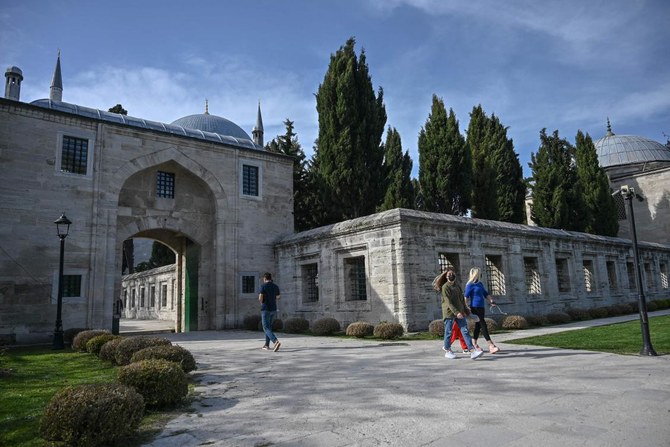
Tourists walk on the site of the Suleymaniye mosque in Istanbul, during a new lockdown aimed at fighting a surging third wave of COVID-19 infections. (AFP)
Short Url
Updated 03 May 2021
Follow

Prospects fading, Turkey hopes lockdown rescues tourism season

  • Lockdown through mid-May in part to rescue season
  • Early season COVID-19 rise hits tourism bookings

Turkey’s tourism sector faces another lost season after a rapid coronavirus rise wiped out many early foreign bookings and prompted Russia, its top source of visitors, to halt flights and warn against travel this summer.
In a last-ditch move to cut infections and save the season, President Tayyip Erdogan last week imposed a lockdown through mid-May in part, he said, so that European countries did not leave Turkey behind as they re-open beaches, restaurants and travel.
The foreign cash that tourists spend is critical to offset Turkey’s heavy foreign debt, but revenues plunged 65 percent last year when the pandemic first hit.
The tourism minister told Reuters that 30 million foreigners could arrive this year, twice as many as last, if the lockdown succeeds in lowering daily COVID-19 cases to below 5,000 from near 30,000 in recent days.
But travel agents, associations and hotels said they fear this year will be little better than last after the virus wave briefly ranked Turkey second globally in new cases just as the season kicked off, before it dropped back to fourth.
Some Turkish and Russian agents see a difficult few months until August, when they say the Mediterranean and Aegean hot spots and historic sites in Istanbul and elsewhere could fill up again. Much will depend on last-minute bookings, they said.
“The lockdown decision will probably not be able to save the season” because it was taken too late, said Cem Polatoglu, general manager at Istanbul-based Andiamo Tour.
Even if the lockdown cuts daily coronavirus cases to below 5,000 by the end of May, as the government hopes, he said it takes time for countries to remove travel warnings “which means probably losing July too.”
Coronavirus cases topped 60,000 last month, leaving Turkey’s top five tourist sources — Russia, Germany, Britain, Bulgaria and Iran — with travel warnings in place.
Ankara said Moscow’s decision to halt most flights until June 1 blocked 500,000 tourists, compared to a total of 2.1 million Russians who came last year and some 6 million before the pandemic.
The flight ban could be extended. Deputy Prime Minister Tatiana Golikova said last week Russian operators should not sell tours even after June 1 until authorities decide.
Yana Starostina, manager at Traveland agency in Moscow, said clients still want to go to Turkey but added she expects it won’t be possible until August.
Turkey’s foreign and health ministers are set to visit Moscow on May 12 to discuss travel.
Mediterranean tourist hubs are trying to lock in bookings despite a shifting map of travel warnings, local restrictions and vaccine rollouts.
Last week neighboring Greece lifted quarantine restrictions on more virus-free visitors, while Turkey will ditch virus test requirements for travelers from Britain, China, Ukraine and some others by mid-May.
Tourism accounts for some 12 percent of Turkey’s economy and was the hardest hit sector last year, even though virus-related curbs had been lifted by June.
Turkey’s current account deficit ballooned to $37 billion last year when tourists brought in only $12 billion, down from a record $35 billion in 2019.
Though arrivals were down 54 percent year-on-year in the first quarter, Tourism and Culture Minister Mehmet Ersoy said a sharp drop in coronavirus infections since April 21 was a hopeful sign that “drastic” lockdown measures were working.
“As of June 1, we will open the tourist season and if we can reduce the number of daily cases below 5,000, we maintain our target of 30 million tourists this year,” he told Reuters.
That sounds optimistic to others.
Polatoglu of Andiamo Tour expects only 6 million arrivals this year and said roughly half of Turkey’s 12,000 tour agents are already closed, many unable to repay government loans meant to ease pandemic fallout.
Bora Kok, sales manager at Bora Bora Boutique Hotel in Antalya on the Mediterranean, where tourism season usually starts in April, said the lockdown was overdue but welcome.
“If Russian tourists do not come, there will be serious bankruptcies and potential layoffs,” he said.
Erdogan’s government hopes the lockdown, a drive that has so far vaccinated 16 percent of the population, and a safe hotel certification program will propel last-minute bookings.
Aegean-based Peninsula Tours has had no more than 20 early reservations per day through March and April in its Dalaman region, compared to about 300 last year, said regional manager Ali Kirli. “Early booking has almost come to a halt.”
Turkish Hoteliers Federation Chairman Sururi Corabatir told Reuters: “We had hopes for 2021. But unfortunately the case numbers have not been at the desired levels.”


Over 3k flights cancelled across the Middle East after attack on Iran by the US, Israel

Updated 01 March 2026
Follow

Over 3k flights cancelled across the Middle East after attack on Iran by the US, Israel

RIYADH: US and Israeli strikes on Iran led to widespread airspace shutdowns in the Middle East, canceling and rerouting thousands of flights and paralyzing key international travel corridors.

Flight cancellations affected seven airports across the Middle East, including Dubai and Abu Dhabi in the UAE, Doha in Qatar, and Manama in Bahrain.

Emirates Airlines said in a statement: “Due to multiple regional airspace closures, Emirates has temporarily suspended all operations to and from Dubai, up until 1500 hrs UAE time on Monday, 2 March.”

A flydubai spokesperson said the situation is evolving, and the airline is closely monitoring developments while coordinating with authorities to adjust its flight schedule.

“Our teams are working diligently to implement comprehensive welfare for all affected customers. The safety of our passengers and crew remains our highest priority,” the spokesperson said.

He added: “We are currently experiencing a high volume of calls and appreciate our customers’ patience while our teams work to assist everyone as quickly as possible.”

Qatar Airways announced that the airport will remain closed until at least the morning of March 2.

“Qatar Airways flights to, and from, Doha have been temporarily suspended due to the closure of Qatari airspace,” the airline said.

It added: “Qatar Airways will resume operations once the Qatar Civil Aviation Authority announces the safe reopening of Qatari airspace.”

Saudia also said in an official statement that it had canceled a number of flights due to developments in the region and the closure of airspace.

The organization said the decision was taken in line with aviation safety and security standards, noting that its Emergency Coordination Center is closely monitoring developments with relevant authorities.

Saudia urged passengers to verify the status of their flights before heading to the airport and said guests would be notified of updates through the contact details associated with their bookings.

The carrier added that further information would be announced in a subsequent statement if available.

Air Arabia also said its flights were experiencing cancellations, delays, or rerouting as a result of the evolving situation and airspace closures.

Airlines cited airspace closures and safety concerns as the main reasons for flight disruptions, urging passengers to check official channels for updates as the situation develops.

Israeli airspace also remained closed on March 1st. Israeli airline El Al said it was preparing a recovery effort to bring home Israelis stranded abroad once the airspace reopened.

Travelers were either stranded or diverted to other airports on Feb. 28 after Israel, Qatar, Syria, and Iran as well as Iraq, Kuwait and Bahrain, closed their airspace.

After the UAE announced a temporary partial airspace closure, FlightRadar24 recorded no flights over the country.

The closures affected key hub airports in Dubai, Abu Dhabi, and Doha. Emirates, Qatar Airways, and Etihad, airlines that operate from these hubs, normally handle around 90,000 passengers daily, with even more traveling to other Middle Eastern destinations, according to aviation analytics firm Cirium.

Airports hit by attacks

Two airports in the UAE reported incidents as the government there condemned what it called a “blatant attack involving Iranian ballistic missiles” on Feb.28.

Dubai International Airport, the UAE’s largest and one of the world’s busiest, reported four injuries, while Abu Dhabi’s Zayed International Airport said a drone attack killed one person and injured seven others. Strikes were also reported at Kuwait International Airport.

Though Iran did not publicly claim responsibility, the scope of retaliatory strikes that Gulf nations attributed to Iran extended beyond the US bases that it previously said it would target.

Flight delays, cancellations are likely to continue

“For travelers, there’s no way to sugarcoat this,” said Henry Harteveldt, an airline industry analyst and president of Atmosphere Research Group.

“You should prepare for delays or cancellations for the next few days as these attacks evolve and hopefully end,” he added.

To avoid conflict zones, airlines are rerouting Middle East flights over Saudi Arabia, adding hours and fuel costs, which could push ticket prices higher if the tensions persist.

The extra flights will strain air traffic controllers in the Kingdom, who may need to slow traffic for safety. Meanwhile, countries that closed their airspace will lose out on overflight fees from passing airlines.

Mike McCormick, former head of air traffic control at the FAA and now a professor at Embry-Riddle Aeronautical University, said some countries may reopen parts of their airspace in the coming days once US and Israeli officials provide airlines with details on military flight zones and Iran’s missile capabilities.

“Those countries then will be able to go through and say, ok, we can reopen this portion of our space but we’ll keep this portion of our airspace closed,” McCormick said.

“So, I think what we’ll see in the next 24 to 36 hours is how the use of airspace evolves as the kinetic activity gets more well-defined and as the capability of Iran to actually shoot missiles and create additional risk is diminished due to the attacks,” he added.

But it is unclear how long the disruption to flight operations could last. For comparison, the Israeli and US attack on Iran in June 2025 lasted 12 days.