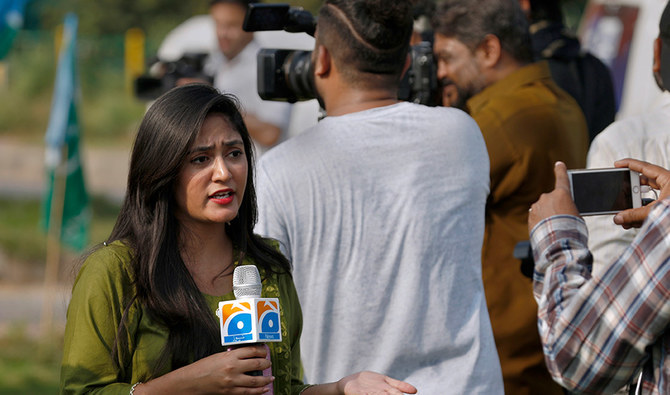
ISLAMABAD: The media is facing growing censorship, attacks and harassment in Pakistan that are threatening freedom of the press, a committee of journalists said Monday.
The government said there are no curbs on journalists in the country.
On Monday, President of Pakistan Federal Union of Journalists Shahzada Zulfiqar and Secretary-General Nasir Zaidi said freedom of the press is their hallmark and they “will not surrender this cause at any cost.” They said journalists were also facing cuts in pay and thousands had become jobless.
Mazhar Abbas, who often reports for Pakistan’s independent Geo Television, told The Associated Press that curbs on media and attacks on journalists increased in recent years. So far, he said, it’s not known whether the state has punished those linked to the abduction or harassment of journalists.
He said the country’s media regulatory body issued more than 12,000 notices to media people, newspapers, and news channels. Abbas said media in Pakistan was facing censorship for which the state uses different tactics, including telling media through the media regulatory body what can be reported and what cannot be reported. News channels are taken off air by the media regulatory body if press advice is not complied with, he said.
However, Fawad Chaudhry, Pakistan’s information minister, said in a statement that Pakistan’s government regards the freedom of the press as a “fundamental, democratic and constitutional right.”
He did not address the allegations by the leaders of the journalists’ association.
There were 148 documented attacks or violations against journalists in Pakistan from May 2020 to April 2021 — an increase over previous years, according to a tally by Dawn, a Pakistani English-language newspaper. It said these incidents included six murders, seven attempted assassinations, five kidnappings, 25 arrests or detentions of journalists, 15 assaults and 27 legal cases registered against journalists.
In an editorial marking World Press Freedom Day, the paper said the space for journalists in Pakistan was shrinking, and “a media in chains cannot hold the powerful to account and serve public interest as it is meant to do.”
In 2020, Pakistan ranked ninth on the Committee to Protect Journalists’ annual Global Impunity Index, which assesses countries where journalists are murdered regularly and their killers go free. According to the CPJ, Bangladesh, Russia and India are ahead of Pakistan. Although the Pakistan government says it supports freedom of speech, rights activists often accuse Pakistani state institutions of harassing and attacking journalists.


Pakistani journalists’ group vows to fight for press freedom
https://arab.news/nxsjr
Pakistani journalists’ group vows to fight for press freedom

- 148 documented attacks or violations against journalists in Pakistan from May 2020 to April 2021
- Information minister says government regards press freedom as "fundamental, democratic, constitutional right"

Pakistan says responding to Afghan ‘offensive operations’ after border fire as tensions escalate
- Afghan Taliban spokesperson says “large-scale offensive operations” launched against Pakistani military bases
- Pakistan says Afghan forces opened “unprovoked” fire across multiple sectors along shared border
ISLAMABAD: Afghanistan’s Taliban authorities said on Thursday they had launched “large-scale offensive operations” against Pakistani military bases and installations, prompting Pakistan to say its forces were responding to what it described as unprovoked fire along the shared border.
The escalation follows Islamabad’s weekend airstrikes targeting what it said were Tehreek-e-Taliban Pakistan (TTP) and Daesh militant camps inside Afghanistan in response to a wave of recent bombings and attacks in Pakistan. Islamabad said the strikes killed over 100 militants, while Kabul said dozens of civilians were killed and condemned the attacks as a violation of its sovereignty.
In a post on social media platform X, Afghan government spokesperson Zabihullah Mujahid said Afghanistan had launched “large-scale offensive operations” in response to repeated violations by the Pakistani military.
Pakistan’s Ministry of Information said Afghan forces had initiated hostilities along multiple points of the frontier.
“Afghan Taliban regime unprovoked action along the Pakistan–Afghanistan border given an immediate, and effective response,” the ministry said in a statement.
The statement said Pakistani forces were targeting Taliban positions in the Chitral, Khyber, Mohmand, Kurram and Bajaur sectors, claiming heavy Afghan casualties and the destruction of multiple posts and equipment. It added that Pakistan would take all necessary measures to safeguard its territorial integrity and the security of its citizens.
Separately, security officials said Pakistani forces had carried out counterattacks in several border sectors.
“Pakistan’s security forces are giving a befitting reply to the unprovoked Afghan aggression with full force,” a security official said, declining to be named.
“The Pakistani security forces’ counter-attack destroyed Taliban’s hideouts and the Khawarij fled,” they added, referring to TTP militants.
The claims from both sides could not be independently verified.
Cross-border violence has intensified in recent weeks, with Pakistan blaming a surge in suicide bombings and militant attacks on militants it says are based in Afghanistan. Kabul denies providing safe havens to anti-Pakistan militant groups.
The clashes mark the third major escalation between the neighbors in less than a year. Similar Pakistani strikes last year triggered weeklong clashes before Qatar, Türkiye and other regional actors mediated a ceasefire in October.
The 2,600-kilometer (1,600-mile) frontier, a key trade and transit corridor linking Pakistan to landlocked Afghanistan and onward to Central Asia, has faced repeated closures amid tensions, disrupting commerce and humanitarian movement. Trade between the two nations has remained closed since October 2025.


