Turkey facing ‘exodus’ after asylum requests surge 506%

Experts said that the mass exodus is mainly connected to economic hardship and a systematic crackdown on freedom of expression and democracy. (Reuters)
Short Url
Updated 03 May 2021
Follow

Turkey facing ‘exodus’ after asylum requests surge 506%

  • Brain drain triggered by inequality, repression and nepotism, experts warn

ANKARA: A brain drain and youth exodus from Turkey have become increasing points of debate in the country after two TikTok users were recently arrested for posting a satirical video about the inability of young Turks to travel abroad amid the pandemic.

The two 23-year-old users seemingly irked Turkish authorities, and were accused of “openly insulting the state’s sovereign insignia” in the satirical clip.
In Turkey, where even humor has become an inexcusable act for some authorities, an increasing number of citizens are choosing to move abroad, recent statistics show.
The latest data by the European Statistical Office shows that Turkish asylum requests to Europe have increased by 506 percent since 2019.
Experts said that the mass exodus is mainly connected to economic hardship and a systematic crackdown on freedom of expression and democracy.
Turks seeking safe haven in Europe ranked fifth in applications for asylum, immigration and temporary protection to EU countries, ranking just after Syrians, Venezuelans, Afghans and Iraqis.
In the same statistics, Turkey was followed by Somalia, Eritrea, Iran, Nigeria and Pakistan.
About 2,995 Turks applied for asylum in EU countries in 2015, but in 2020, the number soared to 18,145.
The trend has escalated in recent years, especially with regards to white-collar, well-educated youth trying to build new lives and new futures in EU countries, most notably Germany, where most Turks applied for protection and asylum.
The large-scale brain drain has been triggered by the “democratic downgrading” in the country, as well as by deterioration in the standard of living, experts say, with most young Turks unable to see a future for themselves in the country.

FASTFACTS

• Turks seeking safe haven in Europe ranked fifth in applications for asylum, immigration and temporary protection to EU countries, ranking just after Syrians, Venezuelans, Afghans and Iraqis.

• In the same statistics, Turkey was followed by Somalia, Eritrea, Iran, Nigeria and Pakistan.

• About 2,995 Turks applied for asylum in EU countries in 2015, but in 2020, the number soared to 18,145.

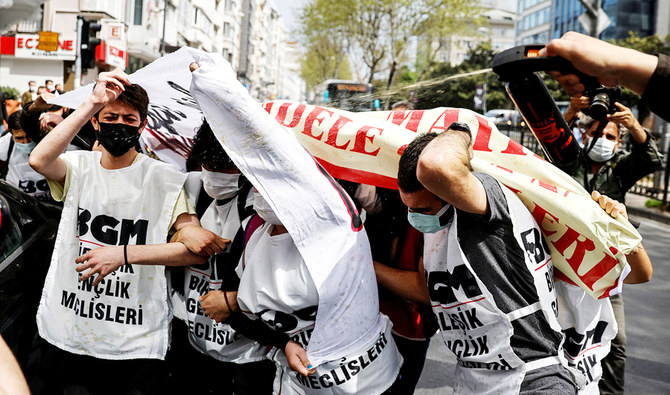
Recent protests by university students against the politically appointed rector to the country’s prestigious Bogazici University, as well as the abrupt Turkish withdrawal from the Council of Europe’s Istanbul Convention that protects women and girls from domestic violence has further triggered an “emotional break” of young people.
Decreased quality in higher education, diminished possibilities for upward social mobility and widespread nepotism in the labor market have also pushed young people toward hopelessness and anger.
Turkey ranks 153rd in the Reporters Without Borders’ 2021 World Press Freedom Index that was announced on April 17.
The country also tops the list of Council of Europe member countries that receive the most judgments in terms of violations of freedom of expression.
In a recent report, the World Bank found that Turkey’s poverty level rose from 10.2 percent in 2019 to 12.2 percent in 2020. With inflation standing at about 12 percent, the youth unemployment rate in the country is estimated to be as high as 22 percent.
According to official Turkish statistics, in 2019, about 330,289 Turks migrated to Europe, the US and other countries, with the majority being aged between 25 and 29.
Turkey has the largest youth population in Europe — numbering almost 13 million people.
A survey conducted by the Istanbul-based Foundation for Social Democracy (SODEV) last year also revealed that Turkish youth increasingly tend to live abroad.
The survey was carried out across 12 provinces with 600 people aged between 15 and 25. About 62.5 percent of respondents said that they would prefer to live abroad if given a choice.
“Many young people want to emigrate, but those who can afford it can go to the European countries,” Ertan Aksoy, SODEV chairman, told Arab News.
According to Aksoy, young people face trouble expressing themselves for fear of facing criminal proceedings or being imprisoned on charges of insulting a public authority.
“They prefer going to countries where they will live freely and be able to self-accomplish,” he said.
Aksoy added that inequality in the job market has also alienated young people in Turkey.
“Despite having received a high-quality education, they realize that those who are not as qualified as them reach higher scales in the labor market. They even take the risk of working in low-paid jobs in Europe just to be able to live abroad with their fundamental rights being under effective state protection,” he said.


Gaza’s Nasser Hospital condemns move by MSF to suspend most services

Updated 16 sec ago
Follow

Gaza’s Nasser Hospital condemns move by MSF to suspend most services

  • On Saturday, MSF said the security breaches, arrests and intimidation put staff and patients at serious risk
  • Nasser Hospital rejects the claims, and says civilian police are inside to protect patients and staff
CAIRO: One of Gaza’s last functioning large hospitals condemned the move by an international organization to pull out of operations over concerns about armed men, claiming on Sunday that the hospital had installed civil police for security. The move comes as at least 10 Palestinians were killed in clashes with the Israeli military in Gaza.
Doctors Without Borders, also known by its acronym MSF, said in a statement Saturday that all its noncritical medical operations at Nasser Hospital were suspended due to security breaches that posed “serious” threats to its teams and patients. MSF said there had been an increase in patients and staff seeing armed men in parts of the compound since the US-brokered October ceasefire was reached.
Nasser Hospital said Sunday that the increase in armed men was due to a civilian police presence aimed at protecting patients and staff and said MSF’s “allegations are factually incorrect, irresponsible, and pose a serious risk to a protected civilian medical facility.”
Nasser Hospital one of few functioning hospitals left in Gaza
Nasser Hospital in Khan Younis is one of the territory’s few functioning hospitals. Hundreds of patients and war-wounded have been treated there daily, and the facility was a hub for Palestinian prisoners released by Israel in exchange for Israeli hostages as part of the current ceasefire deal.
“MSF teams have reported a pattern of unacceptable acts including the presence of armed men, intimidation, arbitrary arrests of patients and a recent situation of suspicion of movement of weapons,” the organization said. The suspension occurred in January but was only recently announced.
Nasser Hospital staff say that in recent months it has been repeatedly attacked by masked, armed men and militias, which is why the presence of an armed civilian police force is crucial. Hamas remains the dominant force in areas not under Israeli control, including in the area where Nasser Hospital is located. But other armed groups have mushroomed across Gaza as a result of the war, including groups backed by Israel’s army in the Israeli-controlled part of the strip.
Throughout the war, which began with the Hamas-led attack on Israel on Oct. 7, 2023, Israel has repeatedly struck hospitals, including Nasser, accusing the militant group of operating in or around them. Hamas security men often have been seen inside hospitals, blocking access to some areas.
Some hostages released from Gaza have said they spent time during captivity in a hospital, including Nasser Hospital.
Ten Palestinians killed in strikes across Gaza
At least 10 Palestinians were killed Sunday by Israeli fire in the Gaza Strip, hospital authorities said.
The dead include five men, all in their 20s, who were killed in an Israeli strike in the eastern part of Khan Younis city, according to the Nasser Hospital, which received the bodies. The strike hit a group of people in an area close to the Yellow Line which separates Israeli-controlled areas from the rest of Gaza, it said.
The Israeli military did not comment on the strike but has said in the past it will attack militants if its troops are threatened, especially near the Yellow Line.
Rami Shaqra said his son, Al-Baraa, was among the militants who were securing the area from potential attacks by the Israeli forces or Israeli-backed armed groups, when they were hit by the Israeli military. He said that they were killed by an airstrike.
Associated Press footage from the morgue showed at least two of the men had headbands denoting membership in the Qassam Brigades, the militant arm of Hamas. In northern Gaza, a drone strike hit a group of people in the Falluja area of Jabaliya refugee camp, killing five people, according to the Shifa Hospital.
The Israeli military said it was striking northern Gaza in response to several ceasefire violations near the Yellow Line, including militants attempting to hide in debris and others who attempted to cross the line while armed.
The Oct. 10 US-brokered ceasefire deal attempted to halt a more than two-year war between Israel and Hamas. While the heaviest fighting has subsided, the ceasefire has seen almost daily Israeli fire.
Israeli forces have carried out repeated airstrikes and frequently fire on Palestinians near military-held zones, killing 601 Palestinians, according to Gaza health officials. The ministry, which is part of the Hamas-led government, maintains detailed casualty records that are seen as generally reliable by UN agencies and independent experts. But it does not give a breakdown of civilians and militants.
Militants have carried out shooting attacks on troops, and Israel says its strikes are in response to that and other violations. Four Israeli soldiers have been killed.