

How Saudi-Greek intelligence sharing delivered a big blow to Hezbollah’s drug operations

1 / 2
2 / 2
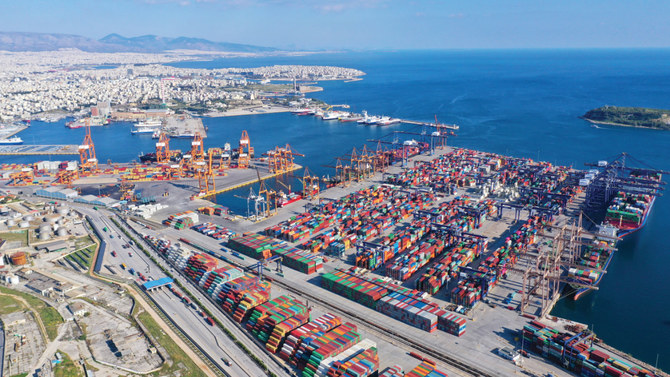
The commercial port of Piraeus, Greece, where assistance from the Saudi drug enforcement agency has led to a major narcotics bust. (Shutterstock)
Short Url
Updated 03 May 2021
Follow

How Saudi-Greek intelligence sharing delivered a big blow to Hezbollah’s drug operations

  • Discovery of processed cannabis at main port of Piraeus viewed as fruit of expanding bilateral cooperation
  • Help provided by Saudi Arabia demonstrates the potential in intelligence exchange for common purposes

ATHENS: The assistance recently provided to Greek authorities by the drug-enforcement agency of Saudi Arabia (GNDC/SA), which led to the discovery of a huge shipment of processed cannabis at Greece’s main port of Piraeus, marks a new chapter in expanding bilateral cooperation between Athens and Riyadh.

The two countries have shown willingness to boost their defense ties, but this specific case shows that cooperation on intelligence issues can be critical.

“The help provided by Saudi Arabia to Greek authorities in seizing tons of cannabis exhibits the potential in exchanging intelligence information for common purposes,” George Tzogopoulos, senior fellow at the Institute of European and International Studies and research associate at the Begin-Sadat Center for Strategic Studies, told Arab News.

The SDOE, Greece’s financial crimes squad, said the drugs were uncovered following a tip-off from the US Drug Enforcement Agency. The shipping container, whose registered contents were three industrial cupcake-making machines, arrived by sea from Lebanon on April 14.
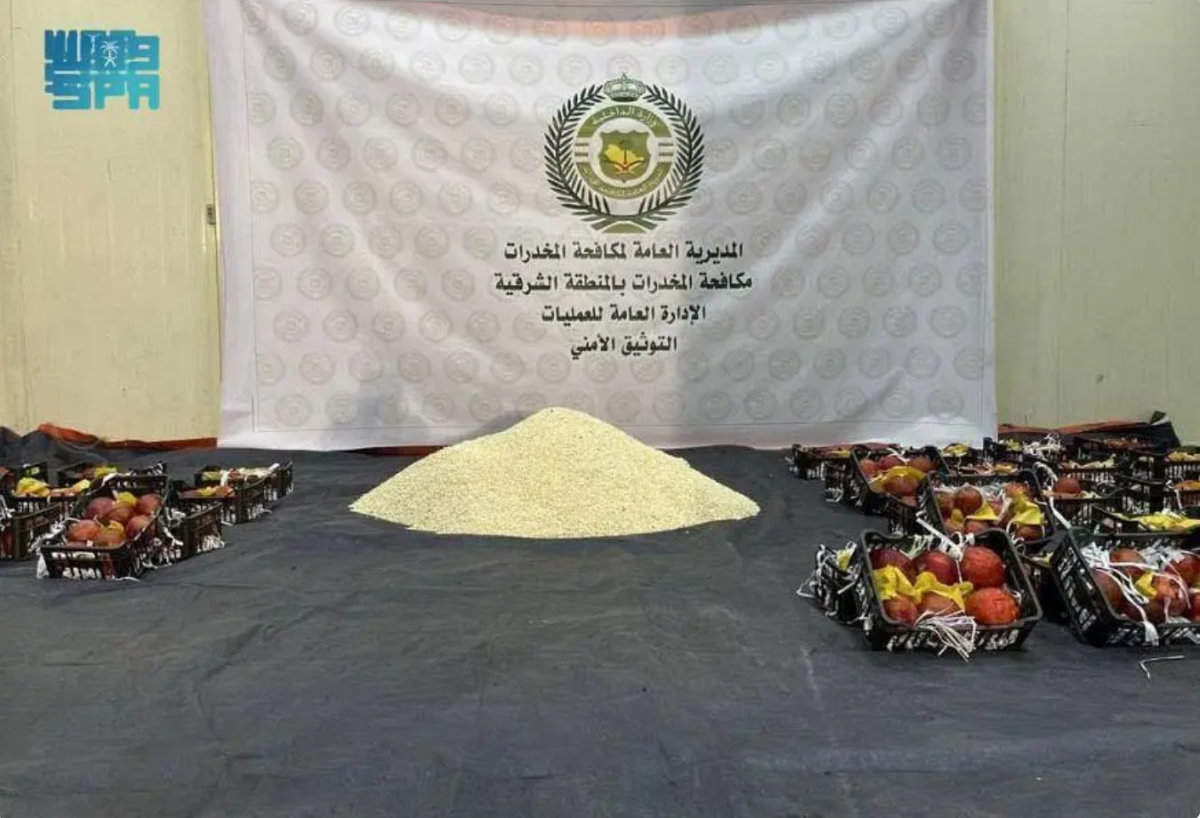


Cooperation between Saudi and Greek anti-narcotics units have resulted in the busting of massive amounts of drugs smuggle from Lebanon. (SPA photo)

It has been scheduled for departure by rail to Bratislava, Slovakia a few days later, passing through North Macedonia, Serbia and Hungary.

Greek authorities raided the container on April 16 and uncovered 4.3 tons of processed cannabis hidden inside a compartment built into a metal tank among the machinery.

According to some estimates, the seized narcotics had a potential street value of €33 million (almost $39.6 million).
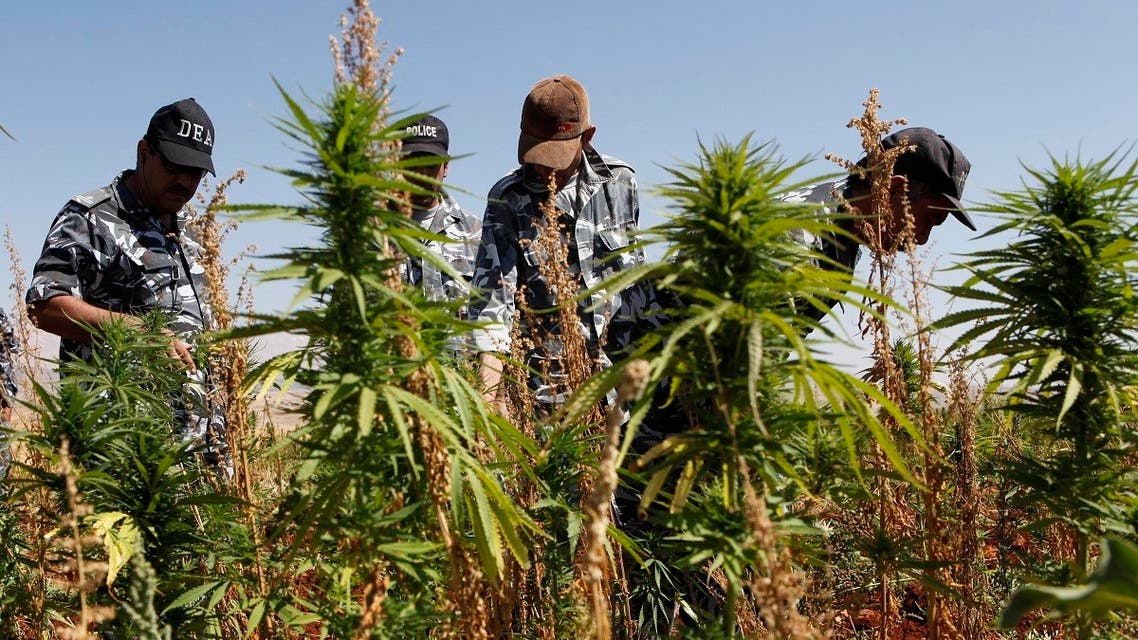


Lebanese anti-narcotics police destroy cannabis plants in the village of Bouday, at the eastern Bekaa Valley near the ancient city of Baalbek. (AP)

This is not the first time Greek and Saudi authorities have worked together to seize large quantities of drugs transported out of Lebanon.

In January 2020, the Greek financial crimes squad worked with GNDC/SA to uncover almost 1.3 tons of processed cannabis hidden in a container at Piraeus destined for Misrata, Libya.

“Greece traditionally enjoys warm relations with Arab countries,” said Tzogopoulos.
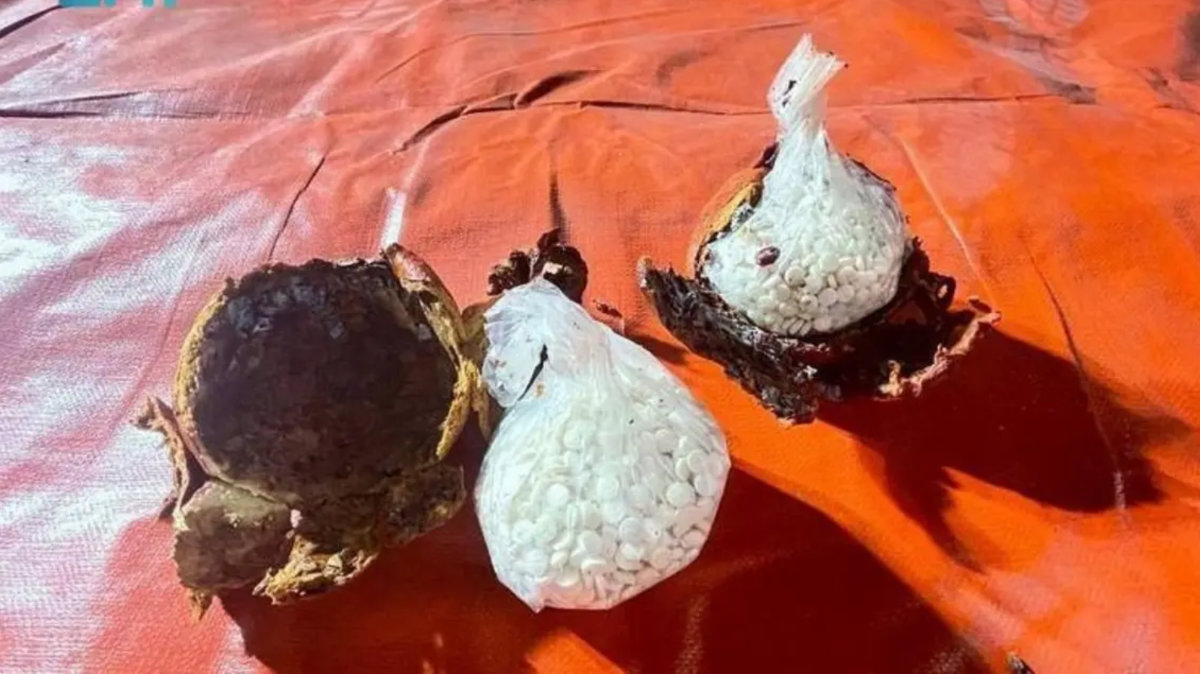


Drug smugglers keep changing their tactics to stay ahead of anti-narcotics teams around ther world. (SPA photo)

He added: “In this respect, ties with Gulf countries and with Saudi Arabia have been strengthened and they recently reached new heights with the visit of Foreign Minister Nikos Dendias and Defense Minister Nikos Panagiotopoulos to Riyadh. The nature of the developing collaboration allows the two countries to embark on various projects of common interest.”

Intelligence cooperation comes as a natural continuation of blossoming defense ties. In March, six F-15 fighter jets of the Royal Saudi Air Force, their crews and supporting technicians arrived on the Greek island of Crete to take part in a major joint air drill, Falcon Eye 1, over the Mediterranean.

During their recent visit to Riyadh, Dendias and Panagiotopoulos announced the deployment of a Patriot-2 air defense missile system (accompanied by 130 personnel) to help defend Saudi Arabia’s energy infrastructure, repeatedly targeted in ballistic missile and drone attacks carried out by the Iran-backed terrorist Houthi militia in Yemen.


US presses missile issue as new Iran talks to open in Geneva

Updated 59 min 9 sec ago
Follow

US presses missile issue as new Iran talks to open in Geneva

  • New round of negotiations in Geneva comes after the US carried out a massive military build-up in the region
  • The dispute between the countries mostly revolves around Iran’s nuclear program

GENEVA: The United States and Iran are set to hold indirect talks in Switzerland on Thursday aiming to strike a deal to avert fresh conflict and bring an end to weeks of threats.
The new round of negotiations in Geneva comes after the US carried out a massive military build-up in the region and President Donald Trump repeatedly threatened to strike Iran if a deal is not reached.
In his State of the Union address on Tuesday, Trump accused Iran of “pursuing sinister nuclear ambitions.”
He also claimed Tehran had “already developed missiles that can threaten Europe and our bases overseas, and they’re working to build missiles that will soon reach the United States of America.”
The Iranian foreign ministry called these claims “big lies.”
The maximum range of Iran’s missiles is 2,000 kilometers (1,200 miles) according to what Tehran has publicly disclosed. However the US Congressional Research Service estimates they top out at about 3,000 kilometers — less than a third of the distance to the continental United States.
The dispute between the countries mostly revolves around Iran’s nuclear program, which the West believes is aimed at building an atomic bomb but Tehran insists is peaceful.
However the US has also been pushing to discuss Iran’s ballistic missile program, as well as Tehran’s support for armed groups hostile toward Israel.
Secretary of State Marco Rubio warned that Iran must also negotiate on its missile program, calling Tehran’s refusal to discuss ballistic weapons “a big, big problem” on the eve of the talks.
He followed up by saying “the president wants diplomatic solutions.”
Iran has taken anything beyond the nuclear issue off the negotiating table and has demanded that the US sanctions crippling its economy be part of any agreement.
‘Neither war nor peace’
Iranian President Masoud Pezeshkian said on Wednesday he had a “favorable outlook for the negotiations” that could finally “move beyond this ‘neither war nor peace’ situation.”
Foreign Minister Abbas Araghchi, who is leading the Iranian delegation at the talks, has called them “a historic opportunity,” adding that a deal was “within reach.”
In a foreign ministry statement that followed a meeting with his Oman counterpart, Araghchi said the success of the US negotiations depend “on the seriousness of the other side and its avoidance of contradictory behavior and positions.”
The US will be represented by envoy Steve Witkoff and Jared Kushner, who is married to Trump’s daughter Ivanka.
The two countries held talks earlier this month in Oman, which is mediating the negotiations, then gathered for a second round in Geneva last week.
A previous attempt at negotiations collapsed when Israel launched surprise strikes on Iran last June, beginning a 12-day war that Washington briefly joined to bomb Iranian nuclear sites.
In January, fresh tensions between the US and Iran emerged after Tehran engaged in a bloody crackdown on widespread protests that have posed one of the greatest challenges to the Islamic republic since its inception.
Trump has threatened several times to intervene to “help” the Iranian people.
Emile Hokayem, senior fellow for Middle East security at the International Institute for Strategic Studies, said that “the region seems to expect a war at this point.”
In January, there was “a big push by a number of Middle Eastern states to convince the US not to” strike Iran.
“But there’s a lot of apprehension at this point, because the expectation is that this time” a war would be “bigger” than the one in June.
Tehran residents who spoke to AFP were divided as to whether there would be renewed conflict.
Homemaker Tayebeh noted that Trump had “said that war would be very bad for Iran.”
“There would be famine and people would suffer a lot. People are suffering now, but at least with war, our fate might be clear,” the 60-year-old said.