

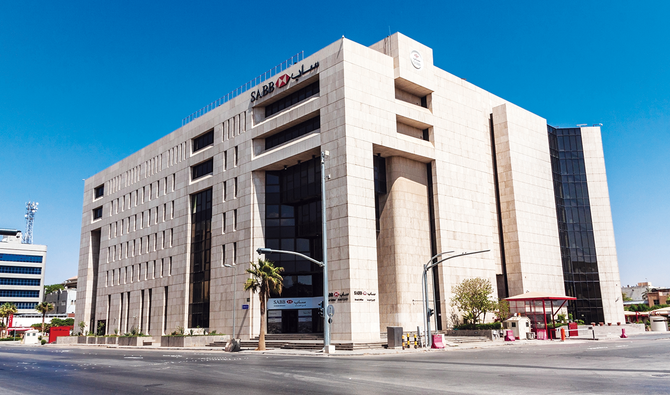
SABB reports net profit of $259m for Q1

The Saudi British Bank operates under the Saudi Central Bank’s supervision and control. SABB was established in 1978 as a Saudi joint stock company.
Short Url
Updated 01 May 2021
Follow

SABB reports net profit of $259m for Q1

The Saudi British Bank (SABB) recorded a net profit after Zakat and income tax of SR970 million ($259 million) for the three months ending March 31. This is a decrease of SR1 million or 0.1 percent compared to SR971 million for the same period in 2020. 

The operating income was SR2.01 billion for the three months ending March 31, a decrease of SR361 million or 15 percent, compared to SR2.37 billion for the same period in 2020.

The loans and advances stood at SR156.7 billion on March 31, an increase of SR1.5 billion or 1 percent from SR155.2 billion on March 31, 2020.

The customers’ deposits amounted to SR183.7 billion for the first quarter of 2021, a decrease of SR4.6 billion or 2.4 percent compared with SR188.3 billion for the same period last year.

The investments stood at SR63.2 billion on March 31, an increase of SR2.7 billion or 4.4 percent from SR60.5 billion on March 31, 2020.

The total assets were SR271.6 billion, an increase of SR5.9 billion or 2.2 percent from SR265.7 billion on March 31, 2020.

The earnings per share of SR0.47 remained stable compared to the corresponding period of the previous year.

Lubna Suliman Olayan, board chair of SABB, said: “As the first quarter of 2021 drew to a close, we completed the last major milestone of the process of integrating SABB and Alawwal bank — ‘Customer Day 1’ — the migration of our retail customers previously served through the Alawwal bank channels onto SABB’s infrastructure. So from March 14 onwards all of our customers — retail, corporate and institutional — are enjoying the same single, seamless quality experience, underpinned by SABB’s systems and infrastructure.

“SABB’s financial performance remained resilient during a period of continued economic challenges posed by the persistence of the global pandemic and heightened competition domestically. Despite these challenges, our lending to customers grew, our funding, liquidity and capital levels remained strong, our costs stayed well controlled, and our cost of credit risk remained low.” She added: “Having delivered a positive return for shareholders in the first quarter, we shall continue to build and remain fully focused on executing our strategic plan and supporting the national economic transformation goals of Vision 2030. The board remains excited about that strategic plan and its ambitious outcomes for our customers, shareholders, staff, and community.” 

Olayan also bid farewell to the outgoing CEO of SABB and welcomed the new chief.

“As he nears his retirement in the second quarter of 2021, we are especially grateful to David Dew for his leadership of SABB over these many years, well positioning the bank to achieve those ambitious outcomes under the leadership of our new CEO, Tony Cripps. I have no doubt that under Tony’s leadership, combined with the support of our management team and board, SABB will deliver those outcomes. As we begin this second quarter, we remain grateful to our customers, management team, staff and shareholders for their continued support and commitment, and to our regulators and government ministries for their continued guidance and vision,” she said.


Kuwait Fund for Arab Economic Development helps combat tropical diseases in Africa

Updated 15 December 2025
Follow

Kuwait Fund for Arab Economic Development helps combat tropical diseases in Africa

The Kuwait Fund for Arab Economic Development is a leading contributor to health and development initiatives in many developing countries, especially in Africa, where tropical and neglected diseases continue to threaten public health and economic resilience. Through financing, technical support, and long-term development strategies, the fund plays a central role in strengthening health infrastructure, improving healthcare access, and supporting global efforts to reduce the burden of infectious and neglected tropical diseases.

KFAED’s approach combines infrastructure development — such as constructing and equipping hospitals and health centers — with broader public-health support including vaccination programs, awareness campaigns, and distribution of essential medical supplies. These efforts raise healthcare standards, lower infection and mortality rates, and contribute to sustainable social and economic development across vulnerable regions.

Disease burden in Africa

More than 2 billion people worldwide suffer from tropical diseases, including nearly 500 million children. Africa bears over 40 percent of this burden, with diseases such as malaria, HIV/AIDS, tuberculosis, lymphatic filariasis, and cholera causing severe humanitarian and economic consequences. In addition, a group known as neglected tropical diseases disproportionately impacts the poorest communities, resulting in chronic disability, disfigurement, and death. The WHO estimates that around 700 million people in Africa alone are infected with one or more NTDs.

High infection rates are driven by limited access to preventive care, exposure to contaminated water due to inadequate sanitation, weak healthcare systems, and conditions of fragility, conflict, and displacement. These challenges impede disease control and strain national health programs.

International cooperation to combat NTDs

In response, global institutions have mobilized to support African countries in controlling and eliminating NTDs. Research identified five diseases that can be effectively controlled through mass-treatment programs: lymphatic filariasis, river blindness (onchocerciasis), schistosomiasis, soil-transmitted helminths, and trachoma.

The NTD program now spans 47 African countries, with 36 affected by all five diseases. Each year, 300–400 million people receive treatment, and 700–800 million tablets are donated by pharmaceutical manufacturers. Despite this, only about 30 percent of infected individuals currently receive the required care, largely because many live in remote areas. Delivery depends heavily on volunteer networks and regional and local organizations.

The NTD program

The NTD program strengthens national disease-control efforts through clinical, logistical, and research support. It assists governments in developing strategic plans, conducting epidemiological studies, mapping disease distribution, evaluating program impact, and coordinating awareness and prevention campaigns. The World Health Organization oversees administrative and technical operations in partnership with several global bodies. Funding flows either directly from donors to field agencies or through pooled trust funds managed by institutions such as the World Bank and WHO.

The program targets five high-impact diseases:

  1. Lymphatic filariasis (elephantiasis): A parasitic disease transmitted by mosquitoes, affecting around 900 million people worldwide. Africa accounts for roughly 30 percent of cases, with more than 400 million people at risk.
  2. River blindness (onchocerciasis): Caused by filarial worms transmitted by blackflies, leading to blindness and chronic skin disease. About 250 million people are infected globally, 90 percent of them in Africa.
  3. Schistosomiasis (bilharzia): A waterborne disease affecting the digestive system and liver. Around 300 million people are infected worldwide, 90 percent in Africa.
  4. Soil-transmitted helminths: Parasitic worms transmitted through contaminated soil. Around 1.5 billion people worldwide are at risk, with over 290 million Africans requiring annual treatment.
  5. Trachoma: A bacterial eye infection that can cause irreversible blindness. About 2.2 million people globally suffer vision impairment due to trachoma, with nearly 185 million living in at-risk areas in Africa.

These diseases were selected due to the availability of free preventive medications, accessible field-survey tools, the ability to deliver multiple treatments simultaneously, and strong governmental commitment within affected countries.

Funding and global partnerships

KFAED is among the earliest and most consistent supporters of the NTD program. It contributed $5 million during Phase 1 (2016–2020) and another $5 million for Phase 2 (2024–2028). Other contributors include the World Bank, Bill and Melinda Gates Foundation, African Development Bank, USAID, the UK Department for International Development, pharmaceutical companies, NGOs, and African governments.

Kuwait Fund’s long-term role in Africa

Since 1974, the Kuwait Fund has financed multiple disease-control programs across Africa, particularly targeting river blindness. Its investments include:

  • First Onchocerciasis Control Program: Covering 11 West African countries.
  • Second Onchocerciasis Control Program: Supporting 20 additional countries in Central, Eastern, and Southern Africa.

Beyond NTD programs, the fund has provided more than $23 million in grants and technical assistance for global health initiatives, including the Guinea Worm Eradication Program, Roll Back Malaria, the Global Fund to Fight AIDS, Malaria and Tuberculosis, and national programs combating transboundary animal diseases.

KFAED has also financed over 70 health-sector projects worth approximately 196.7 million Kuwaiti dinars ($630 million), enhancing infrastructure, equipment, and healthcare access across many developing countries — most of them in Africa.