

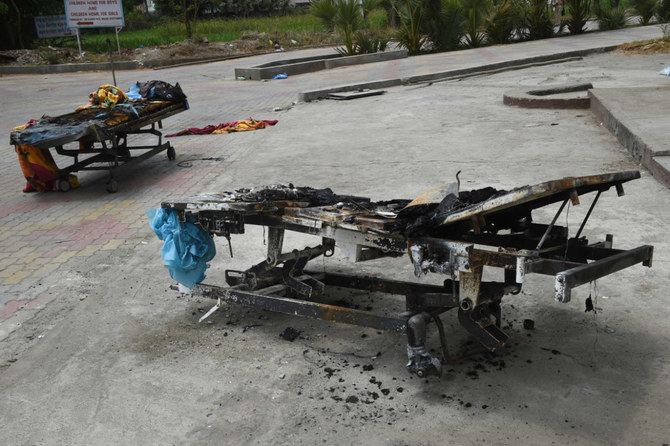
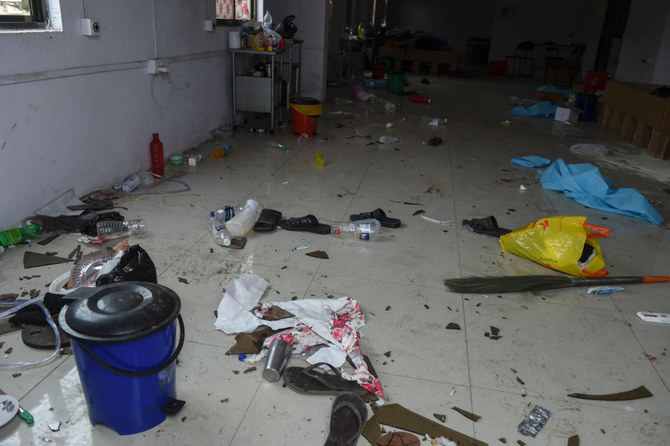


NEW DELHI: A fire in a COVID-19 hospital ward in western India killed 18 patients early Saturday, as the country grappling with the worst outbreak yet stepped up a vaccination drive for all adults even as some states said they don’t have enough jabs.
India on Saturday set yet another daily global record with 401,993 new cases, taking its tally to more than 19.1 million. Another 3,523 people died in the past 24 hours, raising the overall fatalities to 211,853, according to the Health Ministry. Experts believe both figures are an undercount.
The fire broke out in a COVID-19 ward on the ground floor of the Welfare Hospital in Bharuch, a town in Gujarat state, and was extinguished within an hour, police said. The cause is being investigated.
Thirty-one other patients were rescued from the blaze by hospital workers and firefighters and their condition was stable, said police officer B.M Parmar. Late last month, a fire in an intensive care unit killed 13 COVID-19 patients in the Virar area on the outskirts of Mumbai.
India’s government on Saturday shifted its faltering vaccination campaign into high gear by saying all adults 18 and over could get shots. Since January, nearly 10% of Indians have received one dose, but only around 1.5% have received both, although India is one of the world’s biggest producers of vaccines.
Some states have already said they don’t have enough doses for everyone, and even the ongoing effort to inoculate people above 45 is sputtering.
The state of Maharashtra has said it won’t be able to start the expanded vaccinations on Saturday. The health minister for the capital New Delhi, Satyender Jain, said earlier this week that the city doesn’t have enough doses to vaccinate people between the ages of 18 and 44.
India’s capital also extended its week-old lockdown by another week to curb the explosive surge in virus cases, tweeted Arvind Kejriwal, a top elected official.
All shops and factories will remain closed until May 9, except for those that provide essential services such as grocery stores. People are not supposed to leave their homes, except for a handful of reasons like seeking medical care or going to the airport or railroad stations. Daily wage earners and small businesses are expected to suffer a further blow to their livelihoods.
Separately, 12 COVID-19 patients, including a doctor, on high-flow oxygen died Saturday at a hospital in New Delhi after it ran out of the supply for 80 minutes, said S.C.L. Gupta, director of Batra Hospital.
Gupta said the hospital has been facing irregular oxygen supply from manufacturers for more than a week, but it exhausted it completely for the first time.
He said the hospital tank was refilled with enough oxygen for 12 hours and it will again be looking for replenishment.
The New Delhi television news channel also said an attorney for the Batra hospital complained to a New Delhi court that is hearing petitions by several hospitals on the issue.
Hospitals in the Indian capital have been complaining of emergencies caused by irregular oxygen supplies from manufacturers due to the sudden rise in demand caused by the massive spike in infections.
Faced with an unprecedented COVID-19 surge that has filled hospitals and crematoriums, Prime Minister Narendra Modi’s government described the pandemic as a “once-in-a-century crisis.” Modi held a Cabinet meeting Friday that discussed steps to save the country’s crumbling health system by adding hospital beds, resolving issues in production, storage and transport of oxygen and tackling the shortage of essential medicines.
In a now-familiar scene, television images showed a woman gasping for breath in her car while her family looked for a hospital bed on the outskirts of New Delhi. The 33-year-old woman couldn’t find room at three hospitals and died in the car on Friday, The Times of India newspaper reported.
Opposition Congress leader Rahul Gandhi said the Modi government completely failed to understand how to tackle the pandemic, right from the very beginning, despite repeated warnings from scientists and experts.
“They continuously ignored rising cases and were busy instead with election campaigns. They encouraged super-spreader events,” Gandhi said in an interview with the Press Trust of India news agency.
The US meanwhile joined a growing list of countries restricting travel from India, the White House said, citing the devastating rise in COVID-19 cases and the emergence of potentially dangerous variants.
President Joe Biden spoke Monday with Modi about the growing health crisis and pledged to immediately send assistance. This week, the US began delivering therapeutics, rapid virus tests and oxygen to India, along with some materials needed for India to boost its domestic production of COVID-19 vaccines.
Additionally, a CDC team of public health experts was expected to be on the ground soon to help Indian health officials move to slow the spread of the virus.
Other nations have also sent assistance, and the Indian air force airlifted oxygen containers from Singapore, Dubai and Bangkok.
A German military aircraft with 120 ventilators departed for India on Saturday morning, and plans were being made for other flights with more supplies. Also on board was a team of 13 that will help prepare to set up a mobile oxygen production unit that will be flown to India next week, German news agency dpa said.


