

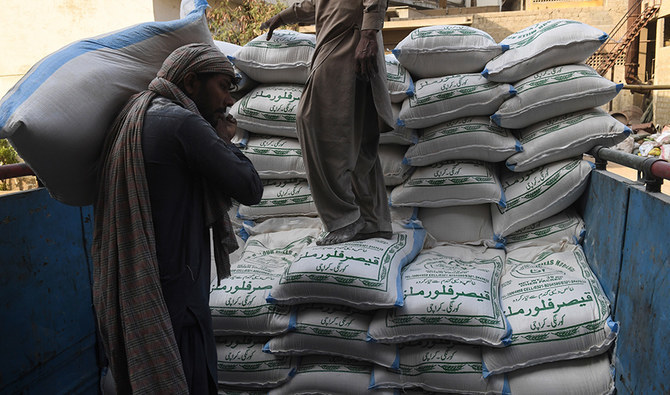

KARACHI: Pakistan estimates it has produced wheat in the range of 26 to 27 million metric tons (MMT) during the current harvesting season, which makes it the most fruitful year for wheat in the history of the South Asian country, the food ministry confirmed this week.
Wheat is the major staple food crop in Pakistan, where upwards of 220 million people live, and constitutes around 60% of the daily diet of people. Since a shortage of wheat supply, the price of flour, its main byproduct, has increased manifold.
The country, which had a wheat surplus since fiscal year 2014-15 had to finally import the commodity in 2020 to meet the growing demands of flour. This year too, despite the bumper crop, Pakistan will have to import wheat again to meet the deficit according to the ministry.
“Estimated wheat production is in the range of 26-27 MMT,” the agriculture ministry said in a written response to Arab News on Thursday, and added that estimated consumption for 2021-22 was around 29 MMT. This shows a deficit of between 2-3 million tons.
Farmers say the bumper crop achieved by the country’s farming community is mainly due to good wheat support prices and weather. The minimum support price was raised from Rs1650 per 40 kg to Rs1800, while in Sindh the price is fixed at Rs2000 per 40 kg.
“The best support prices and favorable weather has played a key role in the bumper crop this year,” Dr. Ibrahim Mughal, Chairman of the Agri Forum Pakistan told Arab News, but added that the country had to produce the estimated 27 MMT to meet its needs.
“If the country fails to produce 27 MMT, we will be in trouble,” Mughal said. The breakdown of wheat consumption, he said, was as follows:
“We will have around 25.5 MMT for human consumption after deduction of 1.2 MMT seed for next year’s sowing, 700,000- 800,000 MMT (0.7-0.8 MMT) for poultry and cattle feed, and around 0.2-0.3 MMT post-harvest or storage losses.”
The country currently holds wheat stocks of 600,595 MMT.
The ministry said that during the current procurement drive for wheat, 2.6 MMT, had already been purchased by the government, which is ‘almost 41% of the target of 6.3 MMT.”
“Minimum strategic reserves of 1 MMT are required with PASSCO (Pakistan Agricultural Storage & Services Corporation) at all times,” the food ministry said.
But data shows that as of this week, PASSCO, the state-owned grain storage entity, has only 123,538 MMT wheat left in stock.
Pakistan has imported 3.61 MMT wheat worth $983.3 million during July-March, 2020-21 period of the current fiscal year, according to the Pakistan Bureau of Statistics.
Current stocks are available for at least three weeks, keeping in view the consumption pattern, if not augmented with fresh procurement ongoing across the country.
Prices in Karachi’s retail market hover around Rs.68-70 kg while in Punjab, a 20 kg bag of flour in the wholesale market is available for Rs1050.
Pakistani flour millers say the high cost of flour is mainly due to the increasing cost of input and restrictions on inter-provincial and inter-district mobility.
“Our input cost has increased manifold, including rising electricity tariffs,” Badar ud Din Kakar, Chairman of Pakistan Flour Mills Association, told Arab News, and added that a ban on movement had increased cost to the millers even more as corruption and bribes had gone up.
“They (millers) are being forced to grease the palms of officials for inter-provincial and inter-district transportation,” he said.
Kakar warned that prices of flour in the coming days would continue to remain on the higher side due to the end of subsidized wheat supply.
“Normalization of supply of wheat is essential to keep food inflation in check,” he said.
On Monday, the Federal Minister for Finance, Shaukat Tarin, while chairing a meeting of the National Price Monitoring Committee had stressed for maintaining strategic reserves of essential commodities and had directed provincial governments and departments concerned to work out estimates and procure wheat and sugar in a smooth and timely manner.


