

Indirect talks on Iran nuclear deal in ‘unclear place’: US security adviser

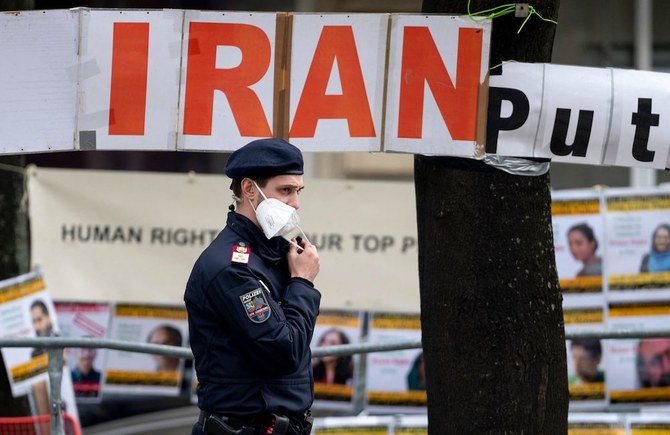
A police officer patrols in front of banners put up by members of the National Council of Resistance of Iran, an Iranian opposition group, in front of the Grand Hotel Wien. (AFP)
Short Url
Updated 30 April 2021
Follow

Indirect talks on Iran nuclear deal in ‘unclear place’: US security adviser

  • Differences remain over what US sanctions will need to end and steps Iran must take to resume obligations

WASHINGTON D.C.: Indirect negotiations between the United States and Iran on a return to compliance to the 2015 Iran nuclear deal are in “an unclear place,” US National Security Adviser Jake Sullivan said on Friday.

Sullivan's comments followed the start this week of a third round of the talks in Vienna in which representatives of Britain, China, France, Germany, Russia and European Union shuttle between US and Iranian delegations.

“I'm not going to characterize the substance of the negotiations at this point because they are in ... an unclear place,” Sullivan told an Aspen Security Fosrum webinar. “We've seen willingness of all sides, including the Iranians, to talk seriously about sanctions relief restrictions and a pathway back into the JCPOA,” referring to the Joint Comprehensive Plan of Action, the nuclear deal's title.

“But it is still uncertain as to whether this will culminate in a deal in Vienna,” he said.

The agreement limited Iran's nuclear program to block the development of nuclear weapons. In return, Iran received relief from U.S. and international sanctions.

Former US President Donald Trump withdrew from the accord in 2018, reimposing and adding US sanctions. In response, Tehran began breaching JCPOA restrictions.

President Joe Biden has pledged to return to the deal. Iran refused direct talks on resuming compliance in exchange for the lifting of US sanctions.

Sullivan was asked whether the Iranians are negotiating in good faith.

“I guess good faith is always in the eye of the beholder,” he said. “The Iranians have come in a serious way to have serious discussions about details and the teams are working through those details now.”

The main differences are over what US sanctions will need to end, the steps Iran must take to resume its obligations to restrict its nuclear program and how to sequence the process.


WHO says Dubai global emergency logistics hub ‘resuming operations’

Updated 5 sec ago
Follow

WHO says Dubai global emergency logistics hub ‘resuming operations’

  • Hanan Balkhy, WHO’s Eastern Mediterranean regional chief, says more than 50 emergency supply requests across 25 countries are affected by the pause
  • The hub stopped work this week after Iran launched waves of missile and drone attacks across the Gulf
GENEVA: The World Health Organization said its global health emergencies logistics hub in Dubai was resuming operations on Friday after a pause caused by the war in the Middle East.
“One of our most immediate concerns is the disruption of humanitarian health supply chains,” Hanan Balkhy, the UN health agency’s Eastern Mediterranean regional chief, told a press conference in Geneva.
“After a temporary pause, WHO’s Hub for Global Health Emergencies Logistics is today resuming operations,” she said, speaking from Cairo.
She said the UAE, in coordination with the UN’s World Food Programme, had confirmed that it stood ready to facilitate urgent humanitarian shipments.
“More than 50 emergency supply requests across 25 countries are currently affected,” said Balkhy.
“These pending requests — which will benefit more than 1.5 million people — include WHO supplies for Lebanon, Gaza, Yemen, and Somalia, as well as polio laboratory supplies for global detection and eradication activities across a number of countries.”
She said the WHO would be working in the coming days to process urgent new shipments and clear priority backlogs.
Balkhy noted that even before the escalation of hostilities in the Middle East, health systems in many countries were already operating at full capacity.
“WHO has pre-positioned trauma supplies and essential medicines at our warehouse in Tehran and is closely monitoring the situation — including potential mass casualty needs, disruptions to essential health services, and possible displacement,” she said.
