Pakistani PM to visit Saudi Arabia on May 7-9

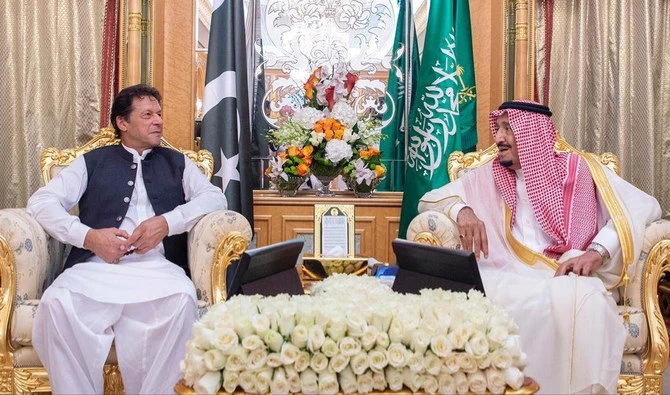
Pakistan's Prime Minister Imran Khan is talking to Saudi King Salman bin Abdulaziz on September 19, 2019. Khan arrived in the Kingdom on a two-day official visit ahead of his trip to New York where he is scheduled to address the United Nations General Assembly later this month. (Photo Courtesy: Consulate General of Pakistan Jeddah)
Short Url
Updated 01 May 2021
Follow

Pakistani PM to visit Saudi Arabia on May 7-9

  • Khan’s entourage to include the foreign minister, information minister and the PM’s special aides on climate change and Middle East
  • Armed forces chief Gen. Qamar Javed Bajwa expected to arrive in the kingdom before Khan, on May 4

ISLAMABAD: Pakistani Prime Minister Imran Khan is scheduled to visit Saudi Arabia early next month, the foreign office said on Thursday, while a source familiar with the matter told Arab News the three-day trip will start on May 7.
Khan will be visiting the kingdom on the invitation of Saudi Crown Prince Mohammed bin Salman.
“I can confirm that Prime Minister Imran Khan will be undertaking an official visit to the Kingdom of Saudi Arabia at the invitation of Crown Prince of Saudi Arabia, His Royal Highness Prince Mohammed bin Salman, early next month,” foreign office spokesperson Zahid Hafeez Chaudhri told reporters during a weekly press briefing.
While Chaudhri said more details will be shared “in due course,” according to the source who will be accompanying Khan during the visit, the trip will take place on May 7-9.
“During the visit prime minister will meet Crown Prince Mohammed bin Salman and other Saudi leaders. Many MoUs and agreements are expected to be signed,” the source said, adding that before to the prime minister’s trip, armed forces chief Gen. Qamar Javed Bajwa will arrive in the kingdom on May 4.
Khan’s entourage, he said, will include several members of the cabinet: Foreign Minister Shah Mahmood Qureshi, Information Minister Fawad Chaudhry, the PM’s special aide on the Middle East, Tahir Ashrafi, and the PM’s adviser on climate change, Malik Amin Aslam.
Back from Iran, Pakistani students say they heard gunshots while confined to campus

Updated 8 sec ago
Follow

Back from Iran, Pakistani students say they heard gunshots while confined to campus

  • Students say they were confined to dormitories and unable to leave campuses amid unrest
  • Pakistani students stayed in touch with families through the embassy amid Internet blackout

ISLAMABAD: Pakistani students returning from Iran on Thursday said they heard gunshots and stories of rioting and violence while being confined to campus and not allowed out of their dormitories in the evening.

Iran’s leadership is trying to quell the worst domestic unrest since its 1979 revolution, with a rights group putting the death toll over 2,600.

As the protests swell, Tehran is seeking to deter US President Donald Trump’s repeated threats to intervene on behalf of anti-government protesters.

“During ‌nighttime, we would ‌sit inside and we would hear gunshots,” Shahanshah ‌Abbas, ⁠a fourth-year ‌student at Isfahan University of Medical Sciences, said at the Islamabad airport.

“The situation down there is that riots have been happening everywhere. People are dying. Force is being used.”

Abbas said students at the university were not allowed to leave campus and told to stay in their dormitories after 4 p.m.

“There was nothing happening on campus,” Abbas said, but in his interactions with Iranians, he ⁠heard stories of violence and chaos.

“The surrounding areas, like banks, mosques, they were damaged, set on fire ... ‌so things were really bad.”

Trump has repeatedly ‍threatened to intervene in support of protesters ‍in Iran but adopted a wait-and-see posture on Thursday after protests appeared ‍to have abated. Information flows have been hampered by an Internet blackout for a week.

“We were not allowed to go out of the university,” said Arslan Haider, a student in his final year. “The riots would mostly start later in the day.”

Haider said he was unable to contact his family due to the blackout but “now that they opened international calls, the students are ⁠getting back because their parents were concerned.”

A Pakistani diplomat in Tehran said the embassy was getting calls from many of the 3,500 students in Iran to send messages to their families back home.

“Since they don’t have Internet connections to make WhatsApp and other social network calls, what they do is they contact the embassy from local phone numbers and tell us to inform their families.”

Rimsha Akbar, who was in the middle of her final year exams at Isfahan, said international students were kept safe.

“Iranians would tell us if we are talking on Snapchat or if we were riding in a cab ... ‌that shelling had happened, tear gas had happened, and that a lot of people were killed.”