



JEDDAH: Saudi Arabia’s coronavirus disease (COVID-19) vaccine rollout has inoculated more than 25 percent of the population.
Over the past year, the Kingdom has promoted strict protocols to curb the virus until the national vaccine campaign started. Every new vaccine administered is another step to normalcy. Saudi health experts have said that in a bid to return to normal life in the fight against COVID-19, vaccines are a necessity, not a luxury.
“The government placed the safety of their people first and the nation lived through an unsettling new normal. Many have come to realize that life is somewhat back to normal with prayers resumed at mosques and people returning to coffee shops. Many have felt the sense of urgency and rushed to take the vaccine. We can’t afford another hit,” infectious disease consultant Dr. Nezar Bahabri told Arab News.
He added: “The vaccines are the only way to return back to our normal lives. This is a humanitarian cause, for yourself, for the people and for the love of the country.”
After the World Health Organization declared a pandemic in March 2020, Saudi Arabia protected its health system and prevented the spread of the virus by imposing flight bans, lockdowns, curfews and making social distancing and the wearing of masks mandatory. The daily case count never made it past 5,000 cases per day, thanks to government efforts supported by the public’s adherence.
The numbers declined, restrictions were loosened and people began to get a grasp of their new reality, gradually and carefully.
But to return to the old normal, COVID-19 vaccines were critical.
By ramping up vaccinations, suffering communities could rebuild foundations for a prosperous and lasting recovery.
Saudi Arabia supported the global vaccine development and pledged $500 million on vaccine campaigns. The Kingdom gave $150 million to the Global Alliance for Vaccines and Immunizations, $150 million to the Coalition for Epidemic Preparedness and Innovation and $200 million to regional and global programs.
Through careful planning and accurate timing, the first batch of Pfizer/BioNtech COVID-19 vaccines arrived in the Kingdom in early December, shortly followed by the Oxford-AstraZeneca vaccine. The national vaccine rollout was already in full swing after both vaccines were cleared for public use by the Saudi Food and Drug Authority, and news of two more jabs pending approval built on hope for a swift recovery.
According to the Saudi Health Council, 5,000 Saudi residents received their first doses on Dec. 18, 2020. By March 3, 1 million people had been inoculated.
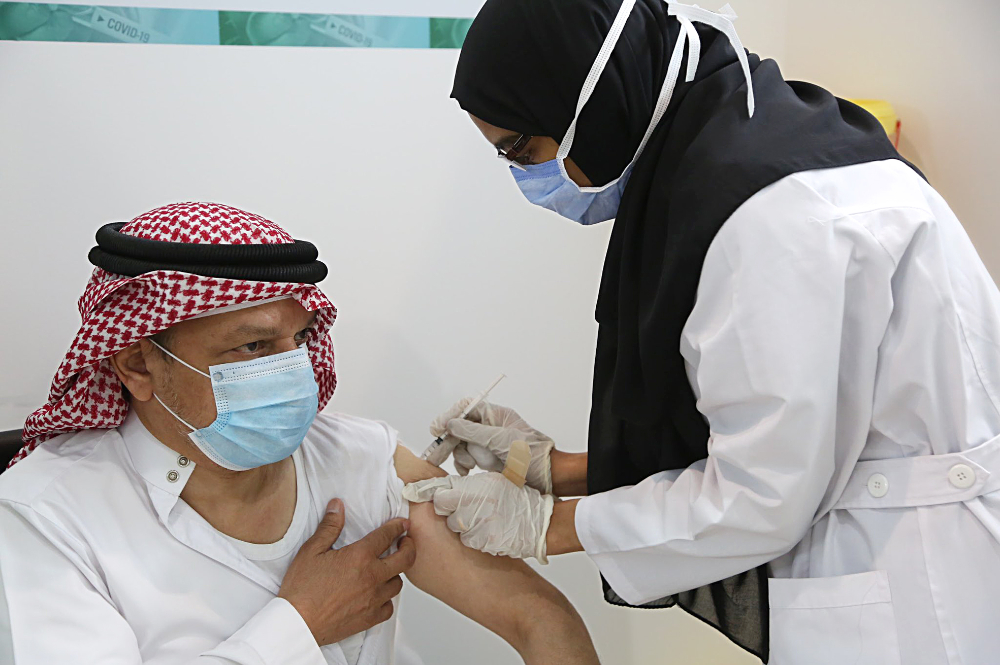
But 1 million is not enough. Late last month, a series of recommendations were put into place by several ministries — notably the Ministry of Hajj and Umrah and the Ministry of Human Resources and Social Development — making it mandatory for employees of certain sensitive sectors to be inoculated or provide weekly negative PCR test results at the expense of the employer.
By March 28, 4 million residents received at least one vaccine dose. The inoculation program picked up speed soon after. Vaccines were administered at a rate of 1 million doses every 5 to 7 days.
“The vaccine is the tool that will reopen doors again. Government sectors have made it mandatory to protect the people, the consequences for those refusing to take it will bear a heavy toll.”
Bahabri said that many people refusing to take the vaccine would start a series of unfortunate events that could lead to a possible collapse in the healthcare system, something that the Kingdom has successfully prevented since the start of the pandemic.
Vaccine hesitancy has been hardened by false claims spreading on social media. Efforts were made to prevent false rumors being shared, such as fines and imprisonment when a perpetrator was caught.
BACKGROUND
• After the World Health Organization declared a pandemic in March 2020, Saudi Arabia protected its health system and prevented the spread of the virus by imposing flight bans, lockdowns, curfews and making social distancing and the wearing of masks mandatory. The daily case count never made it past 5,000 cases per day, thanks to government efforts supported by the public’s adherence.
• Saudi Arabia supported the global vaccine development and pledged $500 million on vaccine campaigns. The Kingdom gave $150 million to the Global Alliance for Vaccines and Immunizations, $150 million to the Coalition for Epidemic Preparedness and Innovation and $200 million to regional and global programs.
“It’s not so much hesitancy anymore, it’s negligence,” said Bahabri, adding: “It’s unfortunate to see this happening. It’s un-Islamic, but fortunately people are listening and heeding the call. It’s an important step, for the citizens and community alike.”
Abu-Talal A., a retired businessman in Jeddah, told Arab News that the past year was difficult with the absence of his children and grandchildren. Having lost his wife nearly five years ago, he blamed his fear of the vaccine on conspiracy theorists and anti-vaccine activists that flooded his social media feeds.
“I trust the experts, I trust the government but I do not know what to expect if I take it.”
He told Arab News that posts by skeptics claiming to have hard evidence that the pandemic is a hoax and that the inoculation would damage his genetics put him in a bubble he said was hard to get out of.
“It’s a scary time and though I resisted for long, my son eventually made the appointment for me and the decision was a fait accompli that rendered me speechless. My children are careful but they want me safe. The support, the internet and transparency in relaying information helps… This has gone long enough and we all need to live normally again,” he said.


