

Industry giants come to India’s rescue

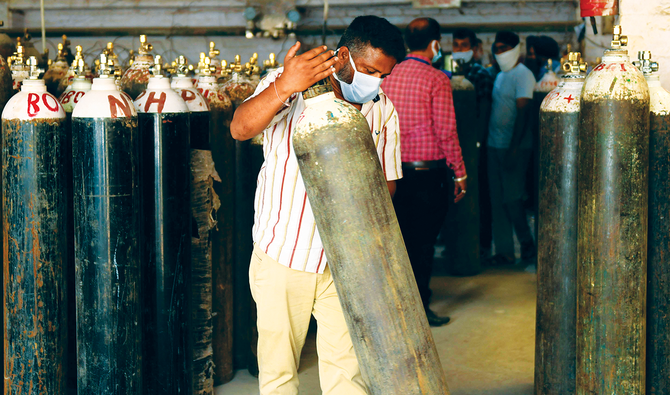
Workers sorting oxygen cylinders used for coronavirus patients before dispatching them to hospitals at a facility on the outskirts of Amritsar. (AFP)
Short Url
Updated 29 April 2021
Follow

Industry giants come to India’s rescue

  • Reliance Industries tweaked manufacturing at its oil refineries to produce oxygen

BENGALURU: Global and Indian firms are flexing their industrial muscle to help the world’s second biggest population battle coronavirus, coming to the rescue of a public health system buckling under the weight of surging infections and deaths.

Amazon.com, Intel and Google, as well as Indian firms Tata Sons, Reliance Industries and JSW Steel have pitched in with everything from airlifts of medical equipment and funding pledges to making medical oxygen.

“What we need is better planning with the recognition that government’s capacity is limited and, therefore, requires private participation,” said economist Madhura Swaminathan of the Indian Statistical Institute in Bengaluru.

Hospitals struggling with a massive second wave of infections are turning away patients as beds and oxygen supplies run out, and social media brim with desperate calls for help in finding supplies of oxygen and drugs such as remdesivir.

A record increase in deaths over the last 24 hours carried India’s toll past 200,000 on Wednesday, a situation that experts blame on lack of oxygen supplies and infrastructure challenges.

On Tuesday Amazon said it would ship 100 ICU ventilator units to India from the US.

It had earlier worked with partners to airlift more than 8,000 oxygen concentrators and 500 ventilators from Singapore, relying on its massive global logistics network to hasten procurement, a spokeswoman said.

Google promised $18 million in new funding for India, including advertising support for public health campaigns.

India’s largest steel maker by market value, JSW, has stopped making some of the construction raw material as it diverts resources to turning out liquid oxygen instead. From April 21 to 23, JSW supplied 898 tons of oxygen each day from its plants, equivalent to about 13 percent of the combined daily demand for 6,785 tons of the lifesaving gas in India’s 20 worst-hit states.

JSW said it was building large COVID patient centers around its plants, so that they can be serviced via a pipeline.

Reliance Industries tweaked manufacturing at its oil refineries to produce hundreds of tons of oxygen for hard-hit areas such as Maharashtra.

Tata Group imported 24 cryogenic containers to transport liquid oxygen, while its Tata Steel unit ramped up oxygen supply.


Saudi minister at Davos urges collaboration on minerals

Global collaboration on minerals essential to ease geopolitical tensions and secure supply, WEF hears. (Supplied)
Updated 20 January 2026
Follow

Saudi minister at Davos urges collaboration on minerals

  • The reason of the tension of geopolitics is actually the criticality of the minerals

LONDON: Countries need to collaborate on mining and resources to help avoid geopolitical tensions, Saudi Arabia’s minister of industry and mineral resources told the World Economic Forum on Tuesday.

“The reason of the tension of geopolitics is actually the criticality of the minerals, the concentration in different areas of the world,” Bandar Alkhorayef told a panel discussion on the geopolitics of materials.

“The rational thing to do is to collaborate, and that’s what we are doing,” he added. “We are creating a platform of collaboration in Saudi Arabia.”

Bandar Alkhorayef, Saudi Minister of Industry and Mineral Resources 

The Kingdom last week hosted the Future Minerals Forum in Riyadh. Alkhorayef said the platform was launched by the government in 2022 as a contribution to the global community. “It’s very important to have a global movement, and that’s why we launched the Future Minerals Forum,” he said. “It is the most important platform of global mining leaders.”

The Kingdom has made mining one of the key pillars of its economy, rapidly expanding the sector under the Vision 2030 reform program with an eye on diversification. Saudi Arabia has an estimated $2.5 trillion in mineral wealth and the ramping up of extraction comes at a time of intense global competition for resources to drive technological development in areas like AI and renewables.

“We realized that unlocking the value that we have in our natural resources, of the different minerals that we have, will definitely help our economy to grow to diversify,” Alkhorayef said. The Kingdom has worked to reduce the timelines required to set up mines while also protecting local communities, he added. Obtaining mining permits in Saudi Arabia has been reduced to just 30 to 90 days compared to the many years required in other countries, Alkhorayef said.

“We learned very, very early that permitting is a bottleneck in the system,” he added. “We all know, and we have to be very, very frank about this, that mining doesn’t have a good reputation globally.

“We are trying to change this and cutting down the licensing process doesn’t only solve it. You need also to show the communities the impact of the mining on their lives.”

Saudi Arabia’s new mining investment laws have placed great emphasis on the development of society and local communities, along with protecting the environment and incorporating new technologies, Alkhorayef said. “We want to build the future mines; we don’t want to build old mines.”