

From Amazon to Tata, industry steps up to combat India’s coronavirus crisis

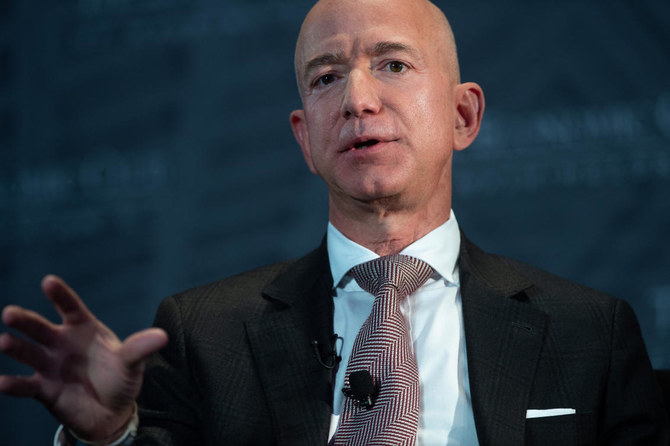
Amazon.com Inc. founder, Jeff Bezos, whose company pledged to send 100 ICU ventilator units to India during the country's ongoing battle against COVID-19. (File/AFP)
Short Url
Updated 28 April 2021
Follow

From Amazon to Tata, industry steps up to combat India’s coronavirus crisis

  • Hospitals struggling with a massive second wave of infections are turning away patients as beds and oxygen supplies run out
  • A record increase in deaths over the prior 24 hours carried India’s toll past 200,000 on Wednesday

BENGALURU: Global and Indian firms are flexing their industrial muscle to help the world’s second biggest population battle coronavirus, coming to the rescue of a public health system buckling under the weight of surging infections and deaths.

Amazon.com, Intel and Google, as well as Indian firms Tata Sons, Reliance Industries and JSW Steel have pitched in with everything from airlifts of medical equipment and funding pledges to making medical oxygen.

“What we need is better planning with the recognition that government’s capacity is limited and therefore requires private participation,” said economist Madhura Swaminathan of the Indian Statistical Institute in Bengaluru.

Hospitals struggling with a massive second wave of infections are turning away patients as beds and oxygen supplies run out, and social media brim with desperate calls for help in finding supplies of oxygen and drugs such as remdesivir.

A record increase in deaths over the prior 24 hours carried India’s toll past 200,000 on Wednesday, a situation that experts blame on lack of oxygen supplies and infrastructure challenges.

On Tuesday Amazon said it would ship 100 ICU ventilator units to India from the United States.

It had earlier worked with partners to airlift more than 8,000 oxygen concentrators and 500 ventilators from Singapore, relying on its massive global logistics network to hasten procurement, a spokeswoman said.

Google promised $18 million in new funding for India, including advertising support for public health campaigns.

India’s largest steel maker by market value, JSW, has stopped making some of the construction raw material as it diverts resources to turning out liquid oxygen instead.

From April 21 to 23, JSW supplied 898 tons of oxygen each day from its plants, equivalent to about 13% of the combined daily demand for 6,785 tons of the life-saving gas in India’s 20 worst-hit states.

JSW said it was building large COVID patient centers around its plants, so that they can be serviced via a pipeline.

Billionaire Mukesh Ambani’s Reliance Industries tweaked manufacturing at its oil refineries to produce hundreds of tons of oxygen for hard-hit areas such as Maharashtra, India’s richest and worst-hit state.

Tata Group, one of India’s oldest conglomerates, imported 24 cryogenic containers to transport liquid oxygen, while its Tata Steel unit ramped up oxygen supply.

“The government single-handedly cannot deal with this crisis any more, it is very important that the corporate sector gets into motion,” said Kunal Kundu, India economist at Societe Generale in Bengaluru.

“We need all the help we can get.”

Economist Swaminathan called for the scope of private sector contribution to be widened beyond the merely voluntary.

“Anybody who has surplus funds and equipment should step in to help,” she added. “In terms of logistics, beds, oxygen, hospitals, the private sector has to be asked to do its task as part of policy.”


US hotels seek World Cup boost after tourism dip under Trump

Updated 58 min ago
Follow

US hotels seek World Cup boost after tourism dip under Trump

  • At the US hotels that Meade Atkeson manages, a drop in tourism weighs heavily on business — but hoteliers like him hope that World Cup enthusiasm will soon eclipse wariness over President

WASHINGTON: At the US hotels that Meade Atkeson manages, a drop in tourism weighs heavily on business — but hoteliers like him hope that World Cup enthusiasm will soon eclipse wariness over President Donald Trump’s policies.
The US hospitality sector has been reeling from a tourism slump in the world’s biggest economy, which became the only major destination to see a drop in foreign visitors last year.
“Just financially, it’s difficult when international travel is down,” Atkeson told AFP, noting that such visitors tend to stay longer and spend more.
Foreign travelers account for nearly a quarter of business at the three hotels under Sonesta group that he manages — two in Washington and a third in Miami Beach.
Yet, in the first eleven months of 2025, US official data showed that inbound travel dropped by 5.4 percent.
Canadians were noticeably absent, with travel plunging by 21.7 percent from 2024, translating to about four million fewer people. The decline was nearly seven percent for French visitors.
Industry professionals see this as a consequence of Trump’s policies, even if they may not openly say so.
Visitors have chafed at the Republican president’s sweeping tariffs on foreign goods, broadsides against other countries, tightening immigration rules and portrayal of certain Democrat-led cities as ridden with crime.
Canadians “were asked to be the 51st state, right?” Atkeson said.
“If you talk to Canadians, many of them have chosen not to travel out of conscience” or on principle, he added.
Brazilian tourists meanwhile “can go anywhere they want,” he said. “And so they may have gone to Europe, they may have gone to the islands.”
‘Fear’
Thousands of kilometers away, the major resort city of Las Vegas in Nevada — boasting 150,000 hotel rooms — has also had a bad year.
Elsa Rodan, a chambermaid at the Bellagio resort and casino, says her establishment is “blessed” compared with others.
But even so, it has had to lower prices to attract guests, added Rodan, a representative of the Unite Here union who spoke at a Washington press conference.
Unite Here President Gwen Mills urges for a renewed effort to lobby the Trump administration over policies and rhetoric that she believes are jeopardizing the sector employing more than two million people.
According to her, hoteliers are not pushing the government enough.
Employers express “fear, the fear of picking your head up,” she said.
Hopefully ‘better’
Fewer visitors and overnight stays, alongside a drop in revenue, have triggered a $6.7 billion shortfall for Nevada hotels in 2025, according to the American Hotel and Lodging Association (AHLA).
But the organization hopes that 2026 will be a turning point — it is counting on the World Cup, from June 11 to July 19, to attract visitors.
Eleven US cities will be hosting matches.
“It’s being equated to having nearly 80 Super Bowls in just over a month,” AHLA spokesman Ralph Posner told AFP.
“The economic lift won’t be limited to host cities,” he added. “Destinations across the country are hoping to benefit as international visitors extend their trips and travel between markets.”
Las Vegas, for example, hopes to draw fans who might stop there before or after a game in Los Angeles or Kansas City.
Organizers say that besides the seven million spectators in stadiums, the World Cup is set to attract 20-30 million tourists.
The whole event, they believe, can generate $30 billion for the US economy.
“I hope that things will look better,” Atkeson said.
His Miami hotel is under renovations and cannot host much World Cup-related activity.
But his Washington establishments are highlighting their proximity to Philadelphia, where several matches will be held.
Another complication is war in the Middle East following US-Israeli strikes on Iran, which could snarl travel.
“It’s a little too soon to tell how we’re going to do with that, but we’ll see,” he said.