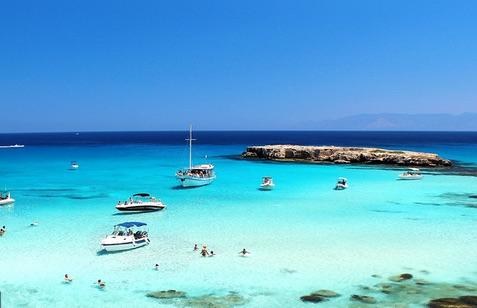
DUBAI: Vaccinated tourists from the UAE will be able to travel to Cyprus as part of a plan to open the island to some 65 countries worldwide.
Also included on the list are Bahrain, Egypt, Kuwait, Lebanon. The change comes into effect on May 10 and means that tourists can enter without the need for a negative COVID-19 test or have to undergo quarantine.
“We will notify our partners in around 65 countries that from 10 May entry will be facilitated for travelers who have completed their vaccination with no need for negative COVID tests or quarantine,” Tourism Minister Savvas Perdios said.
Cyprus went into a two-week lockdown on Monday, after a record surge in coronavirus cases. The island relies heavily on tourism and the 84 percent decline in arrivals last year has had a devastating impact on its economy.

Eid in Cyprus? Vaccinated tourists from UAE, Bahrain, Egypt, Kuwait and Lebanon can visit
https://arab.news/vqm6t
Eid in Cyprus? Vaccinated tourists from UAE, Bahrain, Egypt, Kuwait and Lebanon can visit
- Cyprus went into a two-week lockdown on Monday
- Island economy relies heavily on tourism revenues
Saudi ministry launches private sector tender to operate sports venues in Makkah region
RIYADH: New investment opportunities in athletic facilities across the Makkah region have been launched as Saudi Arabia looks to expands private sector participation in the sports economy and improve the commercial performance of its stadiums.
The Kingdom’s Ministry of Sport announced the offering under its “Sports Facilities Investment” initiative, inviting qualified companies to bid for a three-year contract to operate and manage multiple venues, including King Abdullah Sports City Stadium in Jeddah, Prince Abdullah Al-Faisal Stadium in Jeddah, King Abdulaziz Stadium in Makkah, and the indoor arena at King Abdullah Sports City.
The initiative comes amid a wider push by Saudi Arabia to maximize the commercial value of its sports infrastructure as the Kingdom prepares for major international tournaments and expands its domestic sports economy.
Under the proposed arrangement, the selected operator will manage matches, events, and daily venue services to enhance fan experiences and operational quality, while the ministry will retain responsibility for maintenance and oversight. The model is designed to expand partnerships with the private sector and improve the year-round utilization of sports infrastructure.
The investment opportunity offers multiple revenue streams, including ticket sales, food and beverage concessions, and hospitality services, as well as advertising and venue naming rights, excluding King Abdullah Sports City Stadium, and the ability to host non-sporting events and community activities.
Francesca Petriccione, an international sports lawyer and professor at the University of Milan, said the initiative reflects a broader strategy to transform stadiums into long-term economic assets rather than facilities used only for sporting competitions.
“These stadiums are being developed as long-term economic assets rather than simply event venues,” Petriccione told Arab News. “The infrastructure strategy is not only about match-day capacity but also about commercial activation outside football.”
Petriccione advises leading international football clubs on strategic expansion projects in the Middle East, particularly in Saudi Arabia. Her work focuses primarily on football club acquisitions and cross-border investment in the sports sector.
She explained that the Kingdom’s broader sports infrastructure program, linked to its 2034 FIFA World Cup bid, demonstrates a portfolio approach to stadium development.
“Saudi Arabia’s plan is built around 15 proposed stadiums across five cities, including four existing venues, three already under construction and eight planned new builds,” Petriccione said. “The ministry is trying to avoid the classic white elephant problem by embedding stadiums within a broader utilization model.”
According to the professor, the Kingdom’s stadium program is designed to support both international tournament hosting and long-term infrastructure development.
“The ministry is not simply refurbishing legacy stock but selectively creating a next-generation venue network for top-tier international events,” she said.
Petriccione added that the nation’s approach emphasizes multi-purpose venues capable of hosting concerts, conferences and other large-scale events in addition to football matches, improving utilization rates and strengthening the financial model of sports infrastructure.
“Modern stadiums are financially stronger when they function as experience and events platforms rather than simply football grounds,” she said.
Some venues are also being integrated into larger urban development strategies and tourism ecosystems rather than built as standalone athletic projects, aligning sports infrastructure with broader real estate and destination planning.
Petriccione noted that the ministry’s decision to invite private companies to operate and manage facilities signals a gradual shift toward commercially driven management structures.
“The value is not only in construction — it also lies in operations, facility management, venue technology, hospitality, naming rights, premium seating and non-match-day monetization,” Petriccione said.
The ministry said the investment initiative aims to create a scalable operating model that could later be applied to additional sports facilities across the Kingdom, while increasing financial efficiency, enhancing commercial rights activation and generating new revenue streams for the sports sector.


