

Greece accused of violent pushback campaign against Aegean crossings

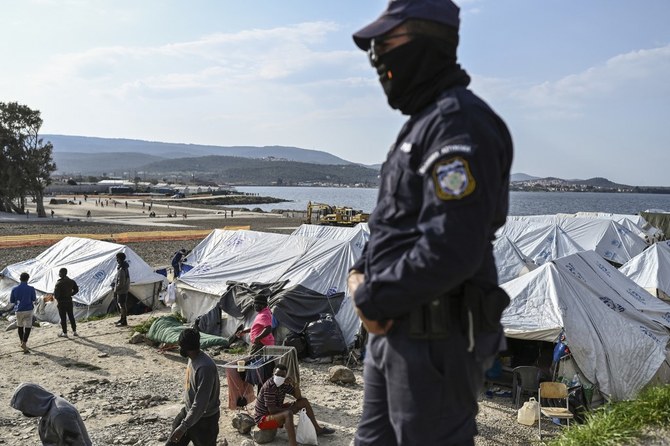
A Greek policeman stands in foreground as migrants walk inside the new refugee camp of Kara Tepe in Mytilene, on Lesbos, on March 29, 2021. (File/AFP)
Short Url
Updated 26 April 2021
Follow

Greece accused of violent pushback campaign against Aegean crossings

  • Legal Centre Lesvos files claim at ECHR alleging widespread illegality in treatment of migrants
  • Refugees say they were beaten, abandoned at sea by Greek commandos

LONDON: Greece has been accused of conducting violent, illegal pushbacks of migrants and refugees trying to reach Europe.

Greek forces boarded a fishing vessel in distress off Crete in October 2020, forcing 200 people, including women and children, into smaller boats and towing them into Turkish waters.

In a lawsuit filed by the NGO Legal Centre Lesvos (LCL) at the European Court of Human Rights (ECHR), it is alleged that the fishing vessel ran into difficulties following a storm after leaving the Turkish city of Marmaris, and that it was intercepted by three Greek vessels that refused to allow it to move after its captain radioed for help.

Masked commandos arrived five hours later and allegedly beat passengers while searching them and confiscating their belongings, including passports, phones and money, before forcing them onto several small rafts and towing them back to where they came from.

LCL says evidence — including GPS coordinates, geo-located pictures and videos, and phone logs from the passengers and crew — suggests that this was a carefully orchestrated operation involving multiple Greek agencies and resources.

One of the migrants on board, a Syrian who was given the pseudonym Mahmoud to protect his identity, told The Guardian: “It was like watching a movie. The men from the speedboats jumped on board screaming and shouting. They all had guns and knives, and were wearing black and masks.”

He added: “They began beating people with batons, looking for the captain. They punched me in the face and broke my glasses.”

Once in Turkish waters, the rafts were abandoned without food, water, life jackets or means to call for help.

“I understand they don’t want us, but you could send us back to Turkey without the need for violence,” Mahmoud said. “When they cut us loose on the rafts, we all thought we were going to die.”

Another Syrian migrant, given the pseudonym Yara, said: “I didn’t even want to go to Greece. We knew that they were harming refugees when they arrive, but it was shocking to experience the reality, which is that Europe doesn’t care at all about human rights and dignity. Despite all of that, I’ll still try again. I can’t build a life in Syria or Turkey.”

LCL’s lawsuit, the fifth such case it has brought before the ECHR, suggests that the incident is not isolated, and that aggressive tactics to stop crossings are systematic.

It alleges that Greece has been employing pushback tactics, illegal under international law, since March 2020 after Turkey told the EU it would no longer abide by a 2016 deal to stop its 4 million registered refugees from making the journey to Europe.

In hundreds of recorded cases, boats crossing the Aegean have been turned around and had their engines disabled, or passengers have been forced onto life rafts and towed back to Turkey.

On at least two occasions, migrants have been dumped on a small, uninhabited Turkish island.

In several other instances, people who have reached Greece say they were forced back onto their vessels and towed across the sea.

The EU border agency Frontex has been accused of covering up at least one pushback incident.

LCL lawyer Natasha Ntailiani told The Guardian: “‘Pushback’ isn’t even really the right term. It’s a decision by the authorities to deliberately abandon people at sea, putting their lives at risk, with no means to call for rescue and no chance at all to claim asylum.”

She added: “It’s a new and disturbing trend characterized by planned and systematic violence, which has increased over the last year in the Aegean region. Even search and rescue vessels and materials are now being used against migrants, which is a remarkable insight into the lengths the Greek authorities are now willing to go to.”


Trump administration labels 3 Muslim Brotherhood branches as terrorist organizations

Updated 5 sec ago
Follow

Trump administration labels 3 Muslim Brotherhood branches as terrorist organizations

  • The State Department designated the Lebanese branch a foreign terrorist organization
  • “These designations reflect the opening actions of an ongoing, sustained effort to thwart Muslim Brotherhood chapters’ violence,” Rubio said

WASHINGTON: President Donald Trump’s administration has made good on its pledge to label three Middle Eastern branches of the Muslim Brotherhood as terrorist organizations, imposing sanctions on them and their members in a decision that could have implications for US relationships with allies Qatar and Turkiye.
The Treasury and State departments announced the actions Tuesday against the Lebanese, Jordanian and Egyptian chapters of the Muslim Brotherhood, which they said pose a risk to the United States and American interests.
The State Department designated the Lebanese branch a foreign terrorist organization, the most severe of the labels, which makes it a criminal offense to provide material support to the group. The Jordanian and Egyptian branches were listed by Treasury as specially designated global terrorists for providing support to Hamas.
“These designations reflect the opening actions of an ongoing, sustained effort to thwart Muslim Brotherhood chapters’ violence and destabilization wherever it occurs,” Secretary of State Marco Rubio said in a statement. “The United States will use all available tools to deprive these Muslim Brotherhood chapters of the resources to engage in or support terrorism.”
Rubio and Treasury Secretary Scott Bessent were mandated last year under an executive order signed by Trump to determine the most appropriate way to impose sanctions on the groups, which US officials say engage in or support violence and destabilization campaigns that harm the United States and other regions.
Muslim Brotherhood leaders have said they renounce violence.
Trump’s executive order had singled out the chapters in Lebanon, Jordan and Egypt, noting that a wing of the Lebanese chapter had launched rockets on Israel after Hamas’ Oct. 7, 2023, attack in Israel that set off the war in Gaza. Leaders of the group in Jordan have provided support to Hamas, the order said.
The Muslim Brotherhood was founded in Egypt in 1928 but was banned in that country in 2013. Jordan announced a sweeping ban on the Muslim Brotherhood in April.
Nathan Brown, a professor of political science and international affairs at George Washington University, said some allies of the US, including the United Arab Emirates and Egypt, would likely be pleased with the designation.
“For other governments where the brotherhood is tolerated, it would be a thorn in bilateral relations,” including in Qatar and Turkiye, he said.
Brown also said a designation on the chapters may have effects on visa and asylum claims for people entering not just the US but also Western European countries and Canada.
“I think this would give immigration officials a stronger basis for suspicion, and it might make courts less likely to question any kind of official action against Brotherhood members who are seeking to stay in this country, seeking political asylum,” he said.
Trump, a Republican, weighed whether to designate the Muslim Brotherhood a terrorist organization in 2019 during his first term in office. Some prominent Trump supporters, including right-wing influencer Laura Loomer, have pushed his administration to take aggressive action against the group.
Two Republican-led state governments — Florida and Texas — designated the group as a terrorist organization this year.