


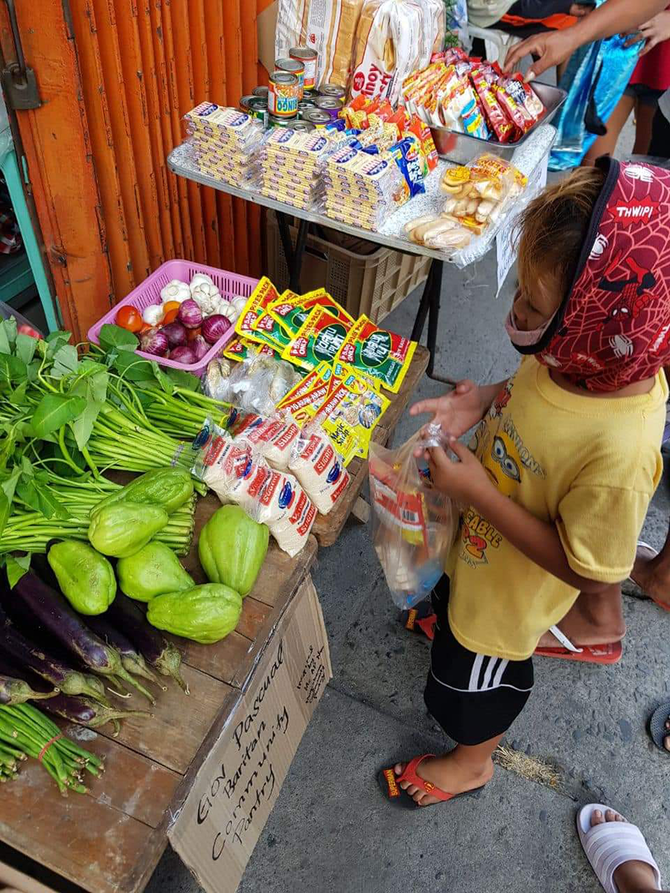
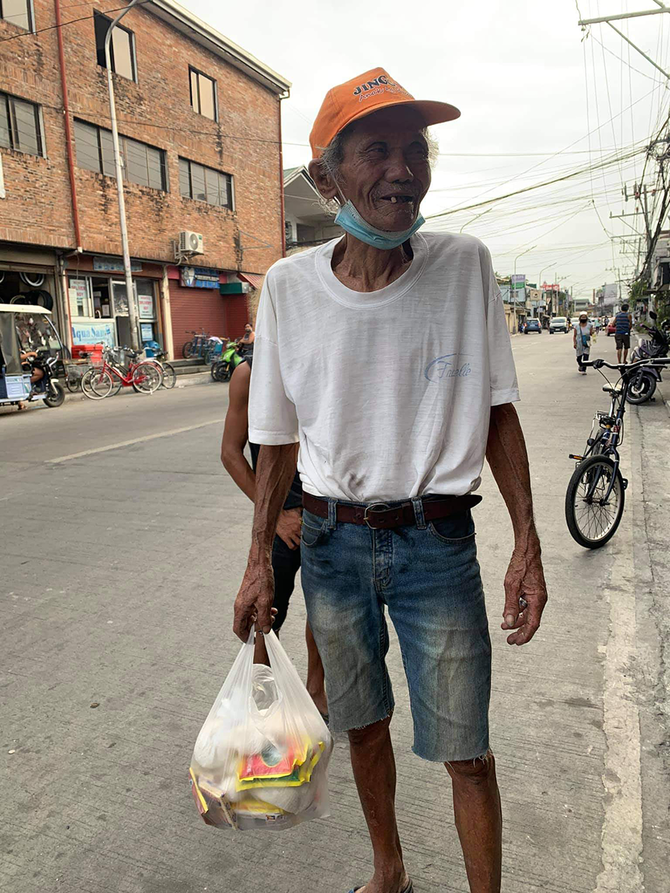

MANILA: It began with a small bamboo cart that Patricia Non set up in a quiet corner of Maginhawa Street in Quezon City two weeks ago.
Non’s mobile “Maginhawa food pantry” includes free food items and essential supplies with signage on the cart reminding Filipinos to “give what you can and take only what you need.”
Soon after launching the initiative on April 14, 26-year-old Non said in a Facebook post that her main goal for setting up the pantry was “to assist those reeling from the economic impact of the pandemic by giving out free food items and other basic goods.
“I know that the community pantry cannot address the root cause of hunger, but it could at least provide some relief to the needy,” she said.
The post went viral, and other Filipinos began to replicate Non’s “modest act” too, with hundreds of community pantries springing up across the Philippines to help coronavirus-weary residents with free meals, bringing their “Bayanihan,” or cooperative spirit, to the fore.
One such example is a community pantry set up along Disomangcop Street in war-torn Marawi, which 27-year-old Uthman bin Mohammed, one of its organizers, says has a much deeper significance for them.
Mohammad, who helped establish the Marawi community pantry, said that the initiative resonated with the “essence of Ramadan” — to increase charity and voluntarily help others — besides catering to those affected by the 2017 siege of the city by Daesh-inspired militants.
“Originally, the Marawi community pantry was inspired (by the) Maginhawa community pantry in Quezon City,” Mohammed, a graduate in Islamic Studies from the Mindanao State University, told Arab News.
“Besides that, one essence of Ramadan is to increase our voluntary act of giving. Fasting makes us feel the hunger which is regularly experienced by the poor and needy ... making us realize how important it is to share something with them … so that we may become generous towards one another, which is also a part of our religion,” he added.
Mohammad said the Marawi community pantry, which he set up with his friends and fellow youth from Lanao del Sur, has no sponsor but was being run on cash and voluntary support extended by other people in the community.
Initially, he explained that they had planned to set up the pantry along Disomangcop Street “as it is convenient for now,” especially since a majority of its residents are from the worst affected areas of Muslim-majority Marawi, which bore the brunt of a five-month-long battle between government forces and the Maute Group four years ago.
“They are IDPs (internally displaced residents) who are entitled to such support,” Mohammed said, adding that soon, they “hope to establish a mobile pantry that will cater to more people in other parts of the city too.”
As of Sunday, halal community pantries had also popped up in other areas of Mindanao, including Zamboanga City, Sulu, and Cagayan De Oro City, with the pantries open to non-Muslims as well.
In Malabon, north of Manila, Nina Louise Tesorero, 23, says she was also inspired by the Maginhawa food pantry to set up a similar one along the Gov. Pascual-Baritan Road, drawing from experience gained during a college project called “Pay It Forward” which she started six years ago.
“From my savings, I started giving out food packs on Christmas Eve to less fortunate residents in Malabon,” she told Arab News.
The initiative gained traction, and soon, Tesorero, along with a group of friends, launched fund-raising activities to help residents in other parts of Manila and nearby provinces.
When the coronavirus disease (COVID-19) pandemic struck, they assisted jeepney and tricycle drivers in Manila who had lost their source of income after the government announced a lockdown to limit the spread.
They also doled out food supplies, face masks and shields to non-medical front-liners such as food delivery workers and those manning checkpoints as part of the “Pay It Forward” initiative.
“Since it started, the response for the community pantry has been very heart-warming. People come not only to collect but to donate cash, food and groceries as well,” she said, adding: “No matter how small ... whatever amount they give will go a long way.”
However, the community pantry initiative has not been without its share of criticism, with Lt. Gen. Antonio Parlade, spokesperson for the government’s high profile anti-communist task force, linking some of the organizers to a communist rebel group.
In one interview, Parlade likened the massive popularity of community pantries “to the work of Satan” and has since received severe backlash for his comments.
In a virtual press briefing on Thursday, Armed Forces (AFP) Chief of Staff Gen. Cirilito Sobejana declined to comment on Parlade’s statements but emphasized the military’s full support to the ongoing humanitarian efforts.
“We are in turmoil with COVID-19 … We have a lot of problems. Some sectors of our society are locked down, they could not earn a living, so this gesture of feeding our less fortunate brothers is a humanitarian act which your armed forces strongly supports,” he said.
Sobejana added that he had already ordered all AFP units, particularly the Civil Military Operations Unit, to organize and support the initiative.
Defense Secretary Delfin Lorenzana said: “Regardless of their belief, as long as they are helping wholeheartedly, we will support (them). We are ready to assist if requested by the local government units and the Department of the Interior and Local Government and, if necessary, to deploy the AFP’s mobile kitchens where they are needed.”
Last week, Senator Panfilo Lacson said that the makeshift community pantries could also be “a sign of desperation.
“It is good that through the community pantries, we see mutual aid by neighbors and barangay (village) residents. But this is also a sign of desperation, that people can no longer rely on (the) government to help them,” he said.
Meanwhile, Dindo Manhit, president of Stratbase ADR Institute think tank, told Arab News that the mobile pantry initiative is “how (the) continuing health crisis due (to the) failure in governance and its economic consequences is being addressed by communities through our values of civic culture.
“It is the core of my belief that we will overcome and recover from COVID-19. through a whole of society approach and not (the) whole of government that (President Rodrigo) Duterte’s administration response is built on,” Manhit told Arab News.


