

New photo exhibition in Riyadh combines calligraphy and natural landscapes

1 / 8
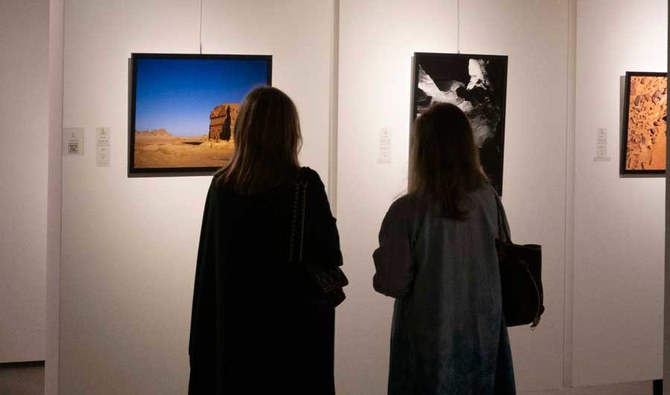
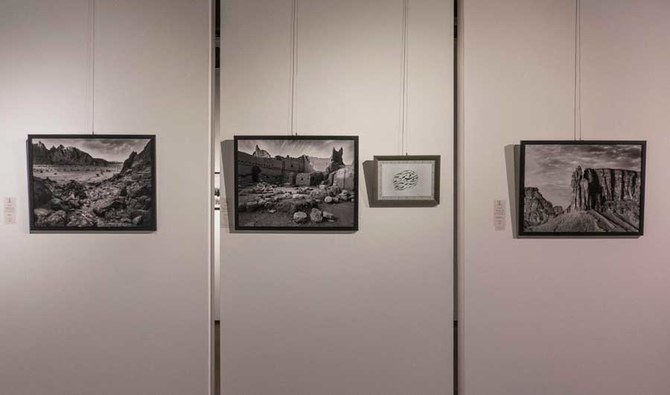
Waleed Almarhoum grew up practicing calligraphy from a young age, later branching out into other mediums, specifically photography, through which he would often focus on light and shadows. (Photo/Ziyad Alarfaj)
2 / 8
Waleed Almarhoum grew up practicing calligraphy from a young age, later branching out into other mediums, specifically photography, through which he would often focus on light and shadows. (Photo/Ziyad Alarfaj)
3 / 8
Waleed Almarhoum grew up practicing calligraphy from a young age, later branching out into other mediums, specifically photography, through which he would often focus on light and shadows. (Photo/Ziyad Alarfaj)
4 / 8
Waleed Almarhoum grew up practicing calligraphy from a young age, later branching out into other mediums, specifically photography, through which he would often focus on light and shadows. (Photo/Ziyad Alarfaj)
5 / 8
Waleed Almarhoum grew up practicing calligraphy from a young age, later branching out into other mediums, specifically photography, through which he would often focus on light and shadows. (Photo/Ziyad Alarfaj)
6 / 8
Waleed Almarhoum grew up practicing calligraphy from a young age, later branching out into other mediums, specifically photography, through which he would often focus on light and shadows. (Photo/Ziyad Alarfaj)
7 / 8
Waleed Almarhoum grew up practicing calligraphy from a young age, later branching out into other mediums, specifically photography, through which he would often focus on light and shadows. (Photo/Ziyad Alarfaj)
8 / 8
Waleed Almarhoum grew up practicing calligraphy from a young age, later branching out into other mediums, specifically photography, through which he would often focus on light and shadows. (Photo/Ziyad Alarfaj)
Short Url
Updated 26 April 2021
Follow

New photo exhibition in Riyadh combines calligraphy and natural landscapes

  • The event showcases the power behind the written word accompanied by some natural landscape photos

JEDDAH: They say that a picture is worth a thousand words, and that written words can drive behavior.

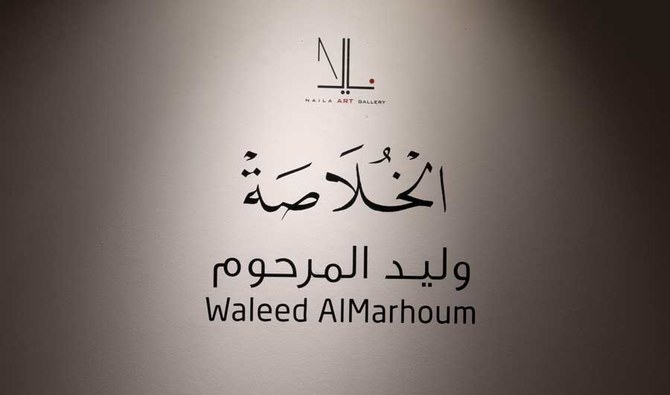
Waleed Almarhoum, a seasoned Saudi photographer and self-described “novice calligrapher” has taken both messages to heart, and has set out to combine the two mediums in an exhibit titled “Al-Khulasah.”
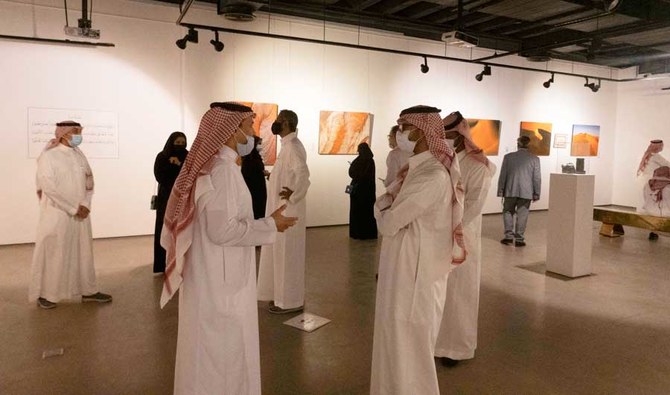
Opening at Riyadh’s prestigious Naila Art Gallery, “Al-Khulasah” showcases the true power behind the written word accompanied by some of his famed natural landscape photos.

Arabic calligraphy:
Ancient craft,
modern art
For the Saudi Ministry of Culture's Year of Arabic Calligraphy in 2020/21, we take an in-depth look at how the craft has developed from ancient to modern times.

Enter


keywords

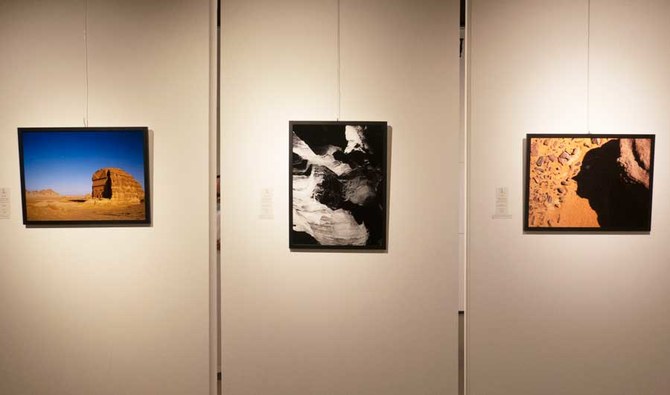
From the golden deserts of the Arabian Peninsula to the thick misty forests of Europe and the lush green jungles of the Philippines, Almarhoum’s photographs capture the light in a special way that mixes and matches lines, to create abstract visions and let the viewer’s imagination run wild, forging new shapes and figures along the way.

HIGHLIGHT

From the golden deserts of the Arabian Peninsula to the thick misty forests of Europe and the lush green jungles of the Philippines, Waleed Almarhoum’s photographs capture the light in a special way that mixes and matches lines.

“‘Al-Khulasah’ refers back to a poem my father read to me, and I chose three verses that spoke to me,” Almarhoum told Arab News. “They explain the purpose of the exhibit and the connotations the images contain.”
Almarhoum grew up practicing calligraphy from a young age, later branching out into other mediums, specifically photography, through which he would often focus on light and shadows, and how they coexist harmoniously in nature.
His calligraphy, meanwhile, is simple, but each brush stroke is influenced by the magnificence of the colors, the tones and the softness of the images they adorn.
“With the right angle and time, sometimes the sun’s rays reflecting off the soft sands can give the illusion of gold. The image is as soft as silk and I mimicked the soft strokes found in (the) image to repeatedly draw the word ‘harir’ (Arabic for silk), to reflect on the similar movement of the sand with similar colors as well,” he said.


How science is reshaping early years education 

Updated 27 December 2025
Follow

How science is reshaping early years education 

DUBAI: As early years education comes under renewed scrutiny worldwide, one UAE-based provider is making the case that nurseries must align more closely with science.

Blossom Nursery & Preschool, which operates 32 locations across the UAE, is championing a science-backed model designed to close what it sees as a long-standing gap between research and classroom practice.

“For decades, early years education has been undervalued globally — even though science shows the first five years are the most critical for brain development,” said Lama Bechara-Jakins, CEO for the Middle East at Babilou Family and a founding figure behind Blossom’s regional growth, in an interview with Arab News.

Lama Bechara-Jakins is the CEO for the Middle East at Babilou Family and a founding figure behind Blossom’s regional growth. (Supplied)

She explained that the Sustainable Education Approach was created to address “a fundamental gap between what we know from science and what actually happens in nurseries.”

Developed by Babilou Family, the approach draws on independent analysis of research in neuroscience, epigenetics, and cognitive and social sciences, alongside established educational philosophies and feedback from educators and families across 10 countries. The result is a framework built around six pillars; emotional and physical security, natural curiosity, nature-based learning, inclusion, child rhythms, and partnering with parents.

Two research insights, Bechara-Jakins says, were particularly transformative. “Neuroscience shows that young children cannot learn until they feel safe,” she said, adding that stress and inconsistent caregiving can “literally alter the architecture of the developing brain.” 

Equally significant was evidence around child rhythms, which confirmed that “pushing children academically too early is not just unhelpful — it can be counterproductive.”

Feedback from families and educators reinforced these findings. Across regions, common concerns emerged around pressure on young children, limited outdoor time and weak emotional connections in classrooms. What surprised her most was that “parents all sensed that something was missing, even if they couldn’t articulate the science behind it.”

At classroom level, the strongest body of evidence centres on secure relationships. Research shows that “secure attachments drive healthy brain development” and that children learn through trusted adults. At Blossom, this translates into practices such as assigning each child “one primary educator,” prioritising calm environments, and viewing behaviour through “a neuroscience lens — as stress signals, not misbehaviour.”

Bechara-Jakins believes curiosity and nature remain overlooked in many early years settings, despite strong evidence that both accelerate learning and reduce stress. In urban centres such as Dubai, she argues, nature-based learning is “not a luxury. It is a developmental need.” 

For Blossom, this means daily outdoor time, natural materials, gardening, and sensory play — intentional choices aimed at giving children what science says they need to thrive.