Pakistan offers support to India amid rampaging second wave of COVID-19 pandemic

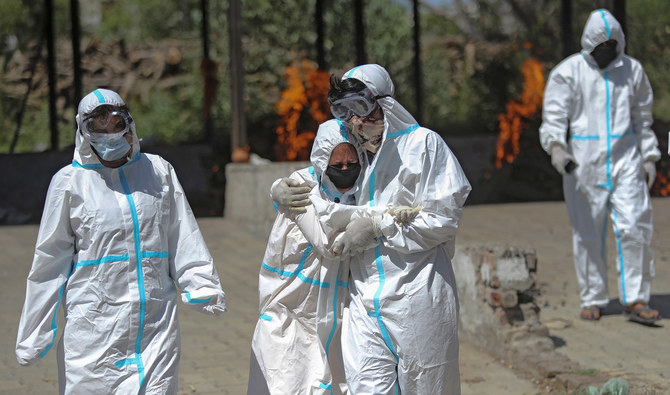
A relative of a person who died of COVID-19 is consoled by another during cremation in Jammu, India, on April 25, 2021. (AP)
Short Url
Updated 25 April 2021
Follow

Pakistan offers support to India amid rampaging second wave of COVID-19 pandemic

  • Says willing to send ventilators, BiPap machines, digital X ray machines, personal protective equipment and related items
  • Says Pakistan and India can work out modalities for quick delivery of relief items, explore future cooperation to mitigate pandemic challenges

ISLAMABAD: Pakistan has offered “relief support” to India as hospitals in the neighbouring nation begged for oxygen supplies on Saturday and coronavirus infections soared, setting a new world record for cases for the third consecutive day.

India is in the grip of a 'tsunami' of disease in its second wave, with the number of cases across the country of around 1.3 billion rising overnight by 346,786, for a total of 16.6 million cases, including 189,544 deaths. The government has deployed military planes and trains to get oxygen to Delhi from far corners of the country and abroad, including Singapore.

"As a gesture of solidarity with the people of India in the wake of the current wave of COVID-19, Pakistan has offered to provide relief support to India,” the Pakistani foreign office said, including ventilators, BiPap machines that can help push air into the lungs, digital X ray machines, personal protective equipment and related items.

“Concerned authorities of Pakistan and India can work out modalities for quick delivery of the relief items,” the statement said. “They can also explore possible ways of further cooperation to mitigate the challenges posed by the pandemic.”

Foreign minister Shah Mahmood Qureshi tweeted: "We believe in a policy of #HumanityFirst."


“As a gesture of solidarity with the people of India in the wake of the current wave of #COVID19, Pakistan has officially offered relief & support to #India, including ventilators, Bi PAP, digital X ray machines, PPEs & other related items. We believe in a policy of #HumanityFirst”

Earlier on Saturday, Pakistani Prime Minister Imran Khan tweeted in solidarity with the people of India:


#IndiaNeedsOxygen and #PakistanStandsWithIndia have been top Twitter trends in Pakistan since Thursday.

Hospitals in Delhi have gone to the city's high court this week seeking it to order state and federal governments to make emergency arrangements for medical supplies, mainly oxygen.

"It's a tsunami. How are we trying to build capacity?" the Delhi high court asked the state and federal governments in response to the plea.




Pakistan capital market transitions to T+1 settlement cycle ahead of multiple advanced markets

Updated 7 sec ago
Follow

Pakistan capital market transitions to T+1 settlement cycle ahead of multiple advanced markets

  • A T+1 settlement cycle means that securities transactions are finalized and settled one business day after trade date
  • Effective from Feb. 9, all eligible trades at the PSX are now settled on a T+1 basis, replacing the previous T+2 cycle

KARACHI: Pakistan’s capital market has officially transitioned to the Trade plus one (T+1) settlement cycle, a landmark reform that strengthens efficiency, reduces risk and aligns the country with international best practices, the Pakistan Stock Exchange (PSX) said on Tuesday.

A T+1 settlement cycle means that securities transactions are finalized and settled one business day after the trade date, which reduces counterparty risk and improves capital efficiency in the exchange of funds and securities. 

Effective from Feb. 9, all eligible trades at the PSX are now settled on a T+1 basis, replacing the previous T+2 cycle. The transition was implemented under the guidance of the Securities and Exchange Commission of Pakistan (SECP) through close collaboration among all stakeholders, according to the PSX.

It aligns Pakistan’s capital market with leading markets such as the United States, Canada, Mexico, Argentina, Jamaica and China, which have already adopted shorter settlement cycles. Europe, the UK and Switzerland are set to follow by 2027. By moving early, Pakistan has demonstrated its commitment to modernization and investor protection.

“The transition to the T+1 settlement cycle brings important advantages for Pakistan’s capital market. It enables faster access to funds and securities, improving liquidity, while reducing settlement and counterparty risk through shorter exposure periods,” the PSX said.

“Quicker trade finalization enhances efficiency and the reform strengthens investor confidence, particularly among institutional and foreign investors. Together, these benefits support a stronger and more resilient market aligned with global best practices.”

Pakistan’s stock market has touched historic highs in recent months as broad institutional buying boosted investor confidence amid ongoing economic reforms under international lending programs. Pakistani state media reported in Jan. around 135,000 new investors had joined the PSX over the last 18 months.

SECP Chairman Dr. Kabir Ahmed Sidhu commended the PSX, the Central Depository Company and the National Clearing Company of Pakistan for the successful implementation of the T+1 settlement system.

“The reform brings Pakistan’s capital market at par with modern jurisdictions by accelerating trade settlement, reducing counterparty and market risks, and enhancing liquidity,” he was quoted as saying by the PSX.

“The adoption of T+1 will strengthen investor confidence and align Pakistan’s capital market with evolving international standards and global best practices.”