In Quetta, descendant of 18th-century soldier turns home into war museum

Javed Bangulzai holds an ancient sword in front of the artifact collection inside his home in Quetta, Pakistan on April 20, 2021. (AN Photo)
Short Url
Updated 24 April 2021
Follow

In Quetta, descendant of 18th-century soldier turns home into war museum

  • Some of the antiques in Javed Bangulzai’s possession are over 300 years old
  • Says favorite item is a sword used in 1777 Mashhad War by his great grandfather

QUETTA: In the basement of his home in southwestern Pakistan, one man’s beloved ‘museum’ is an ode to the brave legacy of Balochistan’s fabled wars.
Located in Quetta, the capital of Balochistan province, a vast collection of swords, rifles, shields and weapons used by Baloch tribes against British colonizers and before, is on display in a 35-ft basement room owned by Javed Bangulzai.
“I have adopted this passion of keeping and displaying antiques...used by Baloch tribes from my father, Muhammad Afzal Bangulzai, who was very fond of preserving the items and war equipment of our forefathers,” the 40-year-old said, while pointing to his favorite objects among dozens of swords, sabers, rifles, jewelry items and tools — some over 300 years old.
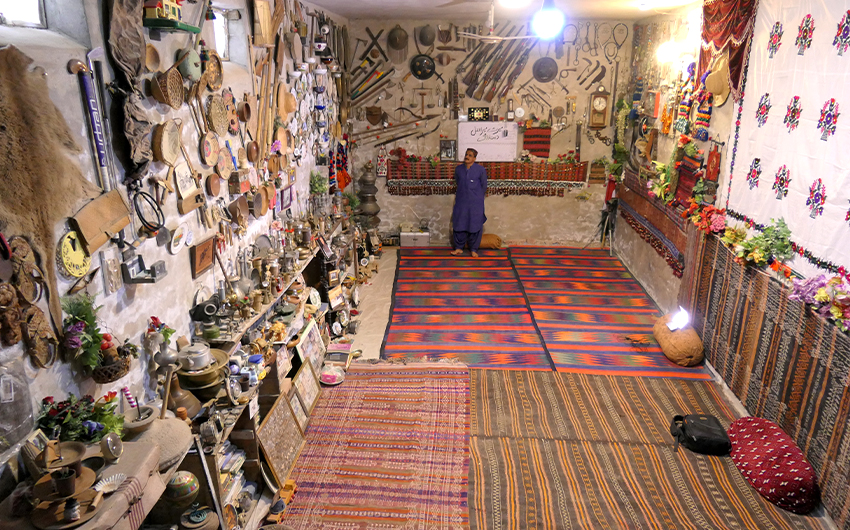


Javed Bangulzai in the basement he's converted into a war museum, inside his home in Quetta, Pakistan, on April 20, 2021. (AN Photo)

“In the whole museum my most favorite item is the Zagham sword which my great-grandfather had used during the Mashhad War in 1777,” he said. 
“Alongside this is the Dhadhri rifle and Roghdar, another type of Balochi rifle, first used by Baloch warriors in Dhadhar district Kachi during the 1839 war when the British Army stormed the Khanate of Kalat.”
While Baloch tribes have been present in South Asia and part of the Middle East since before the Common Era, their own state, the Khanate of Kalat emerged in the region in the 16th century. Its people were famous for battle bravery. After the partition of India in 1947, the khanate remained a princely state until 1955, when it was incorporated into Pakistan. 
For Bangulzai, keeping and studying Baloch heritage is a family affair. Most of the items belong to his ancestors, but some, he said, were gifted by friends who believed the museum was the perfect place to keep them.
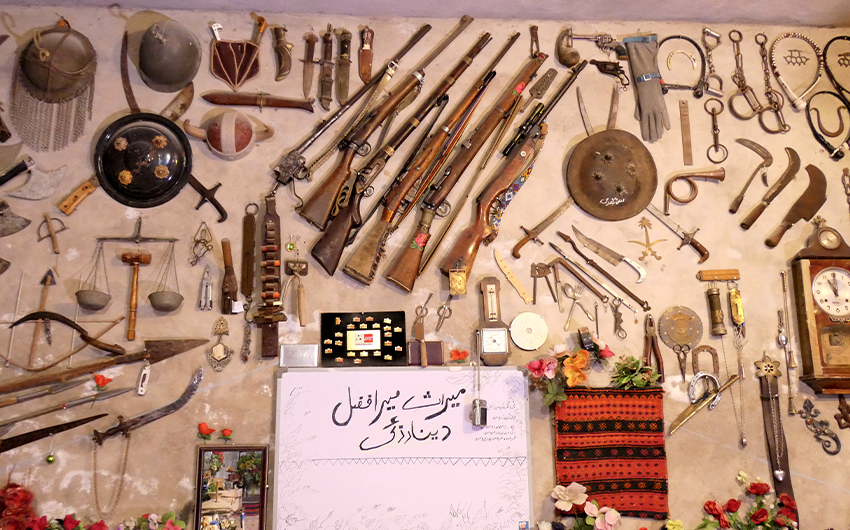


Ancient swords, guns and other war artifacts hang on the wall in Javed Bangulzai’s home in Quetta, Pakistan on April 20, 2021. (AN Photo)

Baloch tribes had advanced weaponry as they were continuously engaged in warfare — against others and among themselves — historian Panah Baloch told Arab News.

“Baloch warriors, with their sharp war skills and bravery remained allies and supported many other tribes and nations who waged wars to free or expand their land. The Balochs have even stood with famous Afghan ruler Ahmad Shah Abdadli who fought to expand his land toward the Persian subcontinent during the 16th century,” he said.
“They made many types of swords like the Sheerazi sword during the Rind and Lashar tribes war in the 16th century and Hindi swords during the war with the British Army.”
The Quetta home museum regularly receives visitors who are guided through the collection and Baloch history by Bangulzai and his younger brothers.
“I spend almost all of my days inside my home museum in order to absorb the whole history of my family,” Bangulzai said, with his hands crossed behind his back, proudly perusing his collection as though for the first time.
“Seeing these swords and rifles... reminds me of their bravery.”
Pakistan, global crypto exchange discuss modernizing digital payments, creating job prospects 

Updated 05 December 2025
Follow

Pakistan, global crypto exchange discuss modernizing digital payments, creating job prospects 

  • Pakistani officials, Binance team discuss coordination between Islamabad, local banks and global exchanges
  • Pakistan has attempted to tap into growing crypto market to curb illicit transactions, improve oversight

ISLAMABAD: Pakistan’s finance officials and the team of a global cryptocurrency exchange on Friday held discussions aimed at modernizing the country’s digital payments system and building local talent pipelines to meet rising demand for blockchain and Web3 skills, the finance ministry said.

The development took place during a high-level meeting between Finance Minister Muhammad Aurangzeb, Pakistan Virtual Assets Regulatory Authority (PVARA) Chairman Bilal bin Saqib, domestic bank presidents and a Binance team led by Global CEO Richard Teng. The meeting was held to advance work on Pakistan’s National Digital Asset Framework, a regulatory setup to govern Pakistan’s digital assets.

Pakistan has been moving to regulate its fast-growing crypto and digital assets market by bringing virtual asset service providers (VASPs) under a formal licensing regime. Officials say the push is aimed at curbing illicit transactions, improving oversight, and encouraging innovation in blockchain-based financial services.

“Participants reviewed opportunities to modernize Pakistan’s digital payments landscape, noting that blockchain-based systems could significantly reduce costs from the country’s $38 billion annual remittance flows,” the finance ministry said in a statement. 

“Discussions also emphasized building local talent pipelines to meet rising global demand for blockchain and Web3 skills, creating high-value employment prospects for Pakistani youth.”

Blockchain is a type of digital database that is shared, transparent and tamper-resistant. Instead of being stored on one computer, the data is kept on a distributed network of computers, making it very hard to alter or hack.

Web3 refers to the next generation of the Internet built using blockchain, focusing on giving users more control over their data, identity and digital assets rather than big tech companies controlling it.

Participants of the meeting also discussed sovereign debt tokenization, which is the process of converting a country’s debt such as government bonds, into digital tokens on a blockchain, the ministry said. 

Aurangzeb called for close coordination between the government, domestic banks and global exchanges to modernize Pakistan’s payment landscape.

Participants of the meeting also discussed considering a “time-bound amnesty” to encourage users to move assets onto regulated platforms, stressing the need for stronger verifications and a risk-mitigation system.

Pakistan has attempted in recent months to tap into the country’s growing crypto market, crack down on money laundering and terror financing, and promote responsible innovation — a move analysts say could bring an estimated $25 billion in virtual assets into the tax net.

In September, Islamabad invited international crypto exchanges and other VASPs to apply for licenses to operate in the country, a step aimed at formalizing and regulating its fast-growing digital market.