DUBAI: Egypt and Russia have agreed to resume flights between the two countries after a five-year suspension, including Hurghada and Sharm El-Sheikh, Presidency’s website reported.
The decision comes after Egypt maintained security standards for its air travel and both sides reached agreements on other undisclosed issues.
Egypt’s President Abdel-Fattah El-Sisi welcomed the resumption of flights between the two countries in a phone call with Russian President Vladimir Putin.
From his side, Putin expressed his country’s keenness to enhance various aspects of the bilateral relations with Egypt, praising the extended partnership between the two countries.
He also affirmed that Russia was counting on Egypt’s pivotal role in stabilizing its entire regional environment.
The report added that the call also covered discussions about developments in Libya and the Renaissance Dam file. It also covered issues of bilateral cooperation in investment, especially regarding the economic zone of the Suez Canal Corridor.
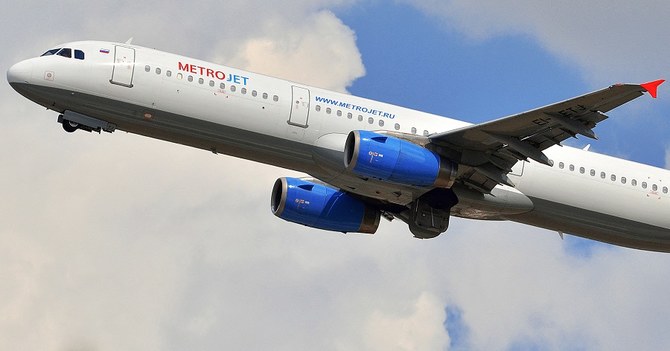
Russian aviation and tourism flights to Egypt were suspended after a Russian passenger plane crashed in the Sinai Peninsula on Oct. 31, 2015, with 224 people on board.

Egypt, Russia to resume flights between both countries
https://arab.news/wmbr9
Egypt, Russia to resume flights between both countries
- Egypt’s President Abdel-Fattah El-Sisi welcomed the resumption of flights
- Putin expressed his country’s keenness to enhance various aspects of the bilateral relations with Egypt
Aoun slams ‘systematic policy of aggression’ as Israeli strikes kill 2, wound journalists in south Lebanon escalation
- Lebanese Army: Attacks terrorize civilians and hinder weapons control plan
- Israeli army spokesperson said military eliminated Abu Ali Salameh, who served as a Hezbollah liaison officer in the area
- Israeli drones targeted sites with heavy airstrikes, wounding journalists in Qanarit and destroying their equipment, cameras and vehicles
BEIRUT: Two people were killed and several journalists wounded in a series of Israeli attacks on Wednesday targeting southern areas, most of which lie north of the Litani River.
The Lebanese Army Command described the escalation as “impeding the army’s efforts and hindering the completion of its plan to confine weapons to Lebanese territory.” It said that the strikes terrorized civilians, caused deaths and injuries, displaced dozens of families and undermined regional stability.
The day’s security situation was dominated by hours of Israeli escalation, including airstrikes and evacuation warnings targeting villages and populated areas ahead of further bombardment.
The Israeli army said that warplanes carried out precision strikes on civilian vehicles in Bazouriyeh, killing a Hezbollah member. A separate drone strike hit a civilian vehicle on the Zahrani-Mseileh road, killing one person, with Israel claiming the target was another Hezbollah operative.
Israeli army spokesman Avichai Adraee said that the military “eliminated Abu Ali Salameh, who served as a Hezbollah liaison officer” in the village of Yanouh, in southern Lebanon. He accused Salameh of managing Hezbollah activities to “enable the group to operate within civilian areas and on private property, and to establish terrorist infrastructure in the heart of populated civilian areas, through the deliberate and cynical exploitation of the residents to serve Hezbollah’s objectives.”
Adraee claimed that on Dec. 13, Israel alerted Lebanon’s enforcement mechanism about a Hezbollah weapons depot in Yanouh. Salameh allegedly relayed the notification to other Hezbollah members, who then blocked Lebanese army access by staging a gathering while removing weapons from the site.
He said that Salameh also coordinated with the Lebanese army to falsely document the property as weapons-free, even as “suspicious boxes” were removed via a back entrance. Adraee called these actions a violation of Israel-Lebanon understandings, adding that “the Israeli army will continue to take measures to eliminate all threats.”
Israeli artillery also shelled the Harmoun area in the Bint Jbeil district, south of the Litani River, prompting Israeli army warnings — complete with maps — for residents of Qanarit, Kfour in Nabatieh and Jarjouh to evacuate immediately.
Israeli drones then hammered the sites with heavy airstrikes, wounding journalists in Qanarit and destroying their equipment, cameras and vehicles.
The Press Photographers Syndicate said: “Israeli claims of maintaining safe distances offer no protection, just as the warnings issued by the enemy to civilians offer no protection. It seems that cameras are not a red line.”
The statement urged photojournalists “to exercise caution and avoid turning their professional commitment into a reckless gamble.”
Civilians in the targeted areas reported receiving phone calls from Israel ordering them to clear squares, residential neighborhoods and a mosque.
The Lebanese Army Command confirmed that “Israeli attacks and violations targeted civilian buildings and homes in several areas, most recently in villages in the south, in a blatant violation of Lebanon’s sovereignty and security, the cessation of hostilities agreement, and UN Security Council Resolution 1701.”
Lebanese President Joseph Aoun issued a statement on Wednesday evening condemning the strikes and accused Tel Aviv of “pursuing a systematic policy of aggression” that targeted civilians and violated international humanitarian law, and constituted “a dangerous escalation.”
“This repeated aggressive behavior proves Israel’s refusal to abide by its commitments under the cessation of hostilities agreement and reflects a deliberate disregard for the efforts exerted by the Lebanese state to control the situation on the ground, maintain stability, and prevent the escalation of the confrontation,” he said.
He called on the international community — particularly the agreement’s sponsors — “to assume their legal and political responsibilities and take clear and effective measures to stop these violations and put an end to the policy of impunity.”
The escalation also came as Aoun reaffirmed his commitment to “monopolizing weapons in the hands of the state throughout all Lebanese territory.”
At a meeting of the Higher Supervisory Committee for Lebanon’s border protection program — attended by the US and Canadian ambassadors — Army Commander Gen. Rudolph Haykal stressed the army’s “absolute commitment” to securing borders but called for “qualitative military support” to tackle challenges on the northern and eastern fronts.
The army said that the ambassadors praised “its professionalism and success,” stressing the need to bolster the military institution to enhance its ability to maintain security nationwide. Lebanese military units are currently securing the northern and eastern borders with Syria to combat smuggling, weapons transfers and illegal infiltration.


