Pakistan awaits $6 bln loan from Exim Bank of China for ML-1 railway project

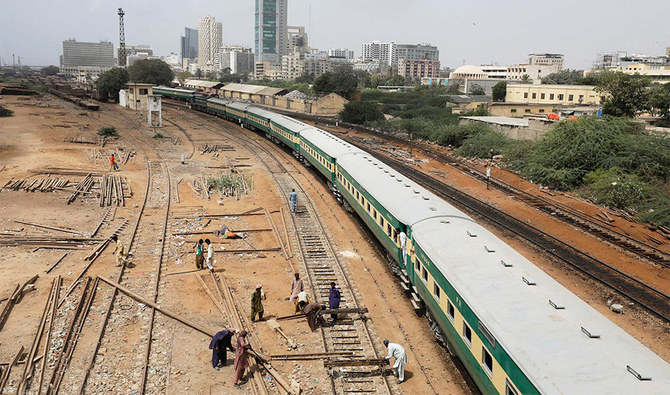
A passenger train moves past laborers working on a railway track along City Station in Karachi, Pakistan, on September 24, 2018. (REUTERS/File)
Short Url
Updated 23 April 2021
Follow

Pakistan awaits $6 bln loan from Exim Bank of China for ML-1 railway project

  • Project to be built on cost-sharing basis between Islamabad and Beijing, major financing coming from China’s Government Concessional Loan 
  • Last year Pakistan approved the project, its costliest to date, as part of multibillion-dollar China-Pakistan Economic Corridor agreement

KARACHI: Pakistan is ready to construct the multibillion-dollar ML-1 railway project after receiving a much anticipated $6 billion loan from the Exim Bank of China, a Pakistan Railways spokesperson has said. 
Pakistan approved the project last year, its costliest to date, as part of the multibillion-dollar China-Pakistan Economic Corridor (CPEC) agreement, giving the go-ahead for a $6.8 billion project to upgrade its railway lines. 
CPEC has seen Beijing pledge over $60 billion for infrastructure projects in Pakistan, central to China’s wider Belt and Road Initiative (BRI) to develop land and sea trade routes in Asia and beyond.
The railway project, known as Mainline-1 (ML-1), is meant to be built on a cost-sharing basis between Islamabad and Beijing, with major financing expected through China’s Government Concessional Loan (GCL), though Pakistani authorities will also provide about $800 million as equity for the project. 
“After finalizing technical and administrative details, Pakistan sent all project documents to the Exim Bank of China through the authorities in Beijing for the approval of loan,” Pakistan Railways spokesperson Hamdan Nazir told Arab News. “The Pakistan Railways has already finalized all documents and the next milestone will be to float the tender,” he continued. 
The Exim Bank of China is one of three institutional banks in China chartered to implement state policies in industry, foreign trade, economy, and foreign aid to other developing countries, and provide policy financial support to promote the export of Chinese products and services.
The ML-1 line will lay down parallel railway tracks along with existing ones that connect the port city of Karachi and Peshawar, allowing trains to run at a speed of 160-kilometer per hour instead of the usual 65 to 110 km/h. Freight trains will operate at 120 km/h after the railway system is upgraded and a computer-based signal and control technology will be introduced. 
Pakistan Railways will be the proposing and implementing agency of the project and work will be awarded through open bidding as per Public Procurement Regulatory Authority (PPRA) Rules through an engineering, procurement, and construction (EPC) contract.
“All the pre-funding formalities, including preliminary feasibilities reports, have been done and tender documents have been completed,” the spokesman said, adding: “When the tender documents are accepted, the actual loan will be sanctioned.” 
The country’s current railway minister Azam Khan Swati did not respond to request for comment for this article. 


Pakistan, China call for more ‘visible, verifiable’ actions to dismantle ‘terrorist’ groups in Afghanistan 

Updated 5 sec ago
Follow

Pakistan, China call for more ‘visible, verifiable’ actions to dismantle ‘terrorist’ groups in Afghanistan 

  • Foreign ministers of China, Pakistan co-chair seventh round of strategic dialogue in Beijing to review bilateral cooperation, regional situation
  • Pakistan accuses Kabul of facilitating attacks launched by militant outfits from Afghanistan’s soil, a charge Kabul has repeatedly denied

ISLAMABAD: Pakistan and China on Monday urged Afghanistan to take more visible actions to dismantle “terrorist organizations” based in its country, vowing to work with world powers to encourage Kabul to adopt moderate policies and integrate into the international community. 

Ties between Pakistan and Afghanistan remain strained as Islamabad alleges militant outfits, mainly the Tehreek-e-Taliban Pakistan (TTP) group, uses Afghan soil to launch attacks against Pakistan. Islamabad accuses the Afghan Taliban government of facilitating these attacks against Pakistan, charges Kabul have repeatedly denied. 

The joint statement by China and Pakistan was released after a meeting of both countries’ foreign ministers, Ishaq Dar and Wang Yi, in Beijing. Dar and his Chinese counterpart co-chaired the Seventh Round of China-Pakistan Foreign Ministers’ Strategic Dialogue in Beijing on Jan. 4 where they reviewed cooperation in trade, investment, economic sectors, counterterrorism, defense and regional matters. 

“The two sides called for more visible and verifiable actions to dismantle and eliminate all terrorist organizations based in Afghanistan which continue to pose serious threats to regional and global security, and prevent terrorist organizations from using the Afghan territory for terrorism against any other country and to endanger any other country,” the statement read. 

The joint statement said the two countries will work with world powers to encourage Kabul to adopt an inclusive political framework, moderate policies, and pursue good neighborliness. 

On bilateral cooperation, China and Pakistan said they had agreed to focus on industry, agriculture and mining, and also promote the building and operation of the Gwadar Port in southwestern Pakistan. 

“The two sides will deepen cooperation in areas such as trade and investment, information technology, science and technology, cybersecurity, technical and vocational training and education, and people-to-people and cultural exchanges,” the statement said. 

“The two sides agreed to further strengthen cooperation in the financial and banking sectors, including extending mutual support at regional and international multilateral financial forums. Pakistan appreciated China for providing support for its fiscal and financial sectors.”

The joint statement said China commended Pakistan’s “comprehensive measures” to combat “terrorism” and protect Chinese personnel, projects and institutions in the country.

“The two sides reiterated their commitment to combating terrorism in all its forms and manifestations with zero tolerance, and agreed to further deepen all-round cooperation on counter-terrorism and security, and make concerted efforts to ensure that the China-Pakistan Belt and Road cooperation advance in a secure and smooth manner,” the statement said. 

Pakistan and China expressed their willingness to conduct a transboundary water resources cooperation, stressing the importance of fulfilling international legal obligations. The statement comes as Pakistan frequently accuses India of violating a water-sharing agreement between the two neighbors, claiming New Delhi purposefully diverts the flow of water away from its territory. 

Islamabad has warned that any move by New Delhi to stop or divert the flow of Indus rivers to Pakistan will be considered an “act of war.”

Pakistan and China also demanded an unconditional, comprehensive and permanent ceasefire in Gaza in their joint statement, reaffirming their support for the Palestinian people’s right to self-determination and for the implementation of a two-state solution in the Middle East. 

“The two sides also expressed their concern at the situation in the occupied West Bank, and urged the need for urgently addressing it,” the statement said.