

13 COVID-19 patients die in Indian hospital blaze

1 / 2
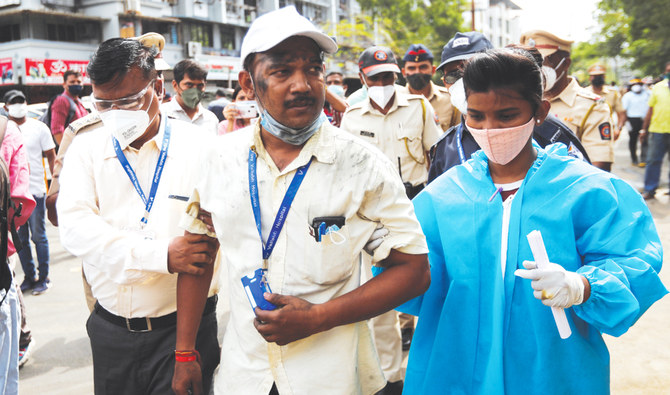
An employee of a hospital in western India is evacuated after it caught fire on Friday amid an extreme surge in coronavirus infections across the nation. (Reuters)
2 / 2
India’s health care system has long suffered from underfunding and the new outbreak has seen critical shortages in oxygen, drugs and hospital beds. (Reuters)
Short Url
Updated 24 April 2021
Follow

13 COVID-19 patients die in Indian hospital blaze

  • No oxygen, hospitals overwhelmed as 333,000 new cases reported
  • India’s health care system has long suffered from underfunding

NEW DELHI: On a day when intensive care patients died when a fire broke out at a coronavirus hospital on the outskirts of Mumbai, dozens of others choked to death as India’s healthcare system was overwhelmed, facing a critical shortage of oxygen amid a devastating surge in infections.
India has reported 333,000 new cases in the past 24 hours, for a second day recording the world’s highest daily tally of coronavirus.
Daily coronavirus deaths jumped to 2,263, while officials across northern and western India, including the capital, New Delhi, warned that most health facilities were full and running out of oxygen.
The fire that broke out at the ICU of the COVID-19 hospital in the Virar area of the Palghar district killed 13 patients in what was the second major hospital incident in the western state of Maharashtra within a week. On Wednesday, an oxygen leakage at a hospital in Nasik district claimed the lives of 24 patients who were on ventilators.
“Such accidents show the pressure under which these hospitals are working and also the laxity in enforcing quality regulations in hospitals,” Mumbai-based researcher and Indian Journal of Medical Ethics editor, Dr. Amar Jesani, told Arab News.
“The situation is extremely grim across the country. People are not able to find a bed, oxygen. It seems a significant number of deaths are taking place due to the non-availability of critical care,” he said.

FASTFACT

The chief minister of Delhi, Arvind Kejriwal, warned in a meeting with Prime Minister Narendra Modi on Friday that there was a ‘huge shortage of oxygen’ at hospitals in India’s capital territory.

TV channels showed footage of people with empty oxygen cylinders lining up outside refilling facilities across the country, hoping to save critically ill relatives.
While the situation in Maharashtra is the worst, with more than 67,000 new COVID-19 cases and 600 deaths reported in the past 24 hours, New Delhi is also under increasing pressure as it reported 24,000 new COVID-19 cases and a record of 306 deaths in the past 24 hours.
The chief minister of Delhi, Arvind Kejriwal, warned in a meeting with Prime Minister Narendra Modi on Friday that there was a “huge shortage of oxygen” at hospitals in India’s capital territory.
At Sir Ganga Ram Hospital, one of the oldest medical facilities in New Delhi, 25 people have died, the hospital’s medical director, Satendra Katoch, said.
 “Low oxygen concentration likely contributed to the deaths of critical patients,” he said. “Critical patients need high pressure, stable oxygen supply.”
As the hospital’s statement that another 60 patients were at risk resulted in panic, oxygen was supplied later in the day.
The developments came as Modi held meetings on Friday with experts, chief ministers of states and oxygen manufacturers to address the crisis, which his government has been accused of mishandling.


Russia’s war footing may remain after Ukraine war, Latvia spy chief warns

Updated 7 sec ago
Follow

Russia’s war footing may remain after Ukraine war, Latvia spy chief warns

MUNICH: Russia will not end the militarization of its economy after fighting in Ukraine ends, the head of Latvia’s intelligence agency told AFP on the sidelines of the Munich Security Conference which ends Sunday.
“The potential aggressiveness of Russia when the Ukraine war stops will depend of many factors: How the war ends, if it’s frozen or not, and if the sanctions remain,” Egils Zviedris, director of the Latvian intelligence service SAB, told AFP.
Some observers believe that Russia has so thoroughly embraced a war economy and full military mobilization that it will be difficult for it to reverse course, and that this could push Moscow to launch further offensives against European territories.
Zviedris said that lifting current sanctions “would allow Russia to develop its military capacities” more quickly.
He acknowledged that Russia has drawn up military plans to potentially attack Latvia and its Baltic neighbors, but also said that “Russia does not pose a military threat to Latvia at the moment.”
“The fact that Russia has made plans to invade the Baltics, as they have plans for many things, does not mean Russia is going to attack,” Zviedris told AFP.
However, the country is subject to other types of threats from Moscow, particularly cyberattacks, according to the agency he leads.
The SAB recently wrote in its 2025 annual report that Russia poses the main cyber threat to Latvia, because of broader strategic goals as well as Latvia’s staunch support of Ukraine.
The threat has “considerably increased” since Moscow’s full-scale invasion of Ukraine in 2022, it said.
The agency has also warned that Russia is seeking to exploit alleged grievances of Russian-speaking minorities in the Baltics — and in Latvia in particular.
Russia’s Ministry of Foreign Affairs has repeatedly claimed to be preparing cases against Latvia, Lithuania and Estonia at the UN International Court of Justice over the rights of their Russian-speaking minorities.
“The aim of litigation: to discredit Latvia on an international level and ensure long-term international pressure on Latvia to change its policy toward Russia and the Russian-speaking population,” the report said.
In 2025, approximately 23 percent of Latvia’s 1.8 million residents identified as being of Russian ethnicity, according to the national statistics office.
Following the Russian invasion of Ukraine in 2022, Latvian authorities decided to require Russian speakers residing in the country to take an exam to assess their knowledge of the Latvian language — with those failing at potential risk of deportation.