60% ginners shut factories in Pakistan in last three years as cotton output nosedives

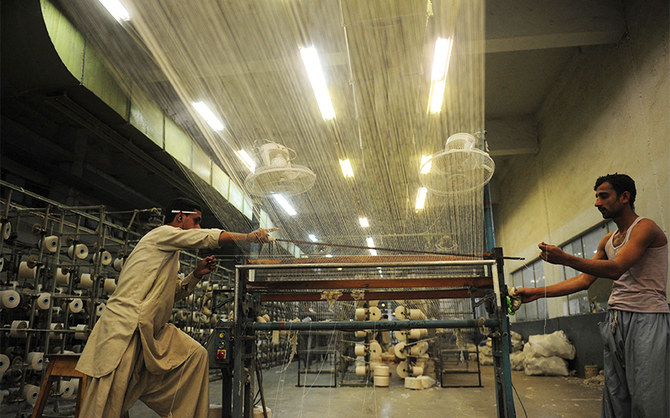
A Pakistani employee working at a textile factory in Karachi, Pakistan, on February 7, 2012. (AFP/File)
Short Url
Updated 21 April 2021
Follow

60% ginners shut factories in Pakistan in last three years as cotton output nosedives

  • Bad weather, pest outbreaks and better margins on other crops have hurt quality and quantity of cotton harvest
  • Production in the current fiscal year is set to tumble to the lowest level in about three decades

ISLAMABAD: Dr. Jassu Mal, chairman of the Pakistan Cotton Ginners’ Association, has said low cotton output has forced more than 60% of ginners to completely shut their factories in the past three years, leaving hundreds of thousands of farmers and textile workers out of work, international media reported on Wednesday. 
Pakistan, one of the world’s largest cotton producers, is finding it increasingly hard to meet its own needs, a problem that could push up import bills and further hurt its fragile economy.
“Years of bad weather, pest outbreaks and better margins on other crops have hurt the quality and quantity of Pakistan’s cotton harvest,” Bloomberg reported. “Production in the current fiscal year is set to tumble to the lowest level in about three decades.”
As a result, the country is spending billions of dollars to import record amounts of cotton to feed its textile industry. Its current account has recently flipped back into a deficit amid higher imports. The move also threatens to boost cotton prices, which have already hit a seven-year high.
Cotton is one of the most important cash crops for Pakistan and commonly referred to as “white gold” by the 1.5 million farmers that depend on it for a living. It serves as the raw material for the textile industry, which provides employment to 40% of the workforce and generates more than half of foreign exchange earnings.
“The cotton crop has shrunk to an alarming level but we don’t see the government taking any serious steps to revive production,” Mal, who is also Chief Executive Officer of Sindh Agro Industries and operates Pakistan’s biggest ginning mill in Hyderabad, told Bloomberg. 
In the latest season, Mal had to close at least three of his seven factories and run others at 50% capacity due to the lack of cotton. The company’s number of ginning workers has plunged to 100 from 400 about five years ago.
Pakistan’s cotton production is forecast to slump to less than 6 million bales in 2020-21, the lowest since at least 1992, Nasim Usman, chairman of the Karachi Cotton Brokers Forum, told Bloomberg. At its peak, output was more than 14 million bales in 2004-05.
The government has set a target for 10.5 million bales for fiscal 2022. 
The country is paying dearly for overseas cotton and would need to import 3 million to 4 million more bales by June, said Khaqan Najeeb, a former adviser to Pakistan’s finance ministry.
Higher purchases could further boost global cotton prices and widen Pakistan’s trade deficit, which rose more than 120% to $3.3 billion in March as Khan’s government struggles to tame inflation. A weaker rupee raises prices of essentials at home when the country’s balance of payment position worsens.


Pakistan opposition rallies in Khyber Pakhtunkhwa to demand release of Imran Khan

Updated 07 December 2025
Follow

Pakistan opposition rallies in Khyber Pakhtunkhwa to demand release of Imran Khan

  • PTI-led gathering calls the former PM a national hero and demands the release of all political prisoners
  • Government says the opposition failed to draw a large crowd and accuses PTI of damaging its own politics

ISLAMABAD: Pakistan’s opposition led by the Pakistan Tehreek-e-Insaf (PTI) party demanded the release of jailed former prime minister Imran Khan at a rally in the northwestern Khyber Pakhtunkhwa province on Sunday, describing him as a national hero who continues to command public support.

The gathering came days after a rare and strongly worded briefing by the military’s media chief, Lt. Gen. Ahmed Sharif Chaudhry, who dismissed Khan as “narcissistic” and “mentally ill” on Friday while responding to the former premier’s allegations that Pakistan’s chief of defense forces was responsible for undermining the constitution and rule of law.

He said that Khan was promoting an anti-state narrative which had become a national security threat.

The participants of the rally called for “civilian supremacy” and said elected representatives should be treated with respect.

“We, the people of Pakistan, regard Imran Khan as a national hero and the country’s genuinely elected prime minister, chosen by the public in the February 8, 2024 vote,” said a resolution presented at the rally in Peshawar. “We categorically reject and strongly condemn the notion that he or his colleagues pose any kind of threat to national security.”

“We demand immediate justice for Imran Khan, Bushra Bibi and all political prisoners, and call for their prompt release,” it added, referring to Khan’s wife who is also in prison. “No restrictions should be placed on Imran Khan’s meetings with his family, lawyers or political associates.”

Addressing the gathering, Sohail Afridi, the chief minister of Khyber Pakhtunkhwa, denied his administration was not serious about security issues amid increased militant activity. However, he maintained the people of his province had endured the worst of Pakistan’s conflict with militancy and urged a rethinking of long-running security policies.

The resolution asked the federal government to restore bilateral trade and diplomatic channels with Afghanistan, saying improved cross-border ties were essential for the economic stability of the region.

The trade between the two neighbors has suffered as Pakistan accuses the Taliban administration in Kabul of sheltering and facilitating armed groups that it says launch cross-border attacks to target its civilians and security forces. Afghan officials deny the claim.

The two countries have also had deadly border clashes in recent months that have killed dozens of people on both sides.

Some participants of the rally emphasized the restoration of democratic freedoms, judicial independence and space for political reconciliation, calling them necessary to stabilize the country after years of political confrontation.

Reacting to the opposition rally, Information Minister Attaullah Tarrar said the PTI and its allies could not gather enough people.

“In trying to build an anti-army narrative, they have ruined their own politics,” he said, adding that the rally’s reaction to the military’s media chief’s statement reflected “how deeply it had stung.”

“There was neither any argument nor any real response,” he added, referring to what was said by the participants of the rally.