

Pakistani foreign minister meets Iran’s Rouhani, discusses border management

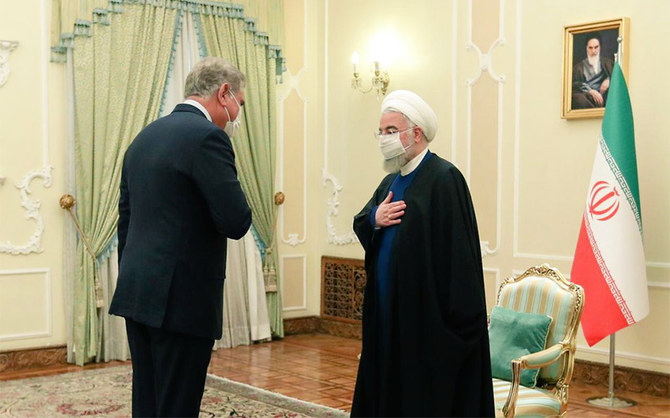
Pakistan’s Foreign Minister, Shah Mahmood Qureshi (left) meets Iranian President Hassan Rouhani in Tehran on April 21, 2021. (Photo courtesy: Shah Mahmood Qureshi/Twitter)
Short Url
Updated 21 April 2021
Follow

Pakistani foreign minister meets Iran’s Rouhani, discusses border management

  • The countries are expected to sign memorandum of understanding on opening of border trade centers during Qureshi’s visit
  • Rights activists say Qureshi’s visit is a great opportunity to bring up the issue of repatriating Pakistanis imprisoned in Iran

ISLAMABAD: Pakistan’s Foreign Minister Shah Mahmood Qureshi met Iranian President Hassan Rouhani on Wednesday and discussed trade, connectivity and border management.
Earlier on Monday, state-run Radio Pakistan reported Qureshi briefing members of his country’s diplomatic mission in Tehran about the establishment of trade centers on the Pak-Iran border, saying they would increase commercial activity between the two countries and bring positive change to the lives of people living on the frontier region.
According to Radio Pakistan, Qureshi said Iranian authorities had agreed to his proposal and were willing to set up the markets. The countries are now expected to sign a memorandum of understanding on the opening of the centers during Qureshi’s visit. 

“Called on President @HassanRouhani and happy to convey the best wishes of President @ArifAlvi and PM @ImranKhanPTI,” Qureshi said in a tweet, “along with sharing Pakistan’s vision and commitment to deepen relations with Iran in trade, investment, connectivity and border management.” 

Coinciding with Qureshi’s visit, Pakistan and Iran inaugurated their third international border crossing point, Mand-Pishin, for facilitating trade.

While trade and border issues are the main part of Qureshi’s trip, rights activists say it is a “great opportunity” for Pakistan to bring up the matter of bringing home 65 Pakistani prisoners under a prisoner transfer agreement signed with Tehran in 2014.
“Iran has released thousands of prisoners since the pandemic first struck,” Justice Project Pakistan (JPP) rights group said in a tweet. “This is an opportunity for Pakistan to bring back its citizens so they can serve the remainder of their sentences closer to their families in these uncertain times.”

In recent years, relations between Iran and Pakistan have been strained with both sides accusing each other of not doing enough to stamp out militants allegedly sheltering across their 900-km border.

In 2019, the two nations said they would form a joint quick reaction force to combat militant activity on their shared border, frequently used for trade and by minority Shia Muslims who travel from Pakistan to Iran for religious pilgrimages. 
 
The border is also the entry point of a lucrative, illegal fuel trade that authorities have struggled to crackdown on for decades.
 
Pakistan has set aside about $20 million to fence its border with Iran.


Bahraini commander witnesses Pakistan Navy passing-out parade in Karachi

Updated 18 sec ago
Follow

Bahraini commander witnesses Pakistan Navy passing-out parade in Karachi

  • Rear Admiral Ahmed Mohamed bin Ali says it is a matter of immense pleasure for him to review commissioning of personnel at his alma mater
  • The training you have received has prepared you to step into a challenging yet deeply satisfying career, he tells young officers, midshipmen

ISLAMABAD: Rear Admiral Ahmed Mohamed Ebrahim Al bin Ali, commander of Royal Bahrain Naval Force, witnessed passing-out parade of Pakistan Navy’s 124th Midshipmen and 32nd Short Service Commission Course in Karachi, where he spoke with the newly inducted officers.

The passing-out parade was held at the Pakistan Naval Academy, at which Commandant Commodore Zia-ur-Rehman congratulated 90 midshipmen and 38 cadets who had completed short service commission after going through academic and training phases.

In his address, Rear Admiral Ali said it was a matter of immense pleasure for him to review the commissioning of personnel at his alma mater, the Pakistan Naval Academy, which he had joined as a cadet in February 1983.

“You must be confident and self-assured that you have been trained at one of the best naval academies of the region. The training you have received at Pakistan Naval Academy has prepared you to step into a challenging yet deeply satisfying career,” he told the young officers and midshipmen.

“It has equipped you with essential military and academic skills and you should spare no effort to build up on these to achieve excellence in your professions.”

Pakistan armed forces have long been training cadets and officers from friendly countries. Currently, the Pakistan Naval Academy is training future officers from Bahrain, Djibouti, Iraq, Sri Lanka and Turkiye.

The Bahraini commander said that being here as the chief guest had taken him back to yesteryears and he would have flashbacks of the familiar sounds and aura of this naval academy.

“I cannot help but marvel at the wonderful transformation that has taken place since my days,” he said.

Pakistan and Bahrain have maintained close diplomatic, security, trade and defense relations and have undertaken joint training and security initiatives, besides regular high-level exchanges.

Bahrain’s Read Admiral Ali met Pakistan Naval Chief Admiral Naveed Ashraf earlier this week, according to Pakistan Navy. They discussed matters of mutual interest, regional maritime security and avenues for bilateral naval cooperation.

Earlier in Sept., Pakistan and Bahrain agreed to enhance cooperation in naval training and regional maritime security operations. During the same month, the Bahraini Chief of Defense Staff Lt. Gen. Thiab Saqer Abdulla Al-Nuaimi met with Pakistan’s Air Chief Marshal Zaheer Ahmed Baber Sidhu and expressed Bahrain’s interest in learning from the PAF’s experience in multi-domain operations.