UAE mulls movement restrictions on residents without COVID-19 vaccines

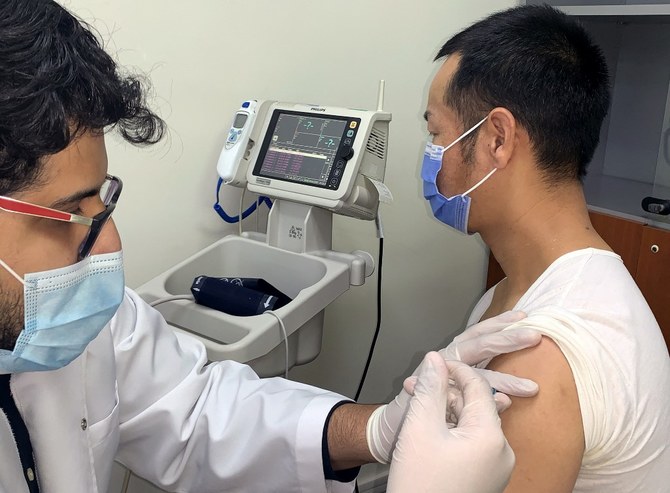
The UAE has provided to 9,788,826 COVID-19 vaccines so far, for a distribution rate of 98.97 doses per 100 people. (AFP)
Short Url
Updated 21 April 2021
Follow

UAE mulls movement restrictions on residents without COVID-19 vaccines

  • The UAE reports 1,903 new coronavirus cases and three fatalities
  • Abu Dhabi earlier approved the use of Pfizer-BioNTech vaccine

DUBAI: The UAE is considering imposing movement restrictions on individuals who remain hesitant to have themselves vaccinated against COVID-19, according to Dr. Saif Al-Dhaheri, spokesman for the National Emergency Crisis and Disasters Management Authority.

“The vaccine is our best means to recover and return to a normal life … Delaying or refraining from taking the vaccine poses a threat to the safety of society and puts all groups, especially those most vulnerable to infection, at risk,” Dr. Al-Dhaheri said in reports from local media.

“Strict measures are being considered to restrict the movement of unvaccinated individuals and to implement preventive measures, such as restricting entry to some places and having access to some services, to ensure the health and safety of everyone,” he added, as he urged residents aged 16 and above to get vaccinated.

The UAE reported 1,903 new coronavirus cases and three fatalities related to the highly transmissible disease overnight, amid the government’s continued inoculation program for citizens and residents.

The country’s COVID-19 caseload now stands at 500,860 while total fatality count is at 1,559, a report from state news agency WAM said.

Health officials said that 113,621 doses of COVID-19 vaccine have been administered in the past 24 hours, bringing the number of jabs given provided to 9,788,826 for a distribution rate of 98.97 doses per 100 people.

Abu Dhabi earlier approved the use of Pfizer-BioNTech vaccine, the second COVID-19 shot to be made available in the emirate after beginning a mass campaign using the Sinopharm vaccine that was trialed in the country.

Pfizer obtained emergency approval in the UAE in December and Dubai rolled out the vaccine during that month.


Hamas official says group in final stage of choosing new chief

The official said the race for Hamas’s leadership is now between Khaled Meshaal (L) and Khalil Al-Hayya (R). (File/AFP)
Updated 51 min 30 sec ago
Follow

Hamas official says group in final stage of choosing new chief

  • Hayya, 65, a Gaza native and Hamas’s chief negotiator in ceasefire talks, has held senior roles since at least 2006
  • Meshaal, who led the political bureau from 2004 to 2017, has never lived in Gaza

CAIRO: A senior Hamas official told AFP on Sunday that the Palestinian movement was in the final phase of selecting a new leader, with two prominent figures competing for the position.
Hamas recently completed the formation of a new Shoura Council, a consultative body largely composed of religious scholars, as well as a new political bureau.
Members of the council are elected every four years by representatives from Hamas’s three branches: the Gaza Strip, the occupied West Bank and the movement’s external leadership.
Hamas prisoners in Israeli jails are also eligible to vote.
The council subsequently elects the political bureau, which in turn selects the head of the movement.
“The movement has completed its internal elections in the three regions and has reached the final stage of selecting the head of the political bureau,” the official said, speaking on condition of anonymity as he was not authorized to speak publicly.
He added that the race for the group’s leadership is now between Khaled Meshaal and Khalil Al-Hayya.
A second Hamas source confirmed the development within the organization, which fought a devastating war with Israel following its October 7, 2023 attack.
Hayya, 65, a Gaza native and Hamas’s chief negotiator in ceasefire talks, has held senior roles since at least 2006, according to the US-based NGO the Counter Extremism Project (CEP).
Meshaal, who led the political bureau from 2004 to 2017, has never lived in Gaza. He was born in the West Bank in 1956.
He joined Hamas in Kuwait and later lived in Jordan, Syria and Qatar. The CEP says he oversaw Hamas’s evolution into a political-military hybrid.
He currently heads the movement’s diaspora office.
Last month, a Hamas source told AFP that Hayya enjoys backing from the group’s armed wing, the Ezzedine Al-Qassem Brigades.
After Israel killed former Hamas leader Ismail Haniyeh in Tehran in July 2024, the group chose its then-Gaza chief Yahya Sinwar as his successor.
Israel accused Sinwar of masterminding the October 7 attack.
He too was killed by Israeli forces in the southern Gaza city of Rafah, three months after Haniyeh’s assassination.
Hamas then opted for an interim five-member leadership committee based in Qatar, postponing the appointment of a single leader until elections, given the risk of the new chief being targeted by Israel.