

Gaza Strip’s Karmousa Kitchen offers Ramadan delicacies

1 / 3
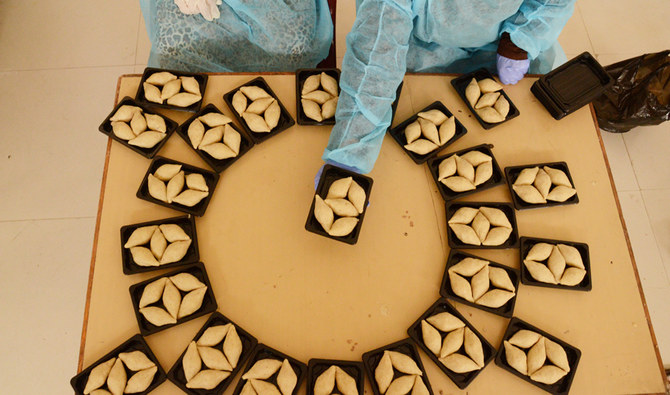
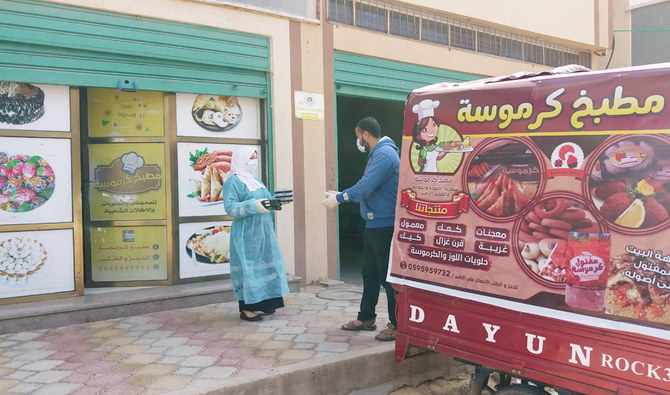
Women shared the work among themselves, with each group undertaking a specific task that they must finish in the shortest period of time. (Supplied)
2 / 3
Women shared the work among themselves, with each group undertaking a specific task that they must finish in the shortest period of time. (Supplied)
3 / 3
Women shared the work among themselves, with each group undertaking a specific task that they must finish in the shortest period of time. (Supplied)
Short Url
Updated 20 April 2021
Follow

Gaza Strip’s Karmousa Kitchen offers Ramadan delicacies

  • Karmousa, named after an Algerian delicacy, relies on social media platforms to promote and market its products

GAZA: Warda Erbee and other women are busy preparing Ramadan foods and sweets in a Gaza Strip kitchen.

Erbee and her colleagues work in Karmousa Kitchen, from the Baraem Development Association, for about seven hours a day to cater for the increased demand during the fasting month.

Erbee, who joined the team in 2017, became the main breadwinner for her family after her husband lost his job due to the pandemic.

She works every day, from 7 a.m. until 2 p.m.

“We work throughout the year at a normal pace, but work increases significantly in the blessed month of Ramadan as the demand is greater for items related to this month, specifically the kubba and sambousak,” she said.

The kitchen’s stand-out offering the rest of the year is the maftool, which is made from wheat or white flour and has earned the satisfaction and admiration of customers.

Karmousa, named after an Algerian delicacy, relies on social media platforms to promote and market its products.

The goal of the Baraem Development Association when launching this project was to help marginalized women cope with poor living conditions.

Kitchen manager Khetam Arafat said that while work did not stop throughout the year, its production doubled during Ramadan and provided additional job opportunities for poor women.

Women shared the work among themselves, with each group undertaking a specific task that they must finish in the shortest period of time.

They need to maintain high levels of accuracy and quality to meet the demands of customers, maintain the position of their products in the market and compete with other factories and kitchens.

According to Arafat, the kitchen’s most famous products are the vegetable and cheese-stuffed sambousak and the Syrian kibbeh made of bulgur and stuffed with minced meat.

“Preparing for Ramadan begins days before in order to meet the demands received by the kitchen and to produce large quantities of items that are in high demand and consumption during this month.”

Despite the emergency conditions resulting from the pandemic, Arafat believed that the demand for Ramadan appetizers and sweets was in line with the annual average.

“Because of an increase in demand this year, the number of female workers has doubled from five to 10, and the number depends on the quality and quantity of the orders.”

From the middle of Ramadan until its end, work in Karmousa is focused on making cakes and maamoul, which are sweets associated with Eid Al-Fitr.

But Arafat feared that an increase in COVID-19 infections in Gaza may lead to a comprehensive closure and inflict heavy losses on the kitchen and all economic sectors.


UN finds dire conditions in Sudan’s El-Fasher during first visit since its fall

Updated 55 min 25 sec ago
Follow

UN finds dire conditions in Sudan’s El-Fasher during first visit since its fall

  • Paramilitary force overran the city in October committing widespread atrocities
  • UN team visited Saudi Hospital where RSF massacred hundreds of people

CAIRO: A UN humanitarian team visited El-Fasher in Sudan’s Darfur region for the first time since a paramilitary force overran the city in October, carrying out a rampage that is believed to have killed hundreds of people and sent most of the population fleeing.
The hours-long visit gave the UN its first glimpse into the city, which remains under control of the Rapid Support Forces. The team found hundreds of people still living there, lacking adequate access to food, medical supplies and proper shelter, the UN said Wednesday.
“It was a tense mission because we’re going into what we don’t know … into a massive crime scene,” Denise Brown, the UN humanitarian coordinator for Sudan, said of Friday’s visit.
For the past two months, El-Fasher has been nearly entirely cut off from the outside world, leaving aid groups unsure over how many people remained there and their situation. The death toll from the RSF takeover, which came after a more than a year-long siege, remains unknown.
Survivors among the more than 100,000 people who fled El-Fasher reported RSF fighters gunning down civilians in homes and in the streets, leaving the city littered with bodies. Satellite photos have since appeared to show RSF disposing of bodies in mass graves or by burning them.
Brown said “a lot of cleaning up” appeared to have taken place in the city over the past two months. The UN team visited the Saudi Hospital, where RSF fighters reportedly killed 460 patients and their companions during the takeover.
“The building is there, it’s clearly been cleaned up,” Brown said of the hospital. “But that doesn’t mean by any stretch of the imagination that this story has been wiped clean because the people who fled, fled with that story.”

El-Fasher lacks shelters and supplies

El-Fasher, the capital of North Darfur state, had been the last stronghold of the Sudanese military in the Darfur region until the RSF seized it. The RSF and the military have been at war since 2023 in a conflict that has seen multiple atrocities and pushed Sudan into one of the world’s worst humanitarian crises.
The UN team visiting El-Fasher focused on identifying safe routes for humanitarian workers and conducted only an initial assessment on the situation on the ground, with more teams expected to enter, Brown said.
“Villages around El-Fasher appeared to be completely abandoned. We still believe that people are being detained and that there are people who are injured who need to be medically evacuated,” said Brown, citing the initial UN findings.
The exact number of people still living in the city is hard to determine, but Brown said they’re in the hundreds and they lack supplies, social services, some medications, education and enough food.
They are living in deserted buildings and in shelters they erected using plastic sheets, blankets and other items grabbed from their destroyed homes. Those places lack visible toilets and access to clean drinking water.
The first charity kitchen to operate since the city’s fall opened Tuesday in a school-turned- shelter, according to the Nyala branch of the local aid initiative Emergency Response Rooms (ERR). The charity kitchen will be operated by ERR Nyala, serving daily meals, food baskets, and shelter supplies. More community kitchens are expected to open across 16 displacement centers, sheltering at least 100 people.
The UN team found a small open market operating while they were in the city, selling limited local produce such as tomatoes and onions. Other food items were either unavailable or expensive, with the price of one kilogram (2.2 pounds) of rice reaching as high as $100, Brown said.

‘Paralyzed’ health care system

Mohamed Elsheikh, spokesperson for the Sudan Doctors Network, told The Associated Press Wednesday that medical facilities and hospitals in El-Fasher are not operating in full capacity.
“El-Fasher has no sign of life, the health care system there is completely paralyzed. Hospitals barely have access to any medical aid or supplies,” he added.
Brown described the situation in El-Fasher as part of a “pattern of atrocities” in this war that is likely to continue in different areas.
The United States has accused the RSF of committing genocide in Darfur during the war, and rights groups said the paramilitaries committed war crimes during the siege and takeover of El-Fasher, as well as in the capture of other cities in Darfur. The military has also been accused of rights violations.