IEA issues ‘dire warning’ on CO2 emissions as it predicts 5% rise

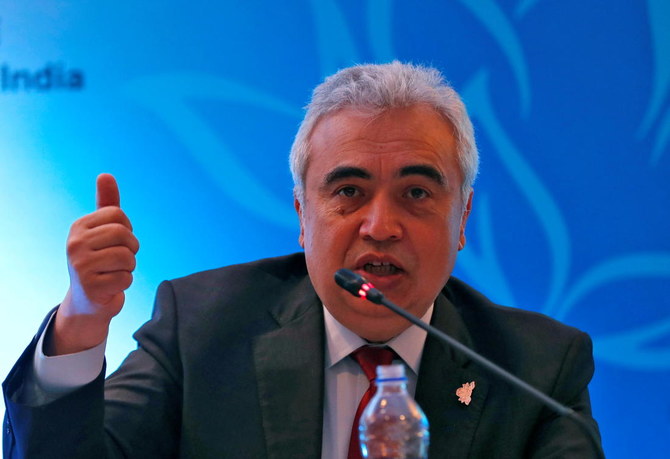
Fatih Birol, executive director of the International Energy Agency, speaks with the media during the International Energy Forum (IEF) in New Delhi. (Reuters)
Short Url
Updated 20 April 2021
Follow

IEA issues ‘dire warning’ on CO2 emissions as it predicts 5% rise

  • This year’s rise will likely be driven by a resurgence in coal
  • Global energy demand is set to increase by 4.6 percent in 2021

LONDON: Global CO2 emissions from energy are seen rising nearly 5 percent this year, suggesting the economic rebound from COVID-19 could be “anything but sustainable” for the climate, the International Energy Agency said on Tuesday.
The IEA’s Global Energy Review 2021 predicted carbon dioxide emissions would rise to 33 billion tons this year, up 1.5 billion tons from 2020 levels in the largest single increase in more than a decade.
“This is a dire warning that the economic recovery from the COVID crisis is currently anything but sustainable for our climate,” IEA Executive Director Fatih Birol said.
This year’s rise will likely be driven by a resurgence in coal use in the power sector, Birol added, which the report forecast to be particularly strong in Asia.
It should also put pressure on governments to act on climate change. US President Joe Biden will hold a virtual summit for dozens of world leaders this week to discuss the issue ahead of global talks in Scotland later this year. Last year, when power use dropped due to the COVID-19 pandemic, energy-related CO2 emissions fell by 5.8 percent to 31.5 billion tons, after peaking in 2019 at 33.4 billion tons.
The IEA’s annual review analyzed the latest national data from around the world, economic growth trends and new energy projects that are set to come online.
Global energy demand is set to increase by 4.6 percent in 2021, led by developing economies, pushing it above 2019 levels, the report said.
Demand for all fossil fuels is on course to grow in 2021, with both coal and gas set to rise above 2019 levels.
The expected rise in coal use dwarves that of renewables by almost 60 percent, despite accelerating demand for solar, wind and hydro power. More than 80 percent of the projected growth in coal demand in 2021 is set to come from Asia, led by China.
Coal use in the United States and the European Union is also on course to increase but will remain well below pre-crisis levels, the IEA said.


Saudi Arabia opens 3rd round of Exploration Empowerment Program

Updated 01 February 2026
Follow

Saudi Arabia opens 3rd round of Exploration Empowerment Program

RIYADH: Saudi Arabia’s Ministry of Industry and Mineral Resources, in collaboration with the Ministry of Investment, has opened applications for the third round of the Exploration Empowerment Program, part of ongoing efforts to accelerate mineral exploration in the Kingdom, reduce early-stage investment risks, and attract high-quality investment from local and international mining companies.

The third round of the Exploration Empowerment Program offers a comprehensive support package targeting exploration companies and mineral prospecting license holders.

The initiative aims to lower investment risks for projects and support a faster transition from prospecting to development.

"The program provides coverage of up to 70 percent of the total salaries of Saudi technical staff, such as geologists, during the first two years, increasing to 100 percent thereafter, in line with program requirements.

This support aims to develop talent, build national capabilities in mineral exploration, promote job localization, and facilitate the transfer of geological knowledge.

The application for the third round opened on Jan. 14, allowing participants to benefit from the Kingdom’s attractive investment environment, its stable legal framework, and streamlined regulatory structures, as well as integrated infrastructure that supports the transition from mineral resources to operational mines.

The ministry has set the timeline for the third round, with the application period running from Jan. 14 to March 31.

This will be followed by the evaluation, approval, and signing of agreements from April 1 to May 31, with the eligible projects set to be announced between June 1 and July 31 of the same year.

The program stages include submitting exploration data during the reimbursement and payment phase from Sept. 1 to Nov. 30, followed by technical and financial verification of work programs and approval of the disbursement of support funds in January 2027.

The exploration data will then be published on the National Geological Database in April 2027.

The ministry emphasized that the EEP focuses on supporting the exploration of strategically important minerals with national priority. It also contributes to enhancing geological knowledge by providing up-to-date data that meets international standards, helping investors make informed decisions and supporting the growth of national companies and local supply chains.

The ministry urged companies to apply early to benefit from the program’s third round, which coincided with the fifth edition of the International Mining Conference, which was held from Jan. 13 to 15.