

Pakistan urges Taliban to stay engaged in Afghan peace process

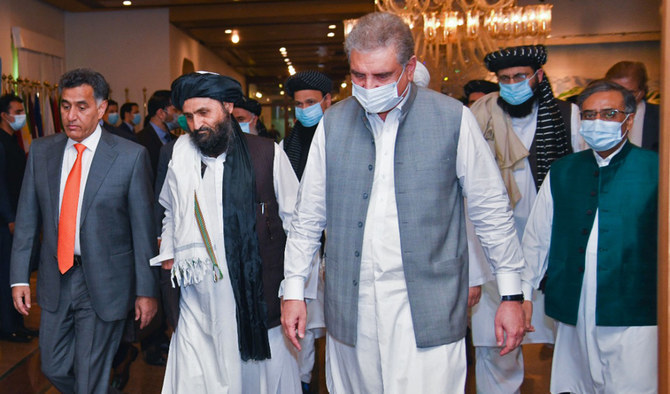
The photograph released by Pakistan's Ministry of Foreign Affairs shows Foreign Minister Shah Mahmood Qureshi, front, receiving Afghan Taliban delegation at the foreign office in Islamabad on Aug. 25, 2020. (Pakistan's Ministry of Foreign Affairs via AN)
Short Url
Updated 19 April 2021
Follow

Pakistan urges Taliban to stay engaged in Afghan peace process

  • FM Qureshi says Taliban will take their own decisions but Pakistan will convince them engagement in their national interest
  • Says troop withdrawal delays were always a possibility due to logistics but Taliban should show flexibility towards new Sept. 11 deadline

ABU DHABI: Pakistan on Monday urged the Taliban to remain engaged in the Afghan peace process after the armed group said it would now shun summits about Afghanistan until all foreign forces leave.

The decision was taken after the United States said last week it would withdraw all troops by Sept. 11 this year, later than a May 1 deadline set out by the previous administration.

"They take their own decisions but we will do whatever we can to convince them that it is in their national interest to remain engaged," Pakistani Foreign Minister Shah Mahmood Qureshi said of the Taliban in an interview with Reuters in Abu Dhabi.

The refusal has thrown the peace process into disarray with Turkey scheduled for Saturday to host a summit that diplomats had hoped could create new momentum towards a political settlement between the Taliban and Afghan government.

The Taliban ruled Afghanistan from 1996 to 2001 when they were ousted by U.S.-led forces, but they still control wide areas.

Qureshi said withdrawal delays were always a possibility due to logistics but that the Taliban had largely succeeded in their objective for foreign troops to withdraw and so should show flexibility towards the new Sept. 11 deadline.

"The troops will be out and a date has been given and the process starts on the 1st of May and goes on until the 11th of September so there is a definite time frame," Qureshi said.

Sources have told Reuters Pakistan was putting pressure on the militants to come back to the table.

Qureshi said he believed the Taliban would benefit from staying involved but said he had no contact with the group.

Pakistan, which helped facilitate U.S.-Taliban negotiations in Doha that resulted in the initial May 1 withdrawal deal, wields considerable influence with the Taliban.

The insurgents have sanctuaries in Pakistan, whose main military-run intelligence service gives them support, according to U.S. and Afghan officials. Pakistan denies the allegation.

Qureshi said he feared violence could escalate if the peace process remains deadlocked, plunging Afghanistan into civil war and leading to an exodus of Afghans.

Pakistan, which hosts close to 3 million Afghan refugees and economic migrants, has built 90% of a fence along its disputed 2,500 km (1,500 mile) border with Afghanistan and would hopefully be completed by September, he said.

He also said Pakistan was ready to engage in direct dialogue with arch-rival India once Jammu and Kashmir statehood was restored, which New Delhi in 2019 split into territories.

"We are two atomic powers that cannot, should not go into a direct conflict. It would be suicidal," Qureshi said.

But he said he had no plans to meet with his Indian counterpart who is also in the United Arab Emirates this week.

Top intelligence officers from India and Pakistan held secret talks in Dubai in January in a new effort to calm military tension over the disputed Himalayan region of Kashmir, sources have told Reuters


Pakistan business group presses for corporate tax rationalization in IMF talks

Updated 5 sec ago
Follow

Pakistan business group presses for corporate tax rationalization in IMF talks

  • Pakistan Business Council calls for abolition of super tax, phased corporate rate cut to 25%
  • PM Sharif has said government is considering reduction in direct taxes in upcoming budget

KARACHI: Pakistan’s business policy advocacy group urged the government to rationalize corporate tax rates during talks with an International Monetary Fund (IMF) delegation on Saturday, arguing such a step would be critical to shifting the economy from stabilization to export-led growth.

The Pakistan Business Council (PBC), which represents many of the country’s largest private-sector companies, said the current tax structure places a disproportionate burden on documented and compliant enterprises.

The engagement follows the arrival of an IMF staff mission in Pakistan earlier this week to begin review talks that will determine the release of the next tranche under the country’s $7 billion Extended Fund Facility (EFF) and the $1.4 billion Resilience and Sustainability Facility (RSF).

The team is expected to start formal negotiations next week, discussions seen as critical to sustaining Pakistan’s fragile economic recovery and maintaining external financing stability.

“Stabilization has provided breathing space,” PBC Chairperson Dr. Zeelaf Munir said according to a statement after the meeting with the IMF delegation headed by mission chief Iva Petrova. “The priority now is institutionalizing growth.”

“A competitive and equitable tax framework, predictable energy pricing and policy consistency are essential to expand exports, attract investment and generate employment at scale,” she continued. “The private sector stands ready to deploy capital where reform signals remain clear and credible.”

In its presentation to the Fund team, the PBC called for the abolition of the super tax, an additional levy imposed in recent years on high-earning companies and individuals to shore up revenues, in all its forms. It also demanded a phased reduction of the corporate tax rate to 25%, and rationalization of advance and withholding tax regimes that businesses say function as de facto minimum taxes.

The PBC urged the broadening of the tax base through stronger enforcement to bring untaxed sectors into the net, rather than increasing the burden on existing taxpayers.

Prime Minister Shehbaz Sharif said earlier this week on Wednesday the government was considering reducing direct taxes in the upcoming federal budget to support businesses, while maintaining that indirect taxes collected from consumers must be properly deposited into the national exchequer.

The IMF review discussions with the Pakistani authorities are expected to focus on fiscal consolidation, monetary policy, structural reforms and climate-related benchmarks tied to the RSF program, as Islamabad seeks to secure continued external financing and strengthen macroeconomic stability.