

Government says won’t be 'blackmailed' as TLP holds 12 police, paramilitary troops hostage

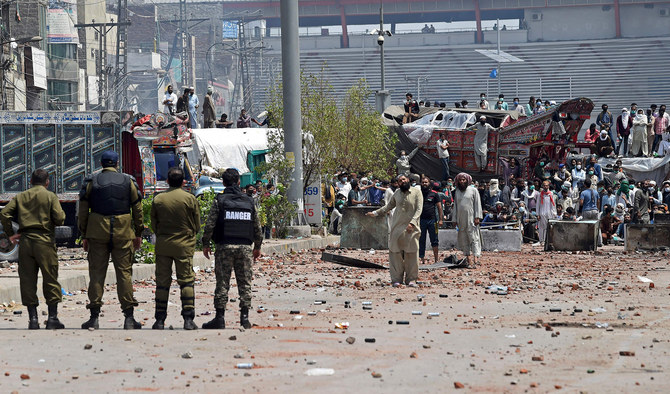
Policemen stand guard as supporters of Tehreek-e-Labbaik Pakistan (TLP) party take part in a protest while blocking a street after their leader was detained following his calls for the expulsion of the French ambassador, in Lahore on April 18, 2021. (AFP)
Short Url
Updated 18 April 2021
Follow

Government says won’t be 'blackmailed' as TLP holds 12 police, paramilitary troops hostage

  • Information minister says government believes in negotiations not blackmail, PM Khan has “strongest affection” for Prophet Muhammad (PBUH)
  • Security beefed up in capital Islamabad with heavy contingents of police

LAHORE/ ISLAMABAD: Twelve security forces personnel, which includes policemen and paramilitary troops, taken hostage by the banned Tehreek-e-Labbaik Pakistan (TLP) religious party during police clashes on Sunday morning have yet to be released, Lahore Police spokesperson Arif Rana said, while the interior ministry said in a statement it would not be blackmailed by the group.
Rioting by the rightwing group has rocked the country since Monday after TLP chief Saad Rizvi was arrested in Lahore a day after he threatened the government with rallies if it did not expel the French envoy to Islamabad over cartoons of the Prophet Muhammad (PBUH) published in France last year.
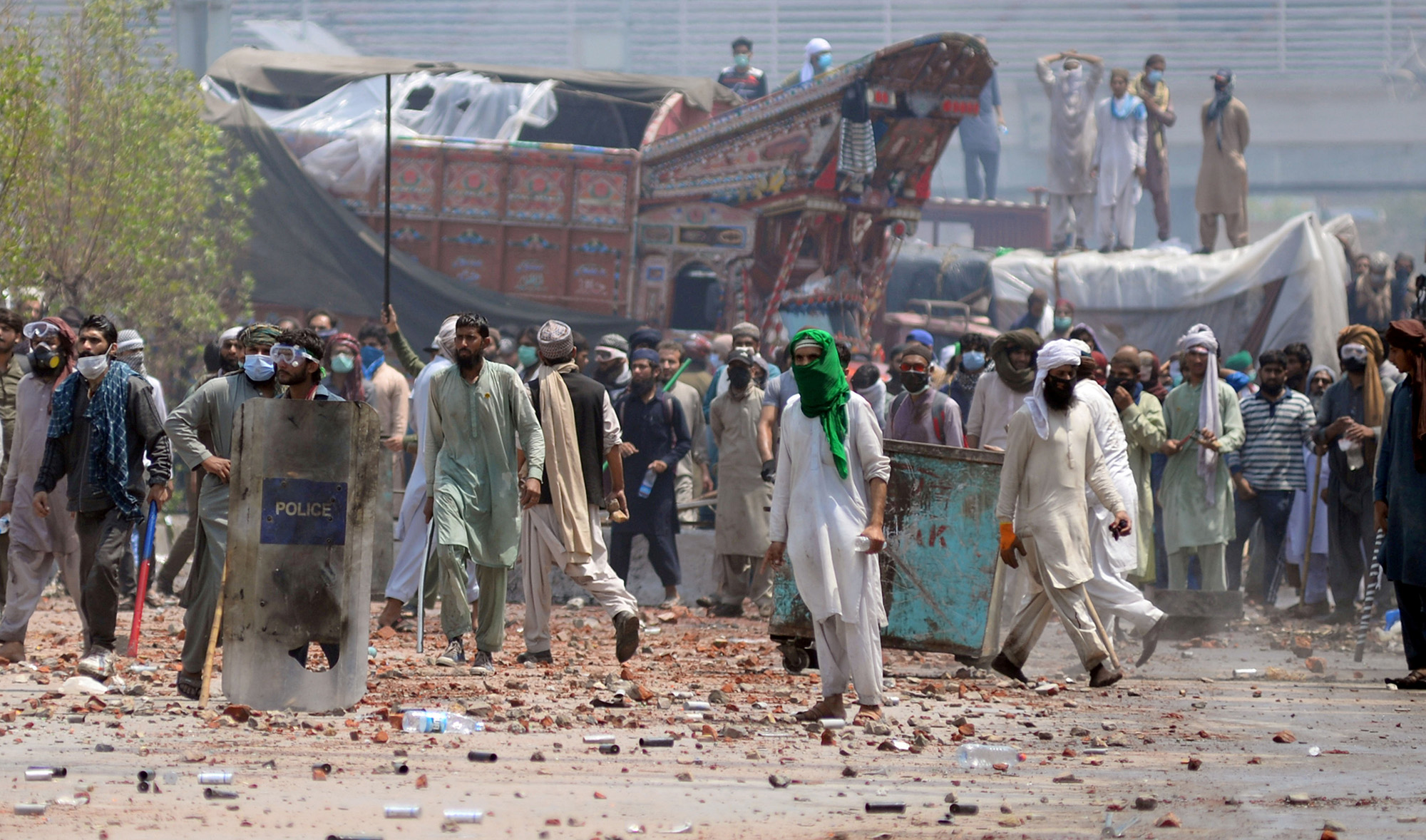


Supporters of Tehrik-e-Labaik Pakistan (TLP) block a road during a protest in Lahore, Pakistan, on April 18, 2021. (REUTERS)

The protests have paralyzed major cities and highways, leading to the deaths of six policemen, according to the government, with thousands of TLP workers under arrest, police say. The riots have also prompted the French embassy to recommend all its nationals temporarily leave the country.
Following last week’s crackdown to quell the protests, there was relative calm in major cities  until clashes erupted in Lahore early morning Sunday, when protesters attacked the Nawankot Police Station. 
“The officers are currently being held [by the TLP] in a mosque in Lahore,” Rana said on Sunday evening. “They are still there.”
"It is the government's mandate to negotiate or not to negotiate with the protesters. We can't do it,” he said.
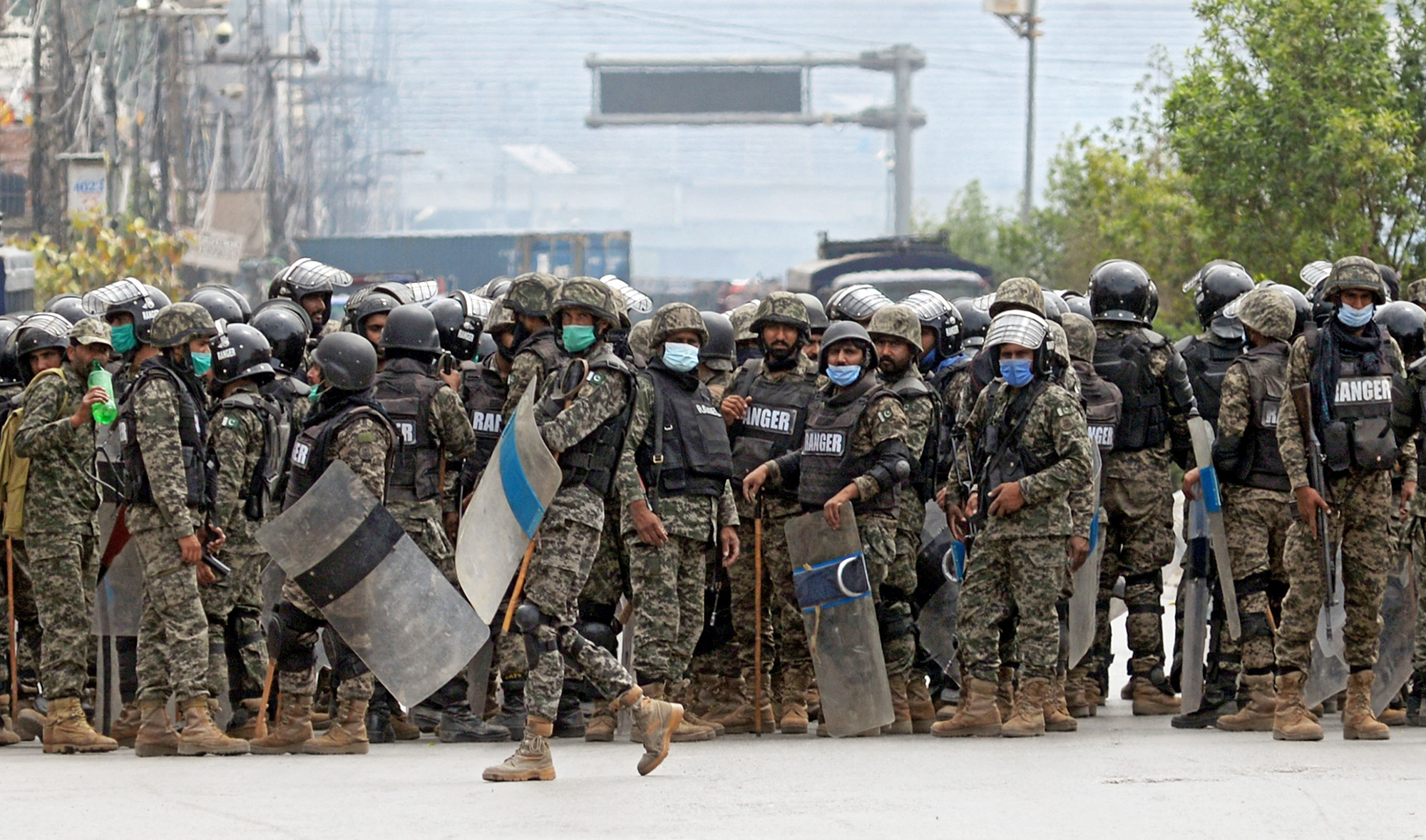


Paramilitary soldiers stand guard on a road during a protest by supporters of the banned political party Tehrik-e-Labaik Pakistan (TLP) in Lahore, Pakistan, on April 18, 2021. (REUTERS)

Hostages include Nawankot deputy superintendent of police, five police constables and two Rangers personnel, Rana had told Arab News earlier in the day, adding that police were trying to recover the abducted officers.
On Sunday evening Information Minister Fawad Hussain Chaudhry said in a statement the government believed in negotiating but wouldn’t be blackmailed.
“The government believes in negotiations but can't be blackmailed,” he said.
“The operation was started after police and Rangers personnel were kidnapped. The state can't be blackmailed by a proscribed armed outfit. [Prime Minister] Imran Khan has the strongest affection with the Prophet (PBUH) and he has talked about this at every forum.”
Earlier on Sunday, police spokesman Rana said the operation against the TLP had been halted as the attackers were armed with petrol bombs and a tanker with 50,000 litres of petrol. By Sunday evening, he said the situation was “at a standstill” with protesters sitting on roadsides with sticks and petrol bombs in their hands and law enforcement personnel standing guard.
“The police are handling the situation cautiously as we don't want to put the lives of our fellows [the hostages] in any danger," he said, adding that over 3,000 law enforcement personnel had been deployed in the area.
On Thursday, the interior ministry said it was moving to have the TLP party banned for attacking law enforcement forces and disrupting public life during its protests. The interior ministry’s decision has been approved by the federal cabinet but needs to be ratified by the Supreme Court for the TLP to be dissolved.
Talking to the media in Islamabad on Sunday, Interior Minister Sheikh Rashid Ahmed said no negotiations were underway with the TLP.
“We tried to negotiate for two, three months with them but in vain. They are not ready to retreat from their agenda, so the government is left with no option but to establish the writ of the state," the minister said.
Meanwhile, security has been heightened in the capital, Islamabad, the DIG operations tweeted Sunday evening.
“Security beefed up in the whole city. Heavy contingents deployed at entry/ exit points & other important installations. All possible steps would be taken for maintenance of law and order situation in the city. Stand by your police & forces,” he tweeted.
Earlier on Sunday, Lahore police told Dawn newspaper that three people had been killed in clashes with police.
In October 2020, protests broke out in several Muslim countries over France’s response to a deadly attack on a teacher who showed cartoons mocking the Prophet Muhammad to his pupils during a civics lesson.
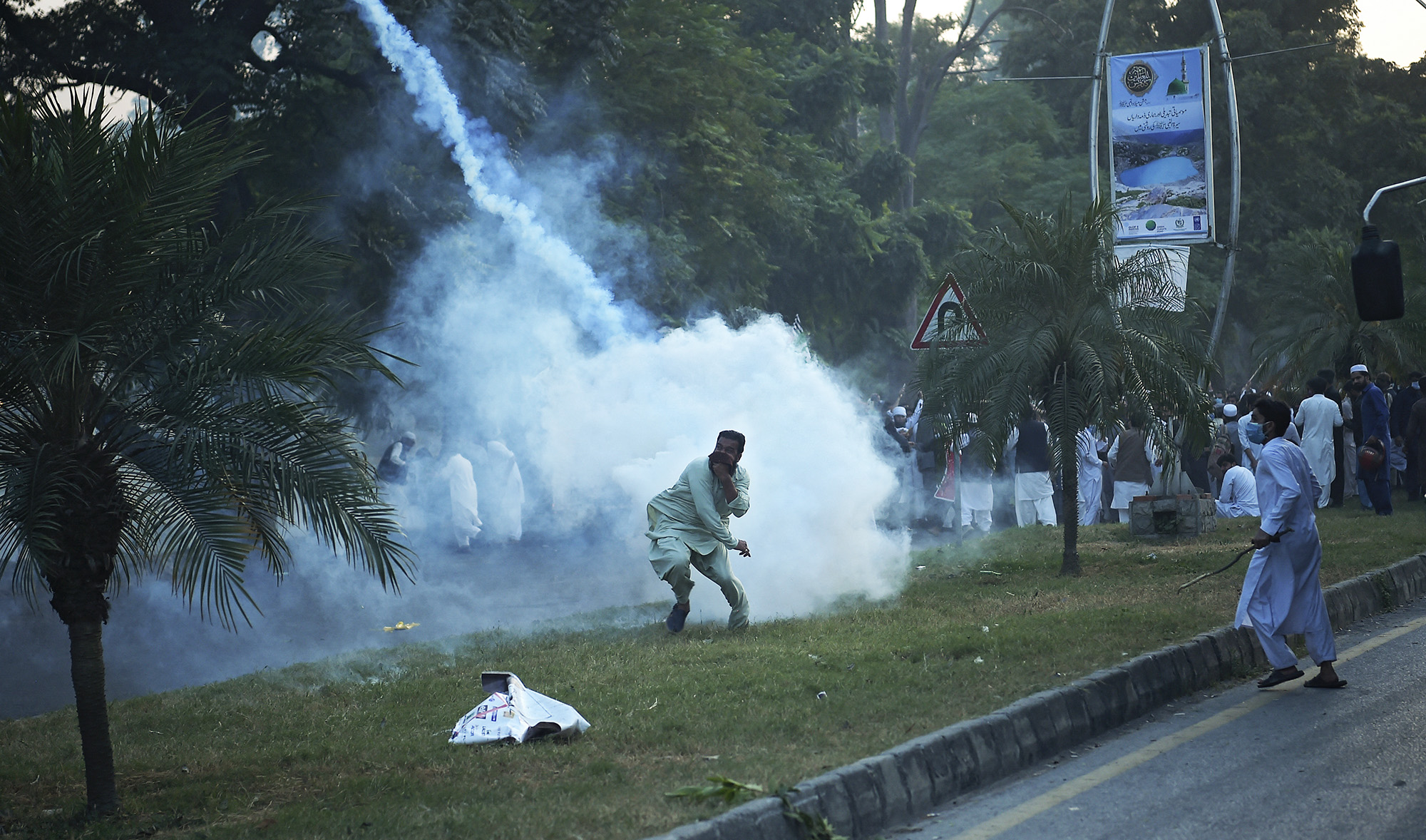


A Pakistani protester returns a teargas shell during a demonstration in Islamabad on October 30, 2020, following French President Emmanuel Macron's comments over the Prophet Mohammed (PBUH) caricatures. (AFP/File)

During similar protests in Pakistan, the government negotiated with the TLP and met a number of its demands, including that it would debate expelling the French ambassador in parliament.
A deadline to make that parliamentary move expires on April 20.


New PIA owner plans more GCC flights, lower airfares

Updated 4 sec ago
Follow

New PIA owner plans more GCC flights, lower airfares

  • New management will focus on religious tourism to Makkah, Madinah and other sites to expand global reach
  • Owner Arif Habib says airfares will be rationalized to make PIA flights affordable for low-income Pakistanis

KARACHI: Pakistan’s recently privatized national carrier, the Pakistan International Airlines (PIA), plans to increase its flights to the Gulf Cooperation Council (GCC) region as part of its post-privatization business strategy to achieve 7.5% annual revenue growth, its new owner said this week.

A Pakistani consortium, led by Arif Habib Group, clinched a 75% stake in PIA for Rs135 billion ($482 million) on Dec. 23 after a competitive bidding process, in a deal that valued the airline at Rs180 billion ($643 million).

The sale marked Pakistan’s most ambitious effort in decades to reform the debt-ridden airline that had accumulated over Rs784 billion ($2.8 billion) in losses. The government said it aimed to end decades of state-funded bailouts and support the airline’s revival.

In an exclusive interview with Arab News, Arif Habib, chairman of Arif Habib Group, shared that he aims to attract around 70 million Pakistanis, who travel annually via different airlines, by making airfares more affordable.

“That [GCC region] is our biggest market... We would definitely try to increase the frequency of flights, increase the number of planes there, and try to capture more market share in that area,” Habib told Arab News on Monday.

“So, there we see a lot of opportunity.”

The new management of PIA, which currently caters to 4 million passengers annually, aims to target religious tourism, which Habib called a “captive market” in Pakistan and the Middle East.

According to PIA spokesperson Abdullah Hafeez Khan, the airline runs around 20 flights daily to the Middle East.

Habib plans to invest around Rs112 billion ($400 million) in PIA to turn the airline around, implementing short- and long-term improvements ranging from upgrading seats to tripling the 19-aircraft fleet, and engaging a foreign airline as a technical partner through strategic divestment over the next seven to eight years.

The group also intends to reduce PIA fares to make air travel more affordable for passengers from Pakistan’s low-income groups.

“Yes, we have been advised that in order to increase our market share, we will have to rationalize the airfares,” Habib said. “That is in the plan, and we will unfold it as it comes.”

The new owners have engaged a global advisory firm, Seabury Aviation Partners, to identify viable markets for the newly privatized airline and expand its presence both locally and internationally.

Habib aims for up to 7.5% annual growth in PIA’s operational revenues to make it profitable and the new management is targeting European and North American markets, particularly routes to and from the United Kingdom, the United States and Canada, for this purpose.

“The UK is the most lucrative market where I think there is a lot of demand,” he said, adding they would also be seeking more flight destinations. “Even for USA there is demand there.”

Habib, however, said the airline would take time to deliver “reasonable” returns to its investors, including AKD Group Holdings, Fatima Fertilizer Company, City Schools, Lake City Holdings and Fauji Fertilizer Company, a publicly listed firm owned by Pakistan’s military.

“In initial period of one to two years, we may see some losses but into medium term, I think, that would be turned around,” he concluded.

PIA posted a pre-tax profit of Rs11.5 billion ($41 million) for the January–June 2025 period, its first such profit for this timeframe in nearly two decades, according to a Reuters report in September. The airline recorded losses during the same period in 2024.

Once considered one of Asia’s leading carriers, PIA struggled with chronic mismanagement, political interference, overstaffing, mounting debt, and operational issues that led to a 2020 ban on flights to the European Union, the UK, and the US following a pilot licensing scandal. The EU and UK have since lifted their bans, giving the airline renewed momentum, while the US ban remains in place.

On Tuesday, PIA announced that the airline will be expanding its UK operations and will operate four weekly flights from Islamabad to London starting Mar. 29.

“The flights are being resumed after a long gap of six years,” PIA spokesman Khan said in a statement. “PIA is already operating three weekly flights to Manchester.”