

‘Full speed ahead’ on new Iranian nuclear deal

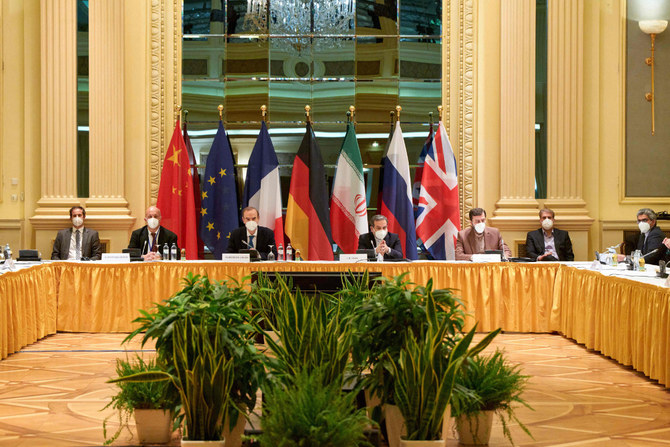
Parties to the Iran nuclear deal — Germany, France, Britain, China, Russia and Iran – are shown attending a meeting at the Grand Hotel of Vienna as they try to restore the Iran nuclear deal. (AFP)
Short Url
Updated 18 April 2021
Follow

‘Full speed ahead’ on new Iranian nuclear deal

  • China’s envoy to the talks said all participants had agreed to accelerate work on issues including which sanctions on Iran the US would lift

JEDDAH: Talks on reviving the nuclear deal with Iran will pick up speed after a second round of negotiations ended in Vienna, delegates said on Saturday.

China’s envoy to the talks said all participants — China, Russia, France, Britain, Germany and Iran — had agreed to accelerate work on issues including which sanctions on Iran the US would lift.

“All parties have agreed to further pick up their pace in subsequent days by engaging in more extensive, substantive work on sanctions-lifting as well as other relevant issues,” Wang Qun said.

The Joint Comprehensive Plan of Action (JCPOA), the 2015 deal to curb Iran’s nuclear program in return for the lifting of sanctions, collapsed in 2018 when the US pulled out. Donald Trump reimposed sanctions, and Iran responded by enriching fissile uranium to levels of purity banned under the deal.

New US President Joe Biden has offered to lift sanctions if Iran returns to compliance with the JCPOA, but so far Iran has insisted that sanctions must be eased first. Talks to break the deadlock began in Vienna last week, involving a group of signatories to the deal known as the Joint Commission.

The US is not present as Iran has declined face-to-face negotiation, but EU officials chairing the talks are carrying out shuttle diplomacy with a US delegation in a nearby hotel.

Wang said: “In the next few days we hope the Joint Commission will immediately start negotiating the specific formula of sanction-lifting.”

EU envoy Enrique Mora said: “Progress has been made in a far from easy task. Now we need more detailed work.”

Tehran’s chief negotiator, Abbas Araqchi, said the Iranian delegation had submitted proposed texts on nuclear issues and the lifting of sanctions, and that work on a common text, “at least in areas where there are common views,” could begin. While serious disagreements remained, “a new understanding appears to be emerging and there is now a common final goal among all,” he said.

The talks have been complicated by an Israeli sabotage attack last week, causing an explosion that crippled Iran’s flagship nuclear development plant at Natanz. Iran on Saturday named a man it wants to arrest in connection with the blast.

“Reza Karimi, the perpetrator of this sabotage ... has been identified” by Iran’s intelligence ministry, but had fled the country before the explosion, state TV said. “Necessary steps are underway for his arrest and return to the country through legal channels,” it said.

State TV also broadcast footage of rows of what it said were uranium enrichment centrifuges that had replaced the ones damaged in the blast at Natanz.


US transfers thousands of Daesh detainees from Syria to Iraq

Updated 8 sec ago
Follow

US transfers thousands of Daesh detainees from Syria to Iraq

BAGHDAD: The United States Central Command said it has completed the transfer of more than 5,700 detained Daesh group suspects from Syria to Iraq.
The detainees from some 60 countries had for years been held in Syrian prisons run by Kurdish-led forces before the recapture of surrounding territory by Damascus prompted Washington to step in.
CENTCOM said it “completed a transfer mission following a nighttime flight from northeastern Syria to Iraq on Feb 12 to help ensure Daesh detainees remain secure in detention facilities.”
“The 23-day transfer mission began on Jan 21 and resulted in US forces successfully transporting more than 5,700 adult male Daesh fighters from detention facilities in Syria to Iraqi custody,” it added in a statement.
The US had previously announced it would transfer around 7,000 detainees.
Daesh swept across Syria and Iraq in 2014, committing massacres and forcing women and girls into sexual slavery.
Backed by US-led forces, Iraq proclaimed the defeat of Daesh in the country in 2017, and the Kurdish-led Syrian Democratic Forces (SDF) ultimately beat back the group in Syria two years later.
The SDF went on to jail thousands of suspected jihadists and detain tens of thousands of their relatives in camps.

- 61 countries -

Last month, Syrian troops drove Kurdish forces from swathes of northern Syria, sparking questions over the fate of the Daesh prisoners.
Lingering doubts about security pushed Washington to announce it would transfer them to Iraq to prevent “a breakout” that could threaten the region.
“We appreciate Iraq’s leadership and recognition that transferring the detainees is essential to regional security,” said head of CENTCOM Admiral Brad Cooper.
“Job well done to the entire Joint Force team who executed this exceptionally challenging mission on the ground and in the air,” he added.
Iraq’s National Center for International Judicial Cooperation (NCIJC) said 5,704 Daesh detainees of 61 nationalities have arrived in Iraq.
They include 3,543 Syrians, 467 Iraqis, and another 710 detainees from other Arab countries.
There are also more than 980 foreigners including those from Europe, Asia, Australia and the United States.
The NCIJC said Iraq’s judiciary will interrogate the detainees before taking legal action against them.
Many prisons in Iraq are already packed with Daesh suspects.
Iraqi courts have handed down hundreds of death sentences and life terms to those convicted of terrorism offenses, including foreign fighters.
Under Iraqi law, terrorism and murder offenses are punishable by death, and execution decrees must be signed by the president.
The detainees in Syria were transferred to Baghdad’s Al-Karkh prison, once a US Army detention center known as Camp Cropper, where former ruler Saddam Hussein was held before his execution.
To make space for the newcomers, authorities moved thousands of prisoners from the Karkh prison to other facilities, a lawyer and an inmate told AFP on condition of anonymity.

- Repatriation -

Iraq has issued calls for countries to repatriate their nationals among the Daesh detainees, though this appears unlikely.
For years, Syria’s Kurdish forces also called on foreign governments to take back their citizens, but this was done on a small scale limited to women and children held in detention camps.
Most foreign families have left northeast Syria’s Al-Hol camp, which holds relatives of Daesh fighters, since the departure of Kurdish forces who previously guarded it, humanitarian sources told AFP on Thursday.
Last month, the Syrian government took over the camp from Kurdish forces who ceded territory as Damascus extended its control across swathes of Syria’s northeast.