

How Jewish women married to Arabs were regarded as a threat to Israel: Haaretz

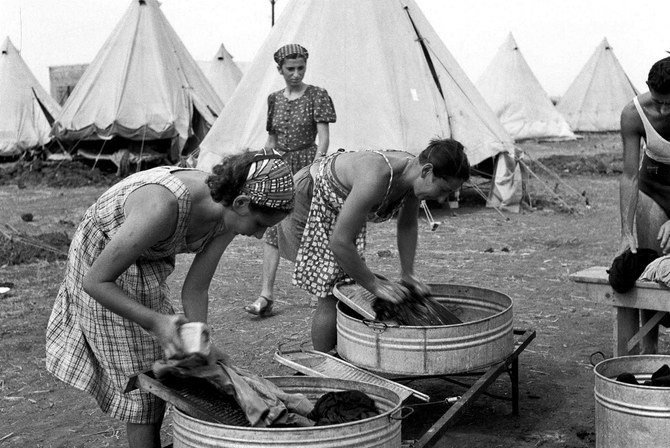
A picture dated March 1, 1940 shows new immigrants wahing their laundry at the immigrants camp near Kibbutz Na'an. (AFP/File Photo)
Short Url
Updated 18 April 2021
Follow

How Jewish women married to Arabs were regarded as a threat to Israel: Haaretz

  • Israeli newspaper Haaretz details cruel treatment they faced from their own community
  • Researcher: ‘Ostracism, denunciation and shaming gave way to violence’

LONDON: During the formation of Israel in the late 1940s, hundreds of Jewish women were branded as enemies for marrying Arab men, resulting in exclusion, isolation, and in some cases murder, according to stories buried in the country’s archives. 

The histories of the “lost” Jewish women — those who married and assimilated into Arab culture — have been revealed by Israeli newspaper Haaretz, which details the cruel treatment they faced from their own community, including “harsh opposition from home, ostracism, labeling, and opprobrium and social alienation.”

Hanania Dery, chief rabbi of Jaffa at the time, traveled to refugee camps in the newly occupied Palestinian territories to search for Jewish women who had married Arab men and converted to Islam.

He reportedly discovered about 600 Jewish women living in Hebron, Nablus, Gaza City, Khan Yunis and East Jerusalem, and encouraged them to return to their Jewish roots.

The subject of interfaith marriage has long been a taboo subject in Israel. Idith Erez, a graduate student in the Israel Studies department at the University of Haifa, has detailed the plight of the “lost” women, and their treatment at the hands of authorities and underground paramilitary groups.

She said two of her own relatives married Arabs, and “the responses in the family ranged from acceptance and reservations to total rejection.”

Erez was warned by colleagues about the lack of material on the subject. She discovered Jewish references to relationships between Jewish women and Arab men from 1917 to 1948, but found that “writers sought to play down the ‘forbidden stories’.”

Erez said: “One can assume that what was perceived as a family or personal stigma, or as national shame, was excluded from the collective memory, relegated to the warehouse of the darkest secrets and remained hidden there.”

But she found stories hidden away in newspapers, and also detailed records of surveillance operations targeting the “lost” women.

Archives from underground Zionist organizations — including Haganah, Lehi and Irgun — revealed that the women were viewed as a threat to the Jewish community, and were targeted as potential spies.

One notable case is detailed in a report sent by a Haganah member to the organization’s intelligence branch in 1942. He outlines a plan to deploy a Jewish woman to spy on senior Arab figures.

“I am thinking this week of getting in touch, to obtain information, with a Sephardi girl from Tiberias who has intimate relations with Kamal Al-Hussein. He likes to waste a lot of money on her,” the member wrote.

The stories discovered by Erez share one common feature: The hostile attitude of Jewish society toward the relationships.

“The phenomenon was perceived as a threat to the resurgent Jewish collective in Israel, as crossing a national and religious border and as the violation of a social taboo,” she said.

“These relationships were seen as the ultimate threat, serious and significant. They were perceived as having the potential to turn the Yishuv (Jewish community) into a Levantine society, to bring about religious conversion and assimilation into Arab society.”

Many Jews saw interfaith relationships as a deviation from the norm, and the women involved as “whores”, “traitors”, “enemies of Israel” and a “national disgrace,” Erez said.

As tensions between Arab and Jewish communities in Palestine grew, reactions to interfaith relationships became more extreme.

“Ostracism, denunciation and shaming gave way to violence in the family and violence perpetrated by security organizations,” Erez said, adding that some women were even murdered.

Esther K. and Mahmoud Al-Kurdi first met in a Jerusalem cafe that the latter owned, and soon fell in love and married, despite not receiving parental agreement.

Their case went to court, where Esther was told to return home. She told Al-Kurdi: “Never mind, a few months will go by, I’ll turn 18 and come back to you, my dear.” It then emerged that she had fallen pregnant and was forced to have an abortion.

Al-Kurdi said following the case: “I loved her so much. I would do anything for her. People are cruel. Why are they trying to take my blood from me?”

Chaya Zeidenberg, 22, whose Arab lover was Daoud Yasmina, was murdered in early 1948 by Lehi.

In a statement, the paramilitary group accused her of “treason against the homeland and the Jewish people and of collaborating with Arab gangs.”

Lehi members raided Zeidenberg’s apartment and drove her to an unknown location, where she was interrogated and shot dead.

She was buried without her surname on the headstone. The local Jewish burial society registered her as a “spy.”

Erez said of her research: “The women involved were opinionated and strong, unwitting feminists who were ahead of their time and defied the social order, the mechanisms of regimentation and the establishment’s balance of forces. 

“They ignored public opinion and the Zionist ethos, which expected the Hebrew woman to nullify her personal yearnings and serve as a ‘sacrifice,’ if needed, on the altar of the nation.

“The steep price paid for maintaining a relationship with an Arab man did not keep them from conducting the relationship.

“These women did not flinch from harsh reactions, and they saw no contradiction between their choice of an Arab man and their national loyalty or religious affiliation.”


Eating snow cones or snow cream can be a winter delight, if done safely

Updated 28 January 2026
Follow

Eating snow cones or snow cream can be a winter delight, if done safely

  • As the storm recedes, residents of lesser-affected areas might be tempted to whip up bowls of “snow cream”
  • Fassnacht said he tried “snow cream” for the first time last year when some students made him some

WASHINGTON: Take two snowballs and call me in the morning?
Dr. Sarah Crockett, who specializes in emergency and wilderness medicine, doesn’t explicitly tell her patients at New Hampshire’s Dartmouth-Hitchcock Medical Center to swallow snow, but she often prescribes more time outside. If that time includes eating a handful of ice crystals straight or adding ingredients to make snow cones and other frozen treats, she’s all for it.
“To stop and just be present and want to catch a snowflake on your tongue, or scoop up some fresh, white, untouched snow that’s collected during something as exciting as a snowstorm, I think that there’s space in our world to enjoy that,” Crockett said. “And while we need to make good choices, I think these are simple things that can bring joy.”
Getting outdoors to enjoy simple pleasures is unlikely to be front of mind for people in a 1,300-mile (2,100-kilometer) stretch of the United States where a massive weekend storm brought deep snow and bitter cold. Freezing rain and ice brought down power lines and tree limbs, leaving hundreds of thousands of homes without power or heating in the South, while snow upended road and air travel from Arkansas to New England.
As the storm recedes, residents of lesser-affected areas might be tempted to whip up bowls of “snow cream” — snow combined with milk, sugar and vanilla — after seeing techniques demonstrated on TikTok. Others might want to try “sugar on snow,” a taffy-like confection made by pouring hot maple syrup onto a plate of snow.
Despite its pristine appearance, snow isn’t always clean enough to consume. Crockett and other experts shared advice for digging in safely while digging out.
The science of snow
Whether it’s rain or snow, precipitation cleans the atmosphere, picking up pollutants as it falls, said Steven Fassnacht, a professor of snow hydrology at Colorado State University. But snowflakes pick up more impurities because they fall more slowly and have more exposed surface areas than raindrops, he said.
That means snow that falls near coal plants or factories that emit particulates into the air contains more contaminants, said Fassnacht, who was in Shinjo, Japan, last week studying the salt content of snow. He said he wouldn’t have hesitated to take a taste there because there weren’t any big industrial complexes upwind.
“Snow can be eaten, but you want to think about the trajectory. Where did that snow come from?” he said.
Timing is another consideration, according to Crockett. The first wave of snow holds the most particulate matter, she said, so waiting until a storm is well underway before putting out a bowl to collect falling snow is one precaution to take.
Ground contamination is an additional factor, experts say. Avoiding yellow snow, which may be tainted by urine or tree bark, is conventional wisdom, but it’s also a good idea to stay away from any snow pushed by snowplows and packed with road salt, deicing chemicals and debris.
Snack versus survival
What about eating snow to survive? Crockett, who oversees the wilderness medicine program at Dartmouth College’s Geisel School of Medicine, says that’s a bad idea.
The energy it takes to melt snow in your mouth as you’re eating it essentially counteracts the hydration benefit, plus it decreases your core body temperature and increases the risk of hypothermia. While outdoor enthusiasts who plan to spend days in the mountains often melt and boil snow to purify it for drinking, it shouldn’t be viewed as an immediate hydration source, she said.
“If you are disoriented on a local hike, I would say your number one priority is to try to reach out for help in any way you can, ... not ‘Can I eat enough snow?’” Crockett said.
Focus on rewards, not risks
Fassnacht, who has studied snow for more than 30 years, said he tried “snow cream” for the first time last year when some students made him some. He described it as a fun experience that got him thinking about flavors and textures, not contaminants.
“It’s a whimsical thing,” he said. “It made me think about what are the characteristics of that freshly fallen snow, and how does that change the taste sensation?”
Crockett likewise is a fan of finding inspiration and wonder in nature. She worries that overprotective parenting has contributed to anxiety in some young people, and that excessive warnings about eating snow could add to that.
“We have to strike that right balance of making sure we’re avoiding danger while not being so protective that we encourage this ‘Everything is going to harm me’ mentality, particularly for children,” she said.
Crockett has four children, including a daughter she described as a “passionate snow eater.” As the recent winter storm got underway, she asked her why she liked eating snow so much and was told, “It makes me feel connected to the Earth.”
“That is actually something that’s really important to me, that we all have this connection to nature,” Crockett said.