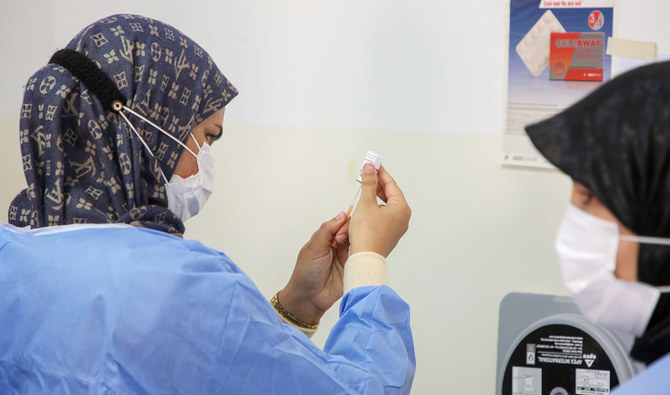
Libya launches public vaccination drive

A health worker prepares to administer the AstraZeneca coronavirus disease (COVID-19) vaccine to a man, in Tripoli, Libya, April 17, 2021. (REUTERS)
Short Url
Updated 17 April 2021
Follow

Libya launches public vaccination drive

  • The AstraZeneca doses were delivered through the Covax program for lower and middle-income countries

TRIPOLI: Libya on Saturday launched its coronavirus vaccination campaign for the general population in Tripoli, with the elderly and healthcare workers given priority in the conflict-hit North African nation.
Those over 70 would get the AstraZeneca jab while the Russian Sputnik V vaccine would be administered to medical personnel and those aged 50-60, the National Center for Disease Control said.
NCDC head Badreddine Al-Najjar said the vaccines would be distributed across Libya “in the coming days,” adding that China’s Sinovac jab would also be available.
Libya has so far received 400,000 doses, including 200,000 Sputnik V shots, 57,600 AstraZeneca jabs and 150,000 from Turkey thought to be China’s Sinovac.
The AstraZeneca doses were delivered through the Covax program for lower and middle-income countries.
Since the pandemic emerged last year, there have been 171,131 confirmed COVID cases in Libya, including 2,882 deaths, out of a population of seven million, officials say.
On Saturday, dozens of men and women wore face masks and sat on chairs that were spread out to ensure physical distancing in the courtyard of a vaccination center in Tripoli as they waited to get a jab.
Libyan authorities have appealed on the general population, including illegal migrants, to register for vaccination and set up an electronic portal in March for that purpose.


Israeli military says it will pursue every successor of Iran’s Khamenei

Updated 58 min 52 sec ago
Follow

Israeli military says it will pursue every successor of Iran’s Khamenei

  • The clerical body that will choose Iran’s next supreme leader has more or less reached a majority consensus
  • Minor disagreement over whether their final ⁠decision must follow an ‌in-person meeting or instead ‌be issued

The Israeli military warned it would continue pursuing every successor of Iran’s next ‌supreme ‌leader.
In a ‌post ⁠on X in ⁠Farsi, the Israeli military also warned it would ⁠pursue every ‌person ‌who seeks ‌to ‌appoint a successor for Ayatollah Ali Khamenei, ‌referring to the clerical body ⁠charged with ⁠choosing the Islamic Republic’s supreme leader.
The clerical body that will choose Iran’s next supreme leader, succeeding the slain Ayatollah Ali Khamenei, has more or less reached a majority consensus, Assembly of Experts member Ayatollah Mohammadmehdi Mirbaqeri said on Sunday.
The Mehr news agency quoted him as saying “some obstacles” still ‌needed to ‌be resolved regarding the ‌process.
On ⁠Saturday, a senior ⁠cleric in the Assembly of Experts said its members would meet “within one day” to choose the leader.
Iranian media said the group had a minor disagreement over whether their final ⁠decision must follow an ‌in-person meeting or instead ‌be issued without adhering to this ‌formality.
Ayatollah Mohsen Heidari Alekasir, another member ‌of the Assembly of Experts, said in a video released by Nournews on Sunday that an in-person meeting by the ‌assembly for a final vote was not possible under current conditions.
He ⁠said ⁠a candidate had been picked, based on the late supreme leader’s advice that Iran’s top leader should “be hated by the enemy” instead of praised by it.
“Even the Great Satan (US) has mentioned his name,” Heidari Alekasir said of the chosen successor, days after US President Donald Trump said that Khamenei’s son, Mojtaba, was an “unacceptable” choice for him.