

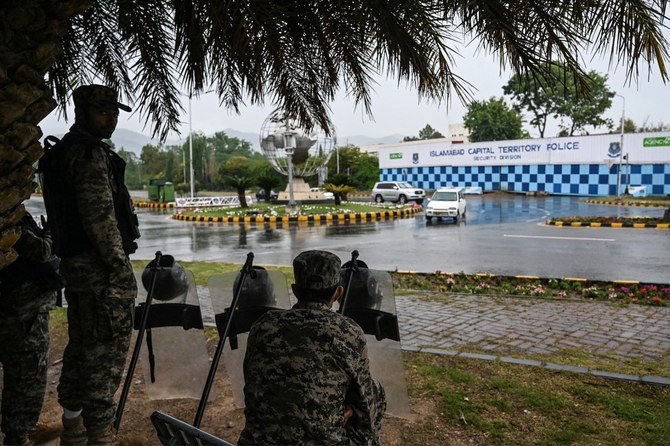

ISLAMABAD: The French community in Pakistan is torn between disbelief, fear and annoyance in reaction to their embassy’s call for them to leave the country after violent protests this week by a religious political party.
Most, it seems, have decided to stay put.
In a terse three-line email, accompanied by the words “urgent,” the embassy in Islamabad on Thursday recommended its nationals and French companies temporarily leave Pakistan, because of “serious threats.”
The email, which did not specify the nature of the risks, caused shock and consternation among the few hundred-strong French community.
Jean-Michel Quarantotti, who has taught French at the American school in Islamabad for three years, was first alerted to the embassy advisory by a student.
“I won’t hide from you that at first I felt a little bit of fear, panic,” he told AFP.
“It’s not my first foreign country — I did a lot before arriving in Pakistan — but I was really shocked. I didn’t expect to go through this.”
His first thought was to pack up and leave, but after discussing the situation with colleagues he said reason took over from emotion.
“The Pakistanis around me advised me to stay,” he said. “They told me that they would protect me.”
“It was very touching to see the solidarity around me, from people who told me: ‘We are here for you, do not worry, we will defend you’.”
The embassy announcement came after days of violent protests by Tehreek-e-Labbaik Pakistan (TLP) after the arrest in Lahore Monday of leader Saad Rizvi, who had called for a march on the capital to demand the expulsion of the French ambassador.
Four policemen were killed in the rioting.
The TLP has been behind several anti-France rallies since President Emmanuel Macron defended the right of Charlie Hebdo magazine to republish cartoons depicting the Prophet Muhammad.
Many of the French people contacted by AFP questioned the timing of the embassy’s message as the Pakistani government had just announced the ban on the TLP and seemed to have the situation under control.
“Yes, there are a lot of risks to live here,” said Quarantotti, “but we don’t need to panic the French community with words that are badly chosen.
“We wonder a little why France needed to publicize this message at the international level, when it could have given a much more discreet message to the (French) community.”
Fellow national Julien — an assumed name because he does not wish to divulge his identity — has also chosen to stay put.
“It’s a recommendation, so I won’t leave,” he told AFP.
He also refused his employer’s offer to repatriate him to Europe or put armed guards outside his home.
“Anyway, since October, November, it’s been all ups and downs. So we’ll wait for it to calm down,” the Islamabad resident said.
“The watchword is vigilance,” added Laurent Cinot, a consultant for the World Bank who arrived in the capital less than two months ago.
He said any threat was not from ordinary Pakistanis, but only the TLP.
Another Frenchman living in Lahore — who is not allowed to give his name or that of his French company for security reasons — has spent nearly ten years in Pakistan in two stints.
“Since I’ve been here a long time, I didn’t really panic,” he said.
Still, he is the only French national contacted by AFP who will leave — on the orders of his employers.
For Cinot, the embassy message will have the unfortunate effect of sending back another very negative picture of Pakistan to France.
“It does not deserve it because, honestly, it is a magnificent country with people who are quite fascinating and kind ... extremely kind,” he said.


