

Six years on, the sound of Makkah’s Ramadan cannon is still missed
Modern technology — most notably the speakers affixed to the minarets — eventually made the cannon obsolete
Updated 17 April 2021
Tareq Al-Thaqafi
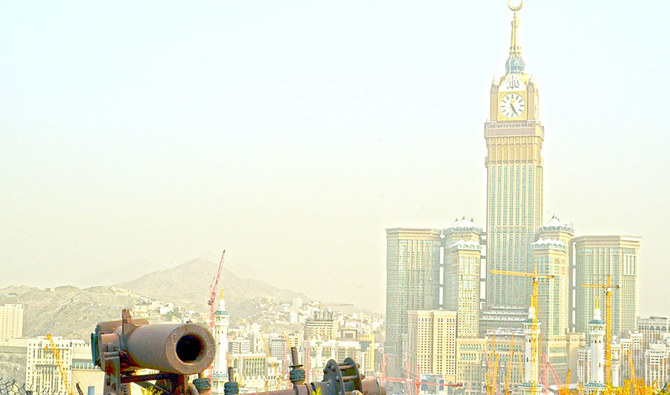
MAKKAH: It has been six years since the cannon that stands atop Mount Abu Al-Madafaa in the north of Makkah has been fired to mark the holy month of Ramadan. But its sound still reverberates in the memories of many Makkans, for whom it was a means to tell the times of fasting, morning prayers, and the beginning and end of Ramadan.
For many years, those who lived near the mountain would climb to its peak to see the cannon being fired once Ramadan was announced. Throughout the holy month, shots would be fired to mark the start of iftar, sahoor, and the start of fasting.
In an interview with Arab News when the cannon was still active, Maj. Abdul Mohsin Al-Maimani — a spokesman for Makkah Police, which was responsible for guarding, maintaining and firing the cannon — noted how popular the cannon was with the public.
“When Makkah Police was founded 75 years ago, it was entrusted with the maintenance and care of this cannon. After Eid, the cannon is returned to a special department. A few days before Ramadan, it is sent back to the mountain. The powder is handled by a special team so that no one gets hurt,” he added.
HIGHLIGHTS
• For many years, those who lived near the mountain would climb to its peak to fire the cannon once Ramadan was announced. Throughout the holy month, shots would be fired to mark the start of iftar, suhoor, and the start of fasting.
• Cannon firing during Ramadan has been traced back as far as the 15th century and the era of the Mamluks.
Fahad Al-Harbi, mayor of Ray Zakhir near Mount Abu Al-Madafaa, told Arab News: “The Ramadan cannon withstood technical changes for long decades until its recent retirement. It represents ancient Makkan history. The blast of the cannon, with all its importance and beauty, became the sound of the call to prayer for the residents of Makkah.”
The cannon has stood on Mount Abu Al-Madafaa for at least a century, and ‘the people of Makkah connected their love for the holy month’ to both the cannon and the mountain.
Dr. Fawaz, Al-Dahas
For many years, he noted, the cannon was “the only means to alert people that it was time to break fast” and “added a distinct character to the holy month” that is still “treasured in people’s memory.”
According to Dr. Fawaz Al-Dahas, director of the Center of Makkah History, the cannon has stood on Mount Abu Al-Madafaa for at least a century, and “the people of Makkah connected their love for the holy month” to both the cannon and the mountain.
“In the past, it was impossible to hear the voice of the Grand Mosque’s muezzins, so the cannon performed the task on their behalf. It remained a tradition held dearly,” said Al-Dahas. But modern technology — most notably the speakers affixed to the minarets of Makkah’s Grand Mosque — eventually made the cannon obsolete.
Cannon firing during Ramadan has been traced back as far as the 15th century and the era of the Mamluks.
‘I feel seen,’ says Saudi storyteller Noura Alashwali
Ministry of Culture-backed incubator helped Jeddah local create her first graphic novel
Updated 6 sec ago
Sumaiyya Naseem
JEDDAH: Visual storyteller Noura Alashwali is one of a generation of Saudi artists whose personal journeys mirror the Kingdom’s cultural transformation, meaning their creative impulses are increasingly backed by public institutions and have an audience ready to listen.
“Creative expression was never just a hobby for me; it was a need,” Alashwali, 37, told Arab News. “From a young age, whether through writing or drawing, creativity felt like a part of who I was. And it still is.”
It was her education at Dar Al-Hekma University, where she obtained a degree in graphic design, that gave structure and language to an instinct she had carried since childhood.
Saudi visual storyteller Noura Alashwali’s debut graphic novel began as a way to process grief in private. (Supplied)
“My earliest memory of drawing with pen and paper is when I was four years old, and I still have those drawings,” she said. Like many artists, she experimented with various mediums as she grew older. Eventually, she found her way to a Saudi art center that she described as “a very popular and wonderful place to learn art.”
At university, Alashwali’s work turned digital. “When I learned about the major, I immediately felt that I belonged. Graphic design is about visual communication. It’s not just about creating art, but about communicating ideas, thoughts, and stories.”
Those ideas would take on a personal weight in 2023 with “Deema and the Old Letters,” her debut graphic novel.
When an idea comes to me (now), I take it more seriously. I honor it and commit to it. I say, ‘Thank you for choosing me. I’m going do my best to manifest you.’
Noura Alashwali, Saudi storyteller
“It was a way for me to process my grief after my mother passed away in 2023,” Alashwali explained. “I was simply writing and drawing while processing very heavy emotions.”
Noura Alashwali's creativity was supported by the Literature, Publishing and Translation Commission's Authors’ Incubator Program in 2024. (Supplied)
What transformed that intimate archive into a published work was institutional support. In early 2024, Alashwali came across an open call from the Ministry of Culture’s Literature, Publishing and Translation Commission for its Authors’ Incubator program.
The inclusion of graphic novels and comics among the supported genres caught her attention. She assembled her materials into a PDF, applied, and was accepted.
For the six-month Riyadh-based program she was paired with a mentor, Dr. Hanan Al-Ghadi from Princess Nourah University, and supported logistically. By November 2024, she had signed with Rashm, a publishing house collaborating with the commission.
Alashwali contrasts the protagonist’s depression with the warmth of Jeddahwi landscapes. (Supplied)
Beyond the mentorship and funding, the experience reshaped her sense of self.
“It felt like a dream. Because of institutional support from the Ministry of Culture, I feel validated. I feel seen,” she said. “It encouraged me to take my practice seriously — not just as self-expression, but as something that contributes to the Saudi cultural scene.”
Initiatives such as the incubator program do not merely teach skills; they signal that deeply personal stories of grief, love and memory have a place in the public cultural sphere.
Alashwali contrasts the protagonist’s depression with the warmth of Jeddahwi landscapes. (Supplied)
While Alashwali hopes her work will be translated into English, publishing in Arabic for Saudi readers was the natural choice. “It’s great to contribute to the local scene with an Arabic graphic novel,” she said.
“Deema and the Old Letters” traces a young woman’s journey through pain and grief, using moonlit symbolism and visual poetry to explore art as a means of self-discovery and healing.
“I wanted it to feel intimate and personal. So ‘Deema’ is also designed like a journal,” Alashwali noted.
The protagonist’s depression is juxtaposed with the warmth of Jeddahwi landscapes.
“Jeddah is home. And when you are home, you’re being your most authentic self,” Alashwali said. “It’s a very kind and happy city; very welcoming and down-to-earth.”
The literature commission’s incubator also expanded Alashwali’s creative world, connecting her to artists from across the Kingdom, including Riyadh, Baha, and the Eastern Province.
“We have lots of beautiful cultures and stories in Saudi Arabia,” she said. “I have developed close friendships which contributed to my creative practice and personal growth.”
This sense of cross-regional exchange reflects a shift: Artists who once worked in silos are now being given room to meet, collaborate and be heard.
“What I enjoy most about being a storyteller in Saudi Arabia is that the scene is still fresh. People notice new work and genuinely connect with it,” Alashwali said. “It doesn’t feel overcrowded and overwhelming.”
Besides the literature commission, she has worked with the Visual Arts Commission and the Heritage Commission, including a workshop on creating eyeglass frames using Saudi craft techniques, created in collaboration with Italian gallery Moi Aussi and the Saudi Artisanal Company.
At Hayy Jameel in December, as part of the three-day “Soul of Palestine” program, Alashwali led a visual storytelling workshop where participants created digital illustrations to celebrate Palestinian heritage and culture.
Earlier in 2025, she participated in the Jeddah Book Fair and the Riyadh International Book Fair. In Jeddah, she worked with younger audiences on transforming emotions into short comics. In Riyadh, the focus shifted to books and artistic practice.
Across these settings, her metric for success remains emotional rather than technical. “It’s when I feel the participants have opened their hearts and try to transform their emotions into a comic, regardless of the drawing skills,” she explained.
Alashwali’s next project is inspired by conversations with her five-year-old daughter. “One day, after smelling a vanilla perfume she loves, she told me: ‘Mama, I think this is the smell of my heart.’ She believed it completely,” she said. “That idea stayed with me — the thought that the world might be kinder if we could smell hearts. So, the project will take the form of a directory of heart scents.”
Her plans for 2026 are modest. “I hope to dedicate more time and energy to my art,” she said. “If that doesn’t happen, publishing my next book will be enough.”
Underpinning it all is a philosophy she returns to — one espoused in one of her favorite books, “Big Magic,” in which Elizabeth Gilbert writes about ideas as living entities searching for someone to bring them into the world.
“As a Muslim, I believe these ideas are created by God,” said Alashwali. “When an idea comes to me now, I take it more seriously. I honor it and commit to it. I say, ‘Thank you for choosing me. I’m going do my best to manifest you.’”