Iran starts enriching uranium to 60% — its highest level ever

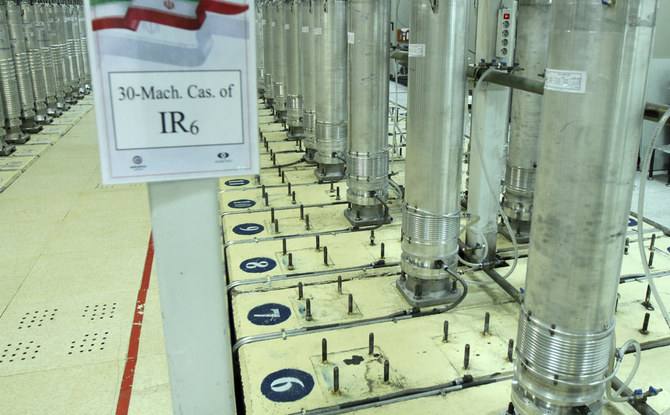
This file photo released Nov. 5, 2019, by the Atomic Energy Organization of Iran, shows centrifuge machines in the Natanz uranium enrichment facility in central Iran. (AP)
Short Url
Updated 17 April 2021
Follow

Iran starts enriching uranium to 60% — its highest level ever

  • The move takes Iran closer to the 90 percent purity level needed for use in a nuclear weapon
  • Britain, France and Germany have expressed “grave concern” over Iran’s latest enrichment move

JEDDAH: Iran began enriching uranium on Friday to its highest-ever purity that edges Tehran close to weapons-grade levels, attempting to pressure negotiators in Vienna amid talks on restoring its nuclear deal with world powers after an attack on its main enrichment site.

A top official said only a few grams an hour of uranium gas would be enriched up to 60 percent purity — triple the level it once did but at a quantity far lower than what the country could produce. 
Iran also is enriching at an above-ground facility at its Natanz nuclear site already visited by international inspectors, not deep within its underground halls hardened to withstand airstrikes.
The narrow scope of the new enrichment provides Iran with a way to quickly de-escalate if it chooses, experts say, but time is narrowing. 
The head of the Atomic Energy Organization of Iran acknowledged the move to 60 percent. Ali Akbar Salehi told Iranian state television the centrifuges now produce 9 grams an hour, but that would drop to 5 grams an hour in the coming days.
“Any enrichment level that we desire is in our reach at the moment and we can do it at any time we want,” Salehi said. Israel, which has twice bombed Mideast countries to stop their nuclear programs, said it was determined to stop Iran from building a nuclear weapon.
“We will do whatever it takes to prevent the extremists (in Iran) from succeeding, and definitely will prevent this regime from having a nuclear weapon,” Israeli Foreign Minister Gabi Ashkenazi told reporters on a visit to Cyprus.
Dr. Hamdan Al-Shehri, Saudi political analyst and international relations scholar, told Arab News that the region’s countries would be the first victims of Iran and its nuclear project. 
“Therefore, they have the right to tell the International Atomic Energy Agency and the nuclear deal’s signatory states that they are not interested in any new agreement with Tehran unless they can participate in it as a primary party. 
“The nuclear deal is not valid unless Iran’s ballistic missile file is added to it, along with its terrorist activities vis-a-vis its regional proxies. Iran’s terrorist militias have expanded and set up camps in four Arab countries. 
“The region’s countries are the ones most concerned with this Iranian threat, as they are the ones affected by it, so they are the ones who must be present during talks with Tehran. 
“Otherwise, all options are available for them to protect their security and stability from Iran’s nuclear file, its interference in the region and its affiliated terrorist militias, as well as from the threat of its ballistic missiles, which it continues to supply to its militias, such as the Houthis, who have used them hundreds of times against civilians, oil installations and global energy sources in Saudi Arabia.”


Libya says UK to analyze black box from crash that killed general

Updated 9 sec ago
Follow

Libya says UK to analyze black box from crash that killed general

TRIPOLI: Libya said on Thursday that Britain had agreed to analyze the black box from a plane crash in Turkiye on December 23 that killed a Libyan military delegation, including the head of its army.
General Mohammed Al-Haddad and four aides died after a visit to Ankara, with Turkish officials saying an electrical failure caused their Falcon 50 jet to crash shortly after takeoff.
Three crew members, two of them French, were also killed.
The aircraft’s black box flight recorder was found on farmland near the crash site.
“We coordinated directly with Britain for the analysis” of the black box, Mohamed Al-Chahoubi, transport minister in the Government of National Unity (GNU), said at a press conference in Tripoli.
General Haddad was very popular in Libya despite deep divisions between west and east.
The North African country has been split since a NATO-backed revolt toppled and killed longtime leader Muammar Qaddafi in 2011.
Haddad was chief of staff for the internationally recognized GNU, which controls the west. The east is run by military ruler Khalifa Haftar.
Chahoubi told AFP a request for the analysis was “made to Germany, which demanded France’s assistance” to examine the aircraft’s flight recorders.
“However, the Chicago Convention stipulates that the country analizing the black box must be neutral,” he said.
“Since France is a manufacturer of the aircraft and the crew was French, it is not qualified to participate. The United Kingdom, on the other hand, was accepted by Libya and Turkiye.”
After meeting the British ambassador to Tripoli on Tuesday, Foreign Minister Taher Al-Baour said a joint request had been submitted by Libya and Turkiye to Britain “to obtain technical and legal support for the analysis of the black box.”
Chahoubi told Thursday’s press briefing that Britain “announced its agreement, in coordination with the Libyan Ministry of Transport and the Turkish authorities.”
He said it was not yet possible to say how long it would take to retrieve the flight data, as this depended on the state of the black box.
“The findings will be made public once they are known,” Chahoubi said, warning against “false information” and urging the public not to pay attention to rumors.