

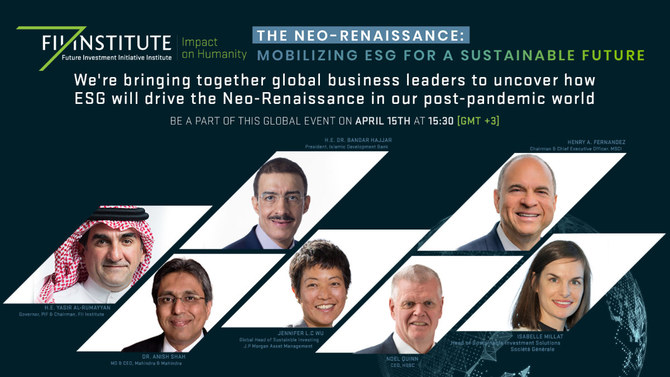

RIYADH: Participants at the Future Investment Initiative (FII) Institute virtual event on Thursday called for inclusive efforts towards achieving environmental, social and governance (ESG) goals, in order to help build a sustainable future for all.
The virtual event — titled “The Neo-Renaissance: Mobilizing ESG for a Sustainable Future” – was opened by FII Institute CEO Richard Attias, who told delegates: “We need to build more sustainable markets in 2021.”
“As we continue to battle the global pandemic, we need to rethink our approach to global sustainability… Although ESG has proven its worth, much remains to be done to ensure we use it to its full potential. The low level of inclusion and participation of emerging markets in the development of ESG frameworks is counterproductive to global sustainability,” he added.
Henry A. Fernandez, chairman and CEO of MSCI, US, said: “We have to look at ESG not only as a threat but also as a significant opportunity. Many companies in emerging markets will come out as major winners and will attract more capital in developed markets.”
Noel Quinn, group CEO of HSBC, highlighted the importance of a clear methodology for sectors to measure their commitments by. “The climate crisis may not be reversible and that’s why I think banks, and financial services more widely, have taken on board the need to make rapid progress and catch up on the work that’s needed around sustainability,” he said.
Bandar Hajjar, president of the Jeddah-based Islamic Development Bank, said ESG is not only important for the developed economy but for the developing economy as well and noted that emerging markets face more challenges in meeting their ESG requirements.
Lorenzo Simonelli, chairman and CEO of Baker Hughes, UK, said that transition is happening, but the energy sector needs to move fast to achieve global goals of reducing carbon emissions.
Anish Shah, MD and CEO of Mahindra and Mahindra, India, pointed out that ESG is “not a distraction” or “something that is a checkbox” but reflects “who we are and what we do.”
Ayaan Zeinab Adam, senior director and CEO AFC Capital Partners from Nigeria, said: “We need to look at Africa from the context of emissions. It is less than four percent, yet Africa is significantly suffering from the rise in global temperature.”
Muhamad Umar Swift, CEO, Bursa Malaysia, said: “A track record of holding companies to account when it comes to ESG issues is something that we are encouraging fund managers to demonstrate.” Investors should think long-term and support companies who are doing the right thing for the future, the chief of the Malaysian stock exchange added.
Murray Roos, global director of capital markets at the London Stock Exchange Group, said: “All investors: Please think long-term and support companies that are doing the right thing for the future.”
Guo Peiyuan, chairman of SynTao Green Finance, China, said: “We believe that climate change and carbon neutrality goals will be very important for ESG investors. Overseas investors are more and more interested in ESG assets in China because they provide lower risk.”
Geoffrey Odundo, chief executive at Nairobi Securities Exchange, said: “We think that there is a need for more rigor around regulations so that sustainable assets are very well regulated and we have a very clear alignment on local reporting standards and indicators.”
Jeff Ubben, founder and managing partner of Inclusive Capital Partners, said: “Renewable energy today is not ‘additional.’ It’s economic on its own.”


