

Yemeni teachers’ union slams Houthi curriculum takeover

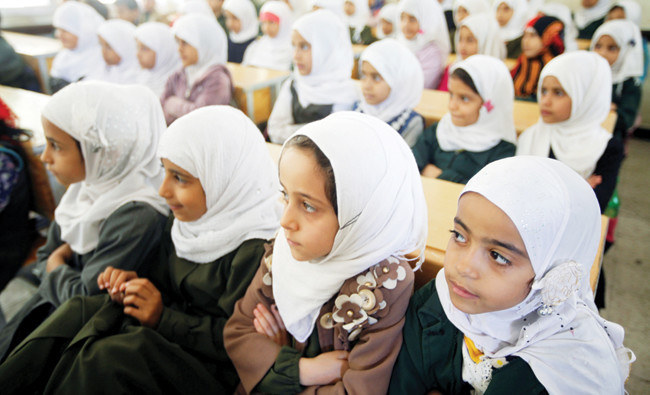
Yemeni children of all ages are exposed to violent imagery in Houthi educational materials. (Reuters/File)
Short Url
Updated 15 April 2021
Follow

Yemeni teachers’ union slams Houthi curriculum takeover

  • Teachers syndicate accuses Iran of ‘policy of cultural colonialism’ in Yemen via Houthi proxies
  • ‘Houthis far more interested in radicalizing than homogeneous education,’ expert tells Arab News

LONDON: Yemen’s union of teachers has denounced the Iran-backed Houthi militia’s takeover of the country’s schools and curriculum, and accused Tehran of using the education system to pursue a “policy of cultural colonialism.” 

Yahya Al-Yinai, head of media at the Yemeni Teachers Syndicate, told the Daily Telegraph that the Houthis have made hundreds of changes to the teaching curriculum since they seized power in a violent 2014 coup. He also said they have replaced nearly 90 percent of school principals with pro-Houthi allies.

Al-Yinai accused Iran of overseeing the changes, saying it is pursuing a “policy of cultural colonialism” by trying to introduce the “ideology of the Khomeinist revolution in Yemen through public education.”

With military and economic assistance from Iran, the Houthis control roughly two-thirds of the Yemeni population.

A report by education watchdog IMPACT-se found that they have been using this position of power to foster hostility to the US, Saudi Arabia and other adversaries of Iran.

Around 3 million young Yemenis currently receive their education in Houthi-controlled parts of the country.

IMPACT-se found that the materials used to educate them are “rife with violence and imagery of death, irrespective of the age of the target audience.”

These images, which include pictures of dead children, are used “to portray the Houthis’ enemies as monstrous and inhumane.”

The organization found that through their signature magazine Jihad, the Houthis aim to indoctrinate Yemen’s next generation toward violence and extremism.

“The Houthi materials grossly violate the ideal of peacemaking, entirely dismissing peace as an option in international conflict resolution, and condemning those who advocate for it as cowardly, foolish or traitorous,” IMPACT-se found. 

“Instead, violent jihad, sacrifice in battle, and supporting the war effort in any way possible is held up as an ideal and a central virtue.” 

Marcus Sheff, IMPACT-se’s CEO, told Arab News: “Despite lip service to Yemeni nationhood, the Houthis are far more interested in radicalizing than in homogeneous education.”

He said the violent and graphic Houthi education materials could have a lasting impact on children exposed to them.

“Any changes that radicalize — and traumatize — young children are significant,” he added. “These changes fly in the face of those in the region who are trying to moderate curricula, not to incite violence and hate, as are the Houthis.”

Arik Agrissi, chief operating officer at IMPACT-se, said: “Textbooks can act as either a barrier or blueprint to radicalization. In the Houthis’ case, it’s explicitly the latter.”


Trump, Erdogan discuss Syria and Gaza in call

Updated 3 sec ago
Follow

Trump, Erdogan discuss Syria and Gaza in call

WASHINGTON/ ANKARA: Turkish President Tayyip Erdogan discussed ​developments in Syria and Gaza with US counterpart Donald Trump in a telephone call on Tuesday as Syria’s Turkiye-backed government announced a ceasefire with US-allied Kurdish forces after days of clashes.
Turkiye separately weighed if Erdogan should join the US leader’s “Board of Peace” initiative.
“President Erdogan stated that Turkiye was closely following developments in Syria, that Syria’s unity, harmony and territorial integrity were important for Turkiye,” the Turkish presidency said in a statement.
Earlier Trump said he had a “very good call” with Erdogan, without elaborating.
Syria’s government seized swathes of territory in the northeast this ‌week, and ‌gave the Kurdish-led Syrian Democratic Forces four days to agree ‌on ⁠integrating ​into the ‌central state.
The SDF’s main ally, the United States, said the partnership with the group had changed nature after Syria’s new government emerged.
The Turkish presidency added that Erdogan and Trump also discussed the fight against the Islamic State militant group and the “situation” of its prisoners in Syrian jails.
Turkiye deems the SDF a terrorist organization linked with the outlawed Kurdistan Workers Party (PKK), which has mounted a four-decade insurgency against the Turkish state.
In its peace process with the PKK, Ankara has called ⁠for the group and its affilites to disband and disarm.
Ankara, the main foreign backer of Syria’s new government, has praised ‌Damascus’ advances against the SDF and repeatedly called for it ‍to integrate with the Syrian state apparatus.

ERDOGAN ‍THANKS TRUMP FOR ‘BOARD OF PEACE’ INVITE
Erdogan told Trump Turkiye would continue to coordinate ‍with Washington on Gaza, the Turkish presidency said.
“President Erdogan thanked US President Trump for the invitation to the Gaza Board of Peace,” it added.
A UN Security Council resolution, adopted in mid-November, authorized the “Board of Peace” and countries working with it to establish an international stabilization force in Gaza.
In October, a ​fragile ceasefire began in Gaza under a Trump plan on which Israel and Palestinian militant group Hamas had signed off.
Earlier on Tuesday, Turkiye said Erdogan ⁠would decide soon on joining the initiative. Turkiye has been critical of Israel’s assault on Gaza, casting it as genocide, while Israel has repeatedly opposed a Turkish role in Gaza.
More than 460 Palestinians, more than 100 of them children, and three Israeli soldiers have been reported killed since the Gaza truce began.
Under Trump’s Gaza plan, the board was meant to supervise Gaza’s temporary governance. Later Trump said it would be expanded to tackle conflicts around the world.
Many rights experts say that Trump’s chairing of a board to supervise a foreign territory’s affairs would resemble a colonial structure.
Diplomats fear such a board for global issues could harm the work of the United Nations.
Among those the White House has named to the board are Secretary of State Marco Rubio, ‌Britain’s former Prime Minister Tony Blair, and Trump’s son-in-law, Jared Kushner.